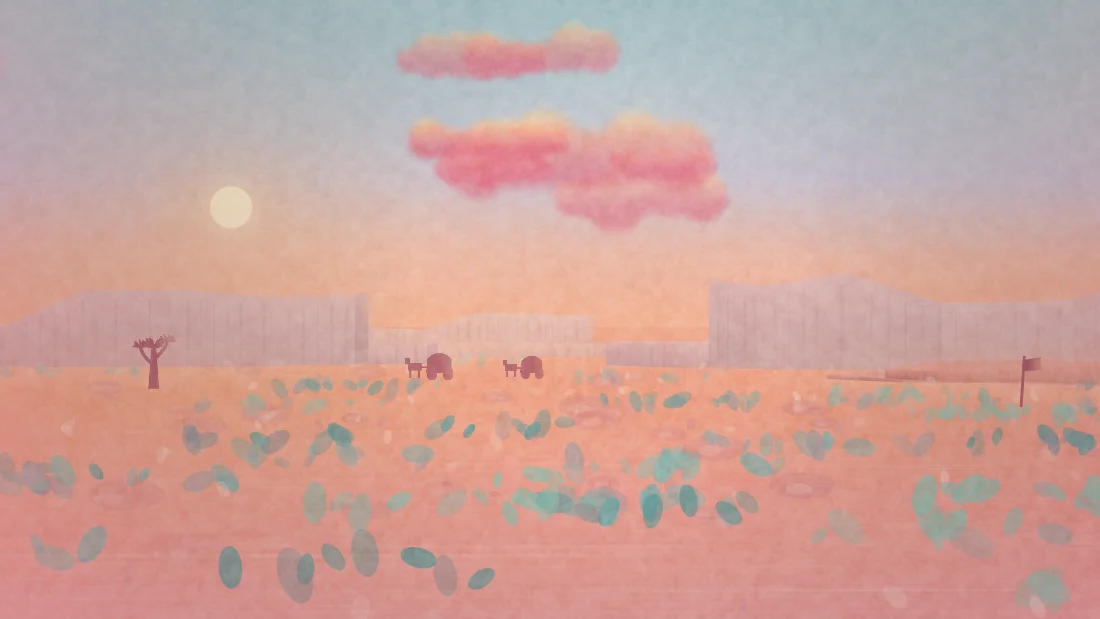
 Series 1
Fifty Plates of the Strip
Every plate hangs straight on and the button walks you round it. Front-on the world folds flat into a painting; step to the side and it was a place the whole time.
Series 1
Fifty Plates of the Strip
Every plate hangs straight on and the button walks you round it. Front-on the world folds flat into a painting; step to the side and it was a place the whole time.
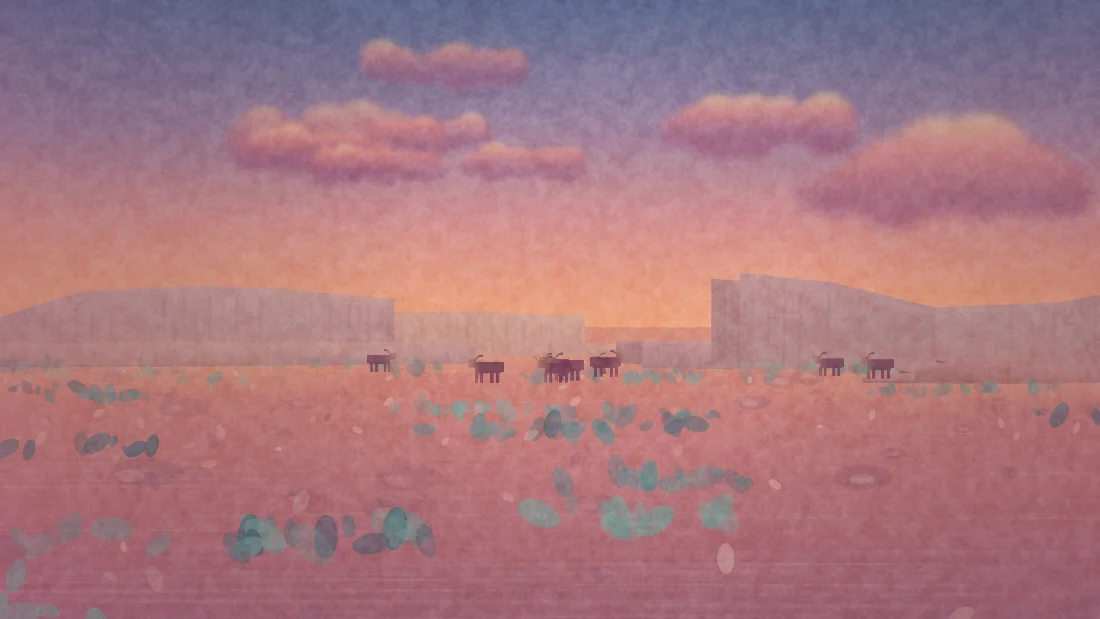 Series 2
Fifty Turns
The button does something different on every plate — a step sideways, forty years, the back of the canvas, the survey plat, the paint letting go of the picture.
Series 2
Fifty Turns
The button does something different on every plate — a step sideways, forty years, the back of the canvas, the survey plat, the paint letting go of the picture.
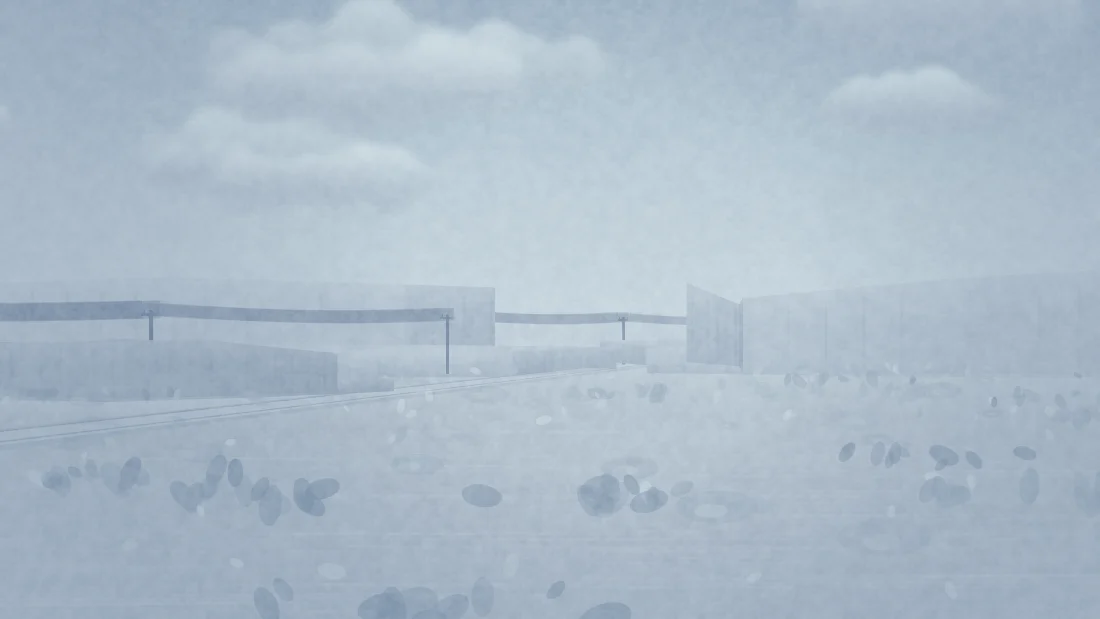 Series 3
Fifty Compound Turns
The turn does not stop at one thing. It passes through a first state and keeps going into a second, and halfway is its own picture.
Series 3
Fifty Compound Turns
The turn does not stop at one thing. It passes through a first state and keeps going into a second, and halfway is its own picture.
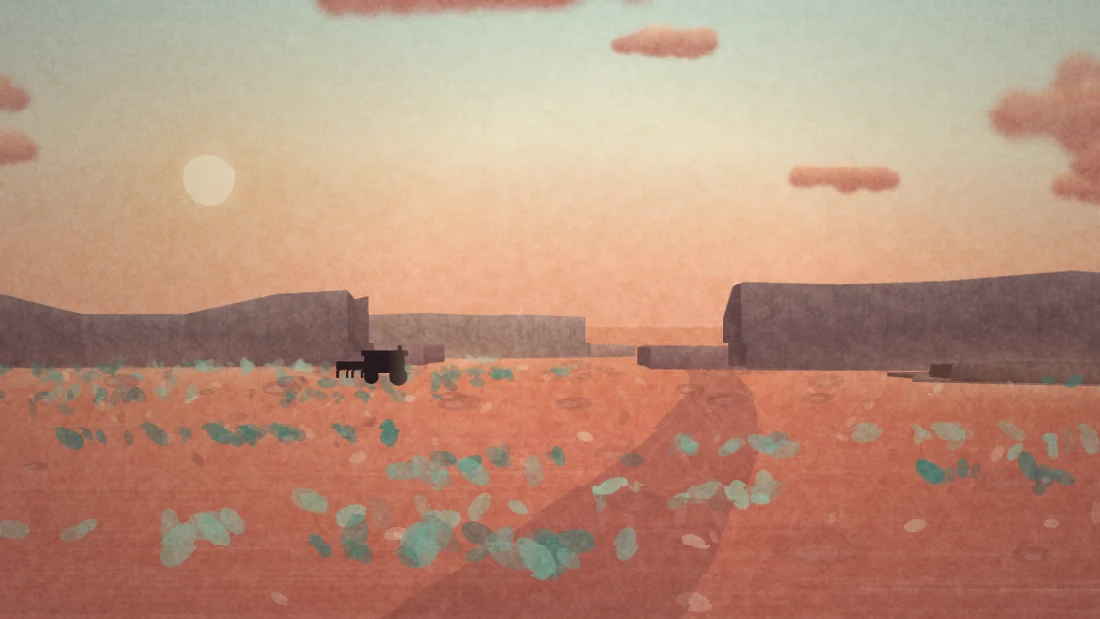 Series 4
Fifty Materials
The turn is the material: ink floods wet cotton, a press slips out of register, paint thickens until the drawing is buried. The subject never moves.
Series 4
Fifty Materials
The turn is the material: ink floods wet cotton, a press slips out of register, paint thickens until the drawing is buried. The subject never moves.
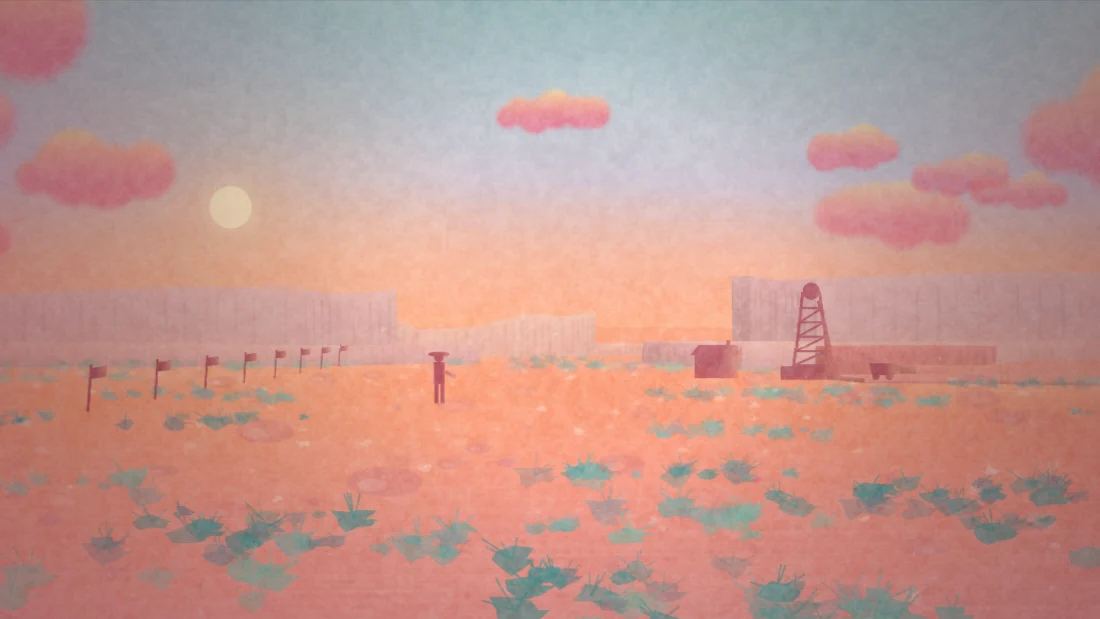 Series 5
Fifty Hours of Light
Sun scattering through dust in visible shafts, highlights blooming and halating, a lens that separates a whisper at the corners. A camera, not a filter.
Series 5
Fifty Hours of Light
Sun scattering through dust in visible shafts, highlights blooming and halating, a lens that separates a whisper at the corners. A camera, not a filter.
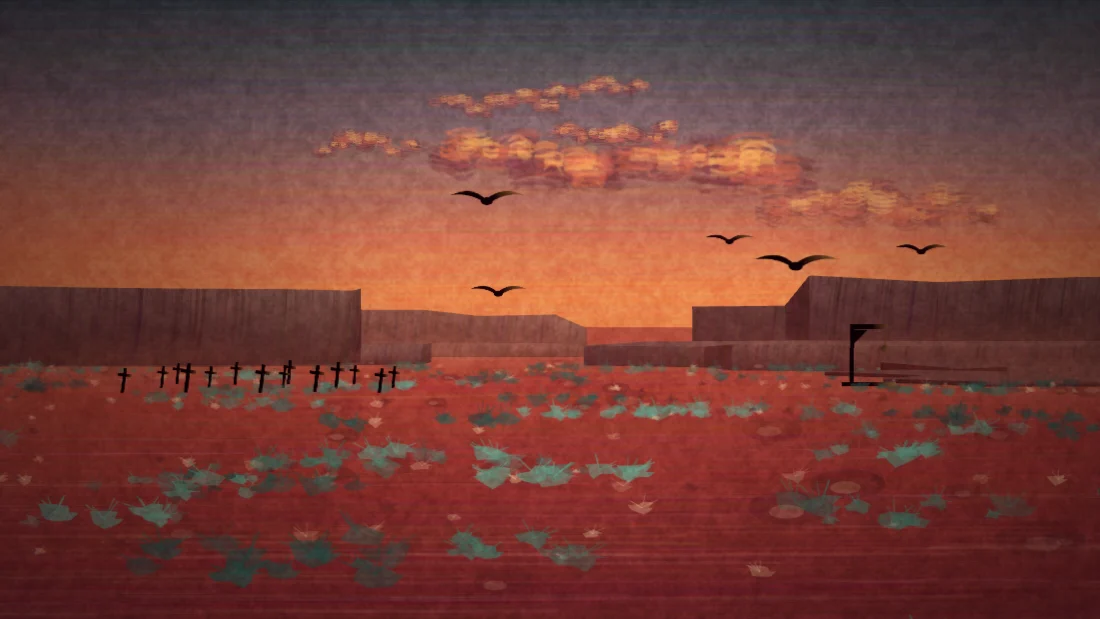 Series 6
Fifty by Hand
Nothing here is filled. The sky is brushed, the rock is stroked, and every edge is a mark rather than a boundary.
Series 6
Fifty by Hand
Nothing here is filled. The sky is brushed, the rock is stroked, and every edge is a mark rather than a boundary.
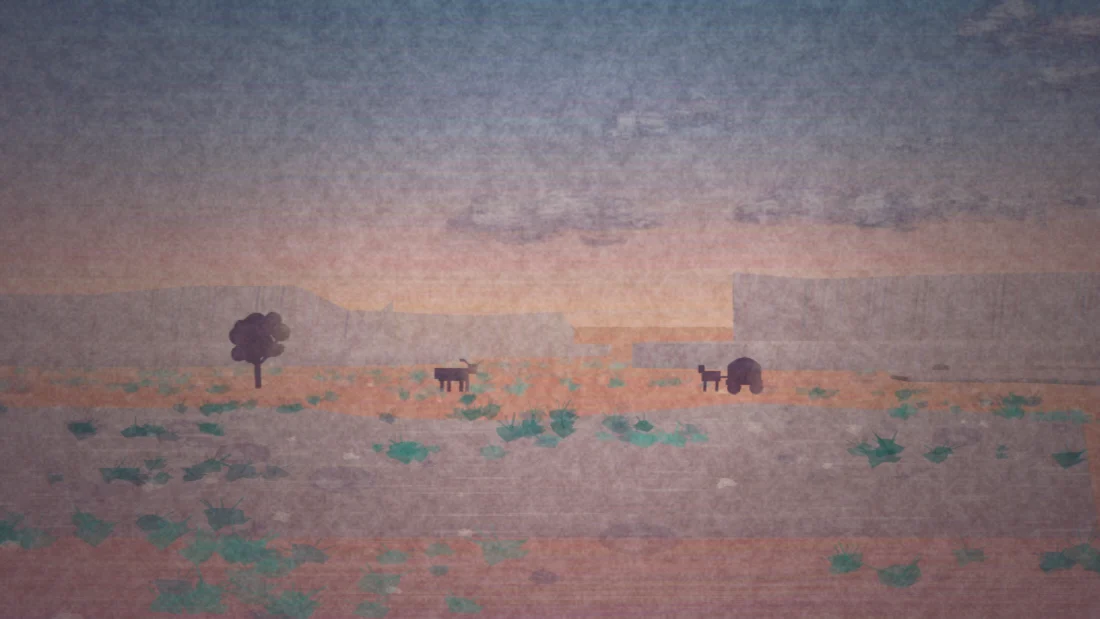 Series 7
Fifty Weathers
Fifty weathers over one country, and the weather is what the plate is about rather than what it happens in.
Series 7
Fifty Weathers
Fifty weathers over one country, and the weather is what the plate is about rather than what it happens in.
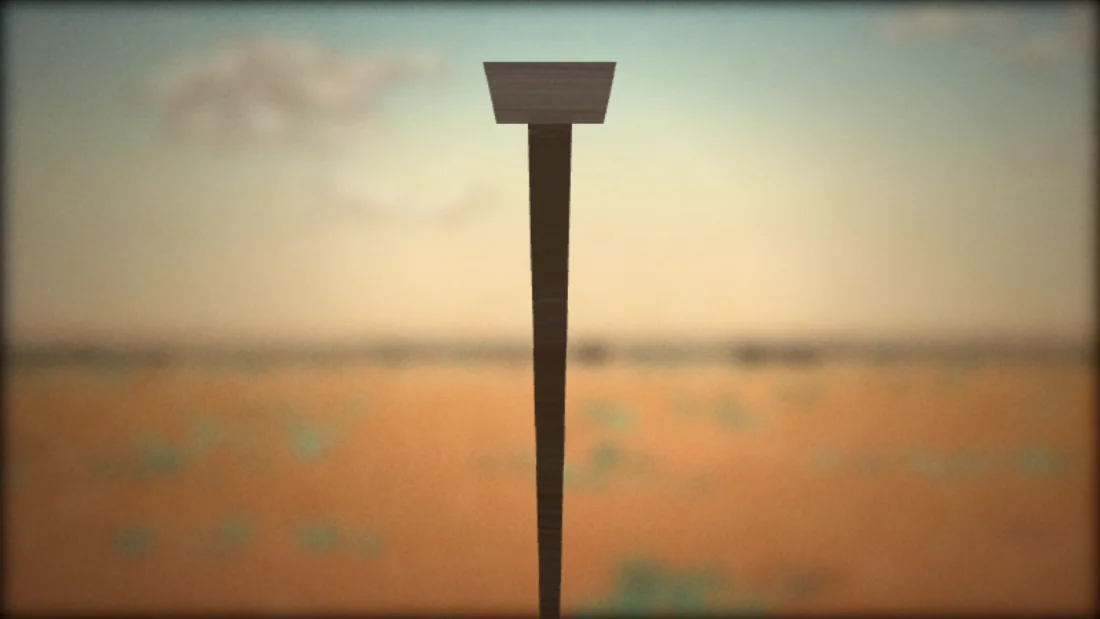 Series 8
Fifty at Arm's Length
Arm’s length. Fifty objects at the distance you would actually hold them, and nothing behind them.
Series 8
Fifty at Arm's Length
Arm’s length. Fifty objects at the distance you would actually hold them, and nothing behind them.
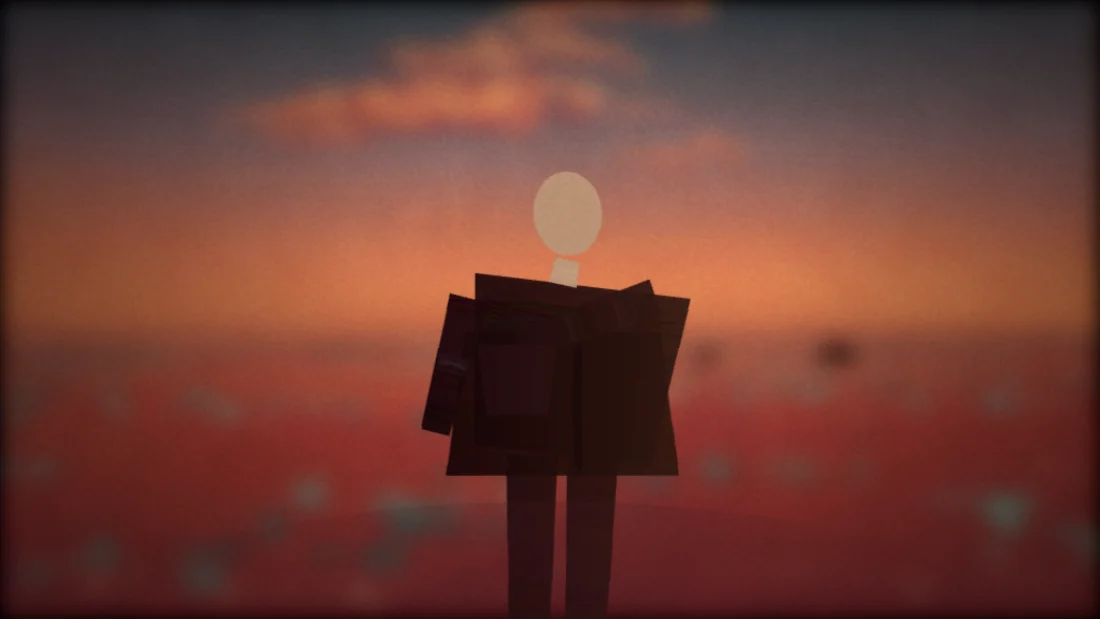 Series 9
Fifty Figures
Fifty figures, at the scale a person is when the country is that size.
Series 9
Fifty Figures
Fifty figures, at the scale a person is when the country is that size.
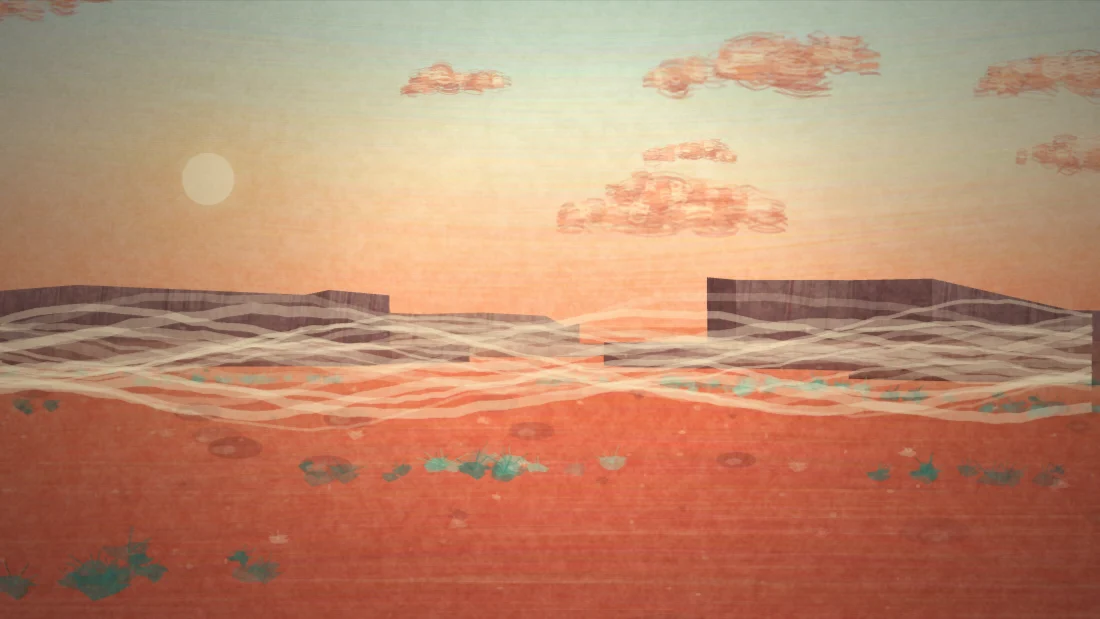 Series 10
Fifty Systems
Nothing is placed. Each plate is a process that actually made that country — sand on a flow field, water cutting downhill, mud cracking into its dual graph — run as a simulation.
Series 10
Fifty Systems
Nothing is placed. Each plate is a process that actually made that country — sand on a flow field, water cutting downhill, mud cracking into its dual graph — run as a simulation.
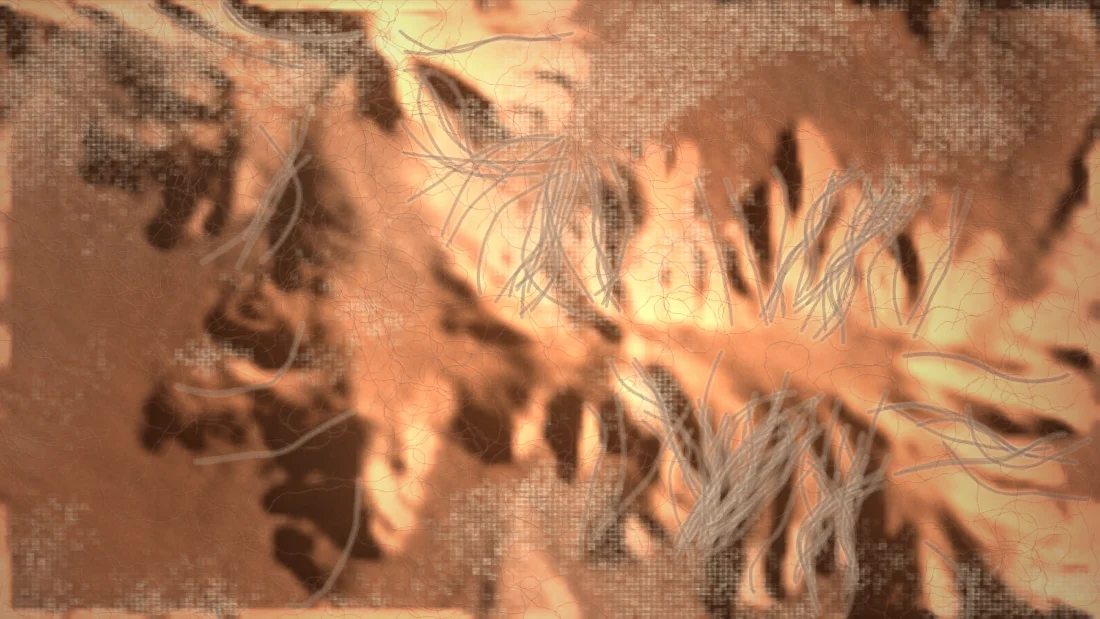 Series 11
Fifty Interferences
One shared substrate, four fields and six processes that all read and write it. No horizon and no sky: you are looking straight down, and the only thing that made it is time.
Series 11
Fifty Interferences
One shared substrate, four fields and six processes that all read and write it. No horizon and no sky: you are looking straight down, and the only thing that made it is time.
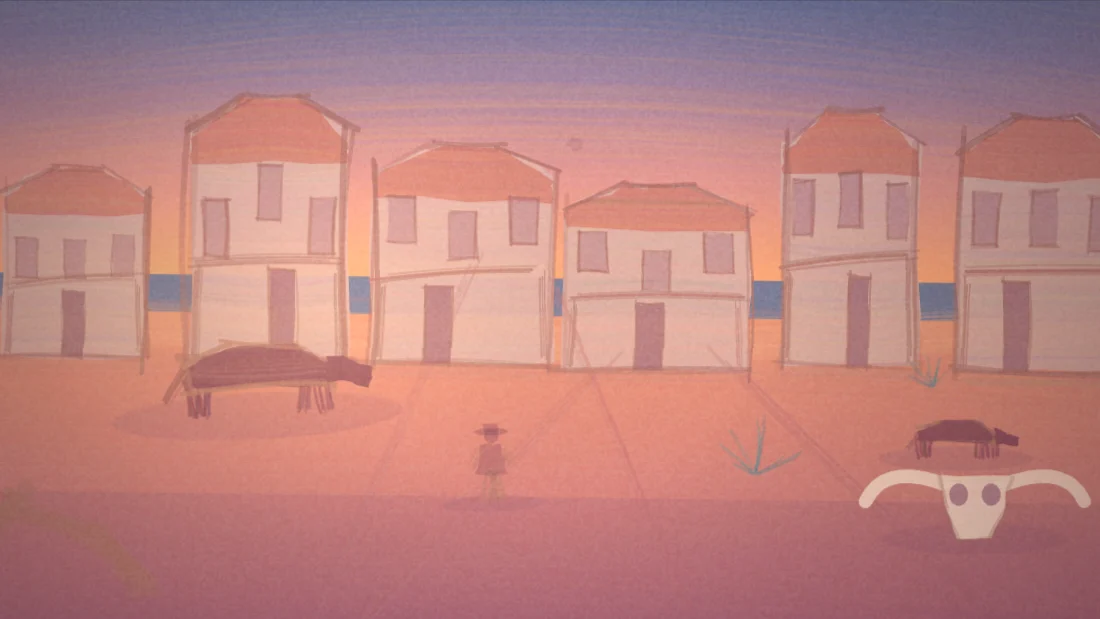 Series 12
Fifty Scores at Chaos 25
The plate is not a picture but a written score, and a chaos factor of 25 decides how faithfully an unreliable hand follows it.
Series 12
Fifty Scores at Chaos 25
The plate is not a picture but a written score, and a chaos factor of 25 decides how faithfully an unreliable hand follows it.
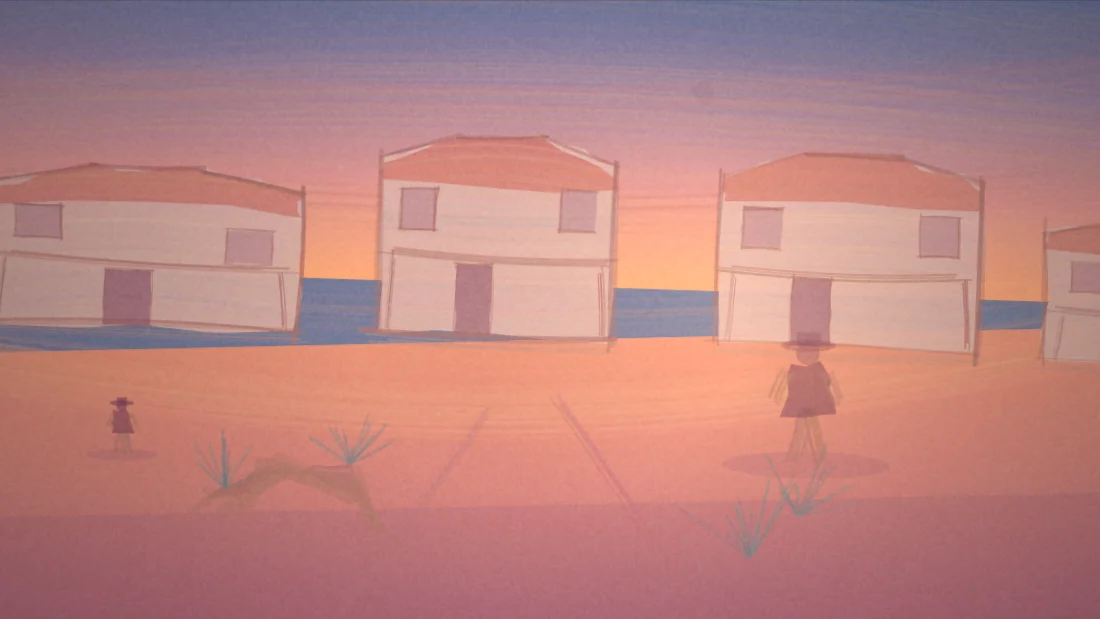 Series 13
Fifty Hands at Twenty-Five
The same idea built properly: fifteen different turns across the fifty, each moving one part of that chaos factor and leaving the rest alone.
Series 13
Fifty Hands at Twenty-Five
The same idea built properly: fifteen different turns across the fifty, each moving one part of that chaos factor and leaving the rest alone.
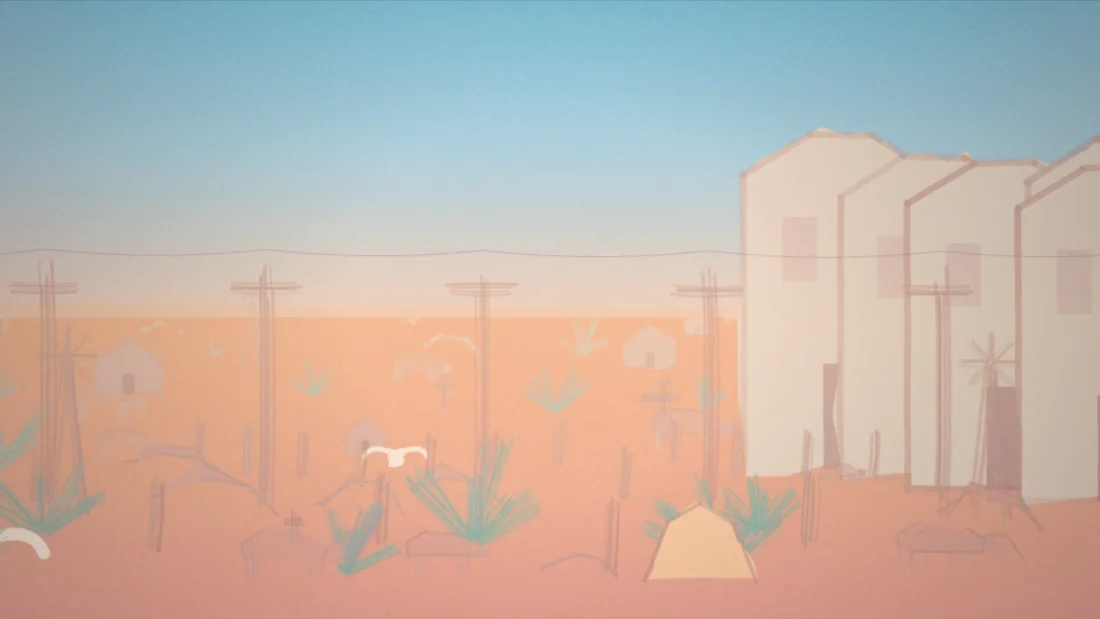 Series 14
One Painting, Fifty Windows
The fifty plates are one painting. Plate 14’s right-hand edge is plate 15’s left-hand edge, and the button walks you a mile east into the next one.
Series 14
One Painting, Fifty Windows
The fifty plates are one painting. Plate 14’s right-hand edge is plate 15’s left-hand edge, and the button walks you a mile east into the next one.
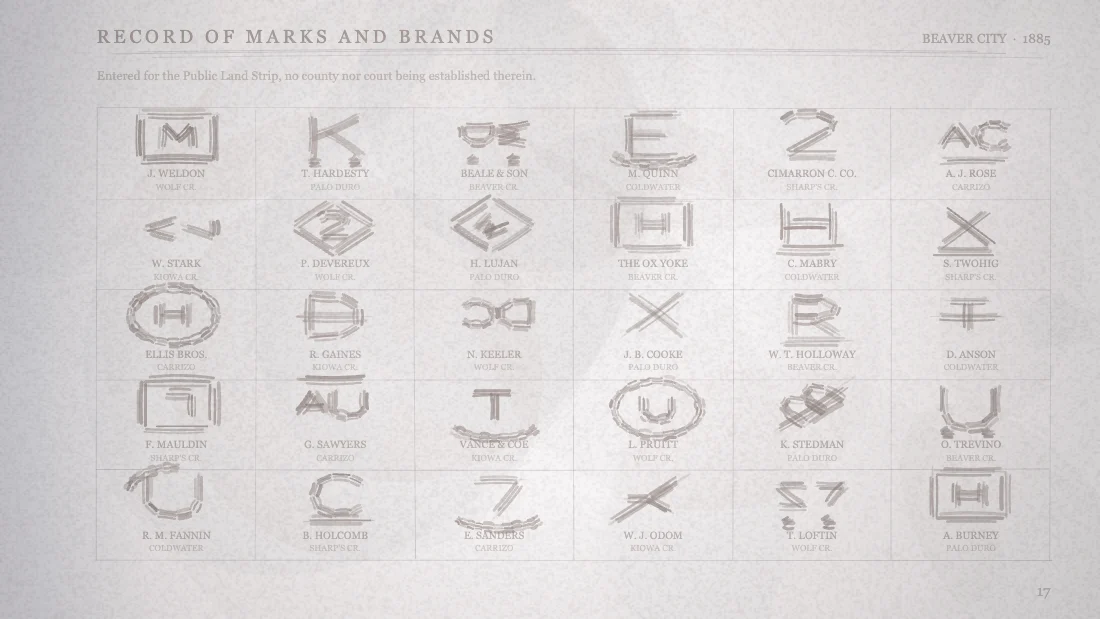 Series 15
Fifty Paintings
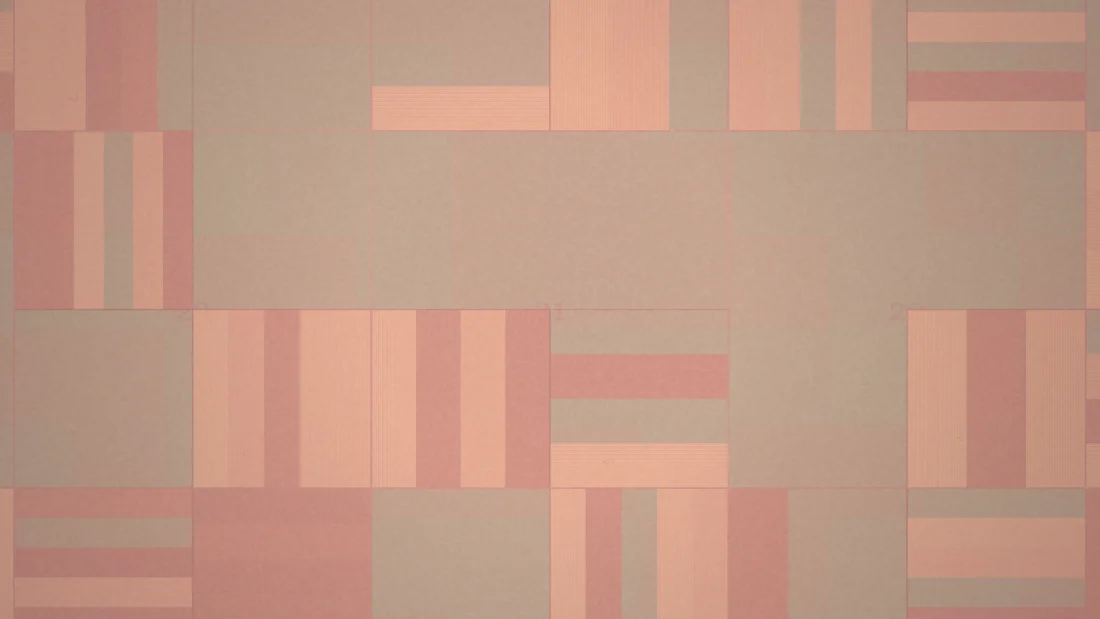
Fifty separate paintings that share a hand and a place and nothing else. A colour field, a page of cattle brands, a well shaft, a hawk on an empty sheet.
Series 15
Fifty Paintings
Fifty separate paintings that share a hand and a place and nothing else. A colour field, a page of cattle brands, a well shaft, a hawk on an empty sheet.
 Series 16
The Descent
One point on the ground and fifty steps down into it: four hundred miles across at the top, one grain of dirt at the bottom.
Series 16
The Descent
One point on the ground and fifty steps down into it: four hundred miles across at the top, one grain of dirt at the bottom.
 Series 17
Fifty Hands, One Turn
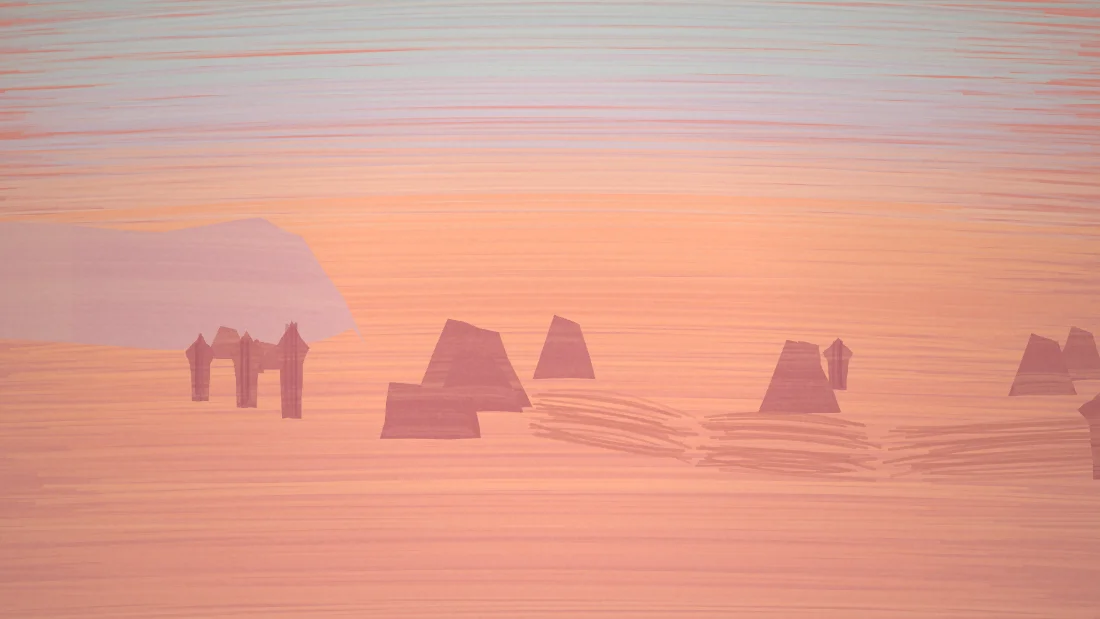
One country built once in three dimensions, and sixteen mediums. Oil keeps its ridge, watercolour is a stain with a tideline, a woodcut is what is left when everything round it is cut away.
Series 17
Fifty Hands, One Turn
One country built once in three dimensions, and sixteen mediums. Oil keeps its ridge, watercolour is a stain with a tideline, a woodcut is what is left when everything round it is cut away.
 Series 18
Four Years
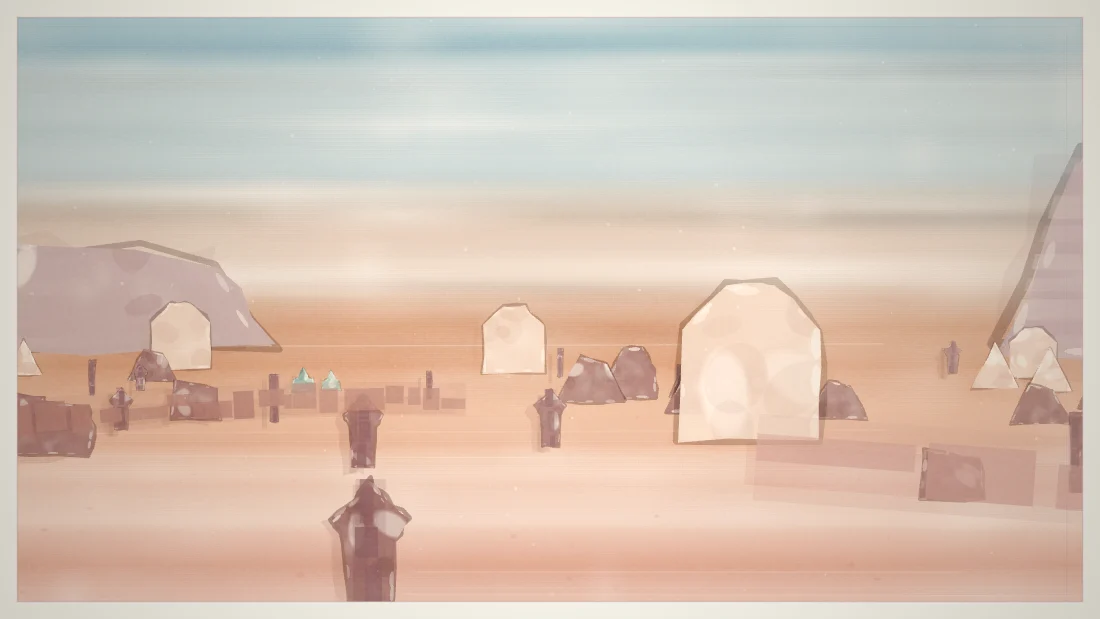
The same ground at fifty consecutive moments — a man crossing it, the stake, the rush, the town, and the scrub coming back over the tailings.
Series 18
Four Years
The same ground at fifty consecutive moments — a man crossing it, the stake, the rush, the town, and the scrub coming back over the tailings.
 Series 19
The Making
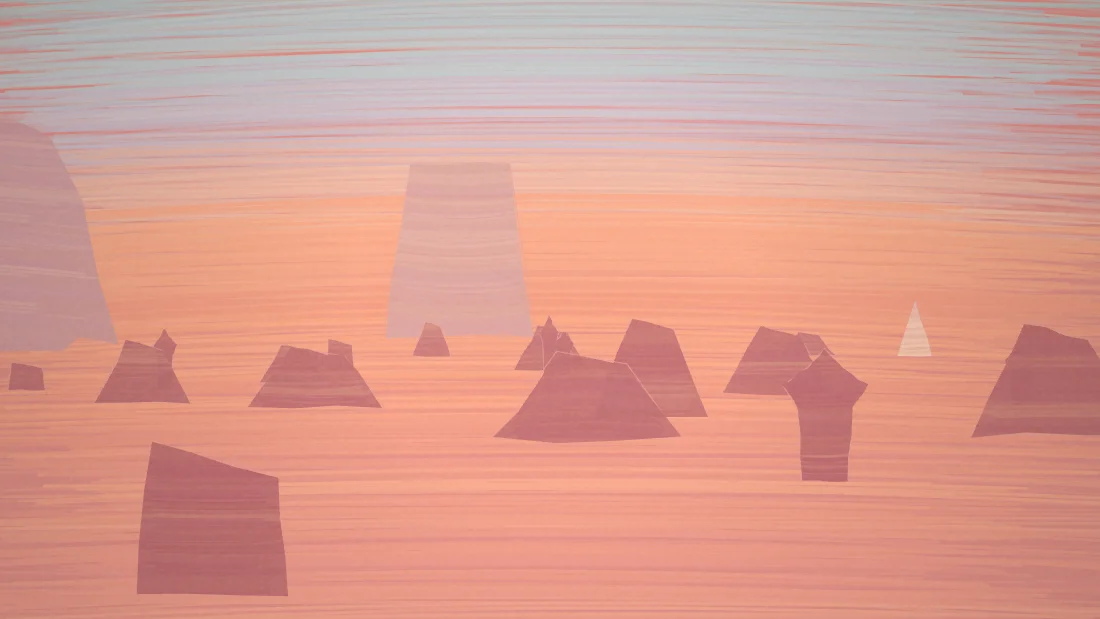
The button shows you the painting being made: primed panel, drawing, dead colour, real colour, modelling, varnish. An oil builds dark to light and a watercolour builds the other way round.
Series 19
The Making
The button shows you the painting being made: primed panel, drawing, dead colour, real colour, modelling, varnish. An oil builds dark to light and a watercolour builds the other way round.
 Series 20
Provenance
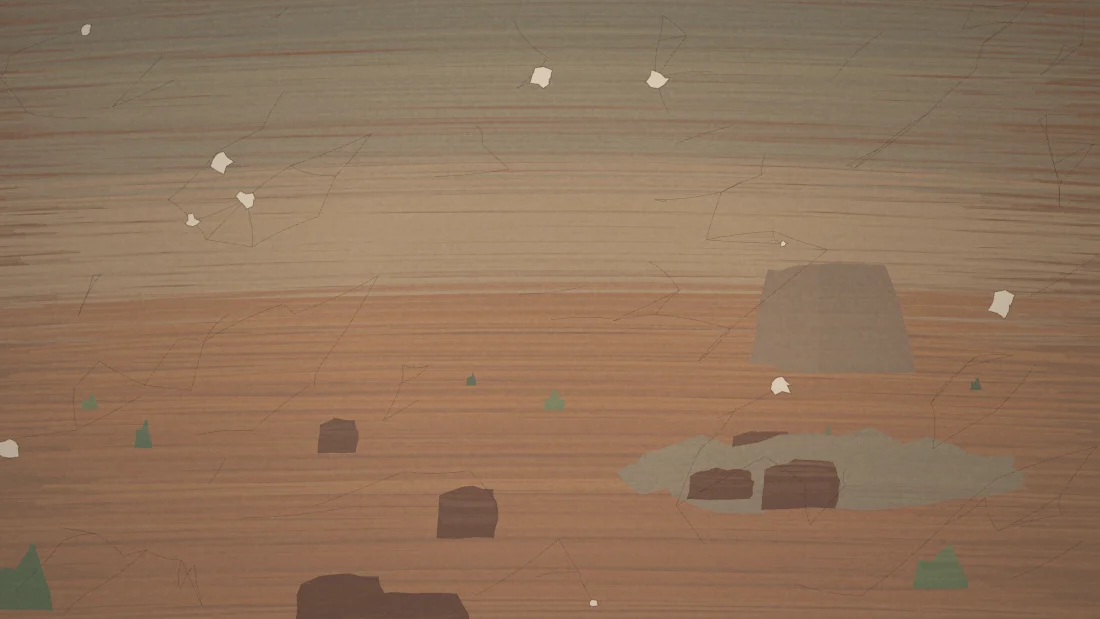
A hundred and forty years happening to a finished picture. The varnish yellows, the panel cracks into a net, flakes lift out of it, and somebody’s grandson cleans it too hard.
Series 20
Provenance
A hundred and forty years happening to a finished picture. The varnish yellows, the panel cracks into a net, flakes lift out of it, and somebody’s grandson cleans it too hard.
 Series 21
Rooms
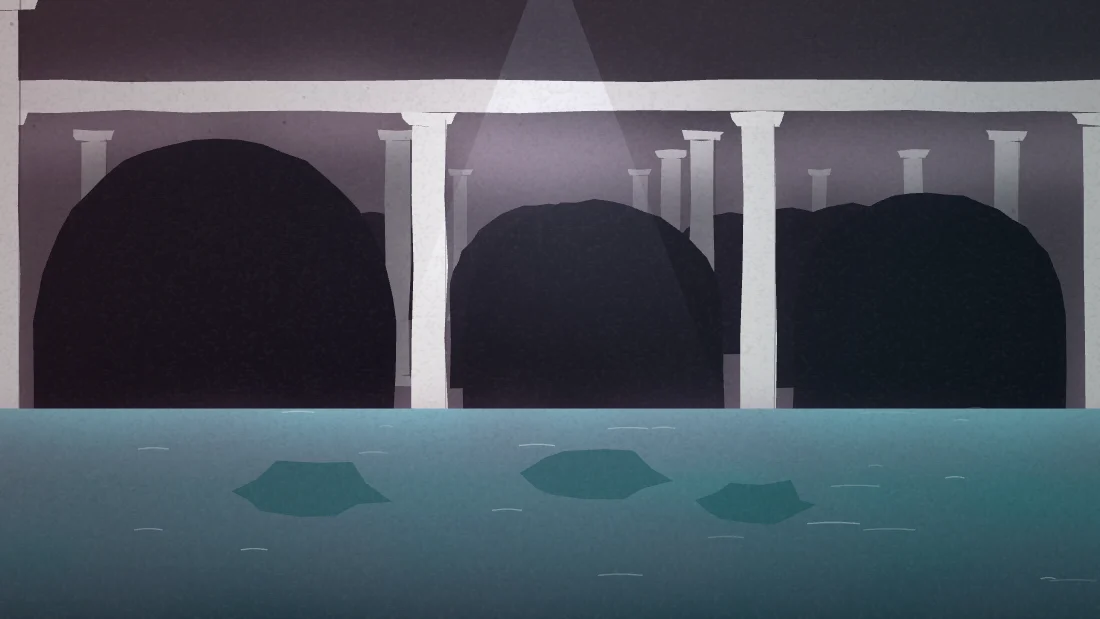
Background painting. Flat confident shapes with nothing graduated inside them, a pencil drawn beside the shape rather than around it, and all the graduation in the air and the light. The button is the light.
Series 21
Rooms
Background painting. Flat confident shapes with nothing graduated inside them, a pencil drawn beside the shape rather than around it, and all the graduation in the air and the light. The button is the light.
 Series 22
Fifty Buttons
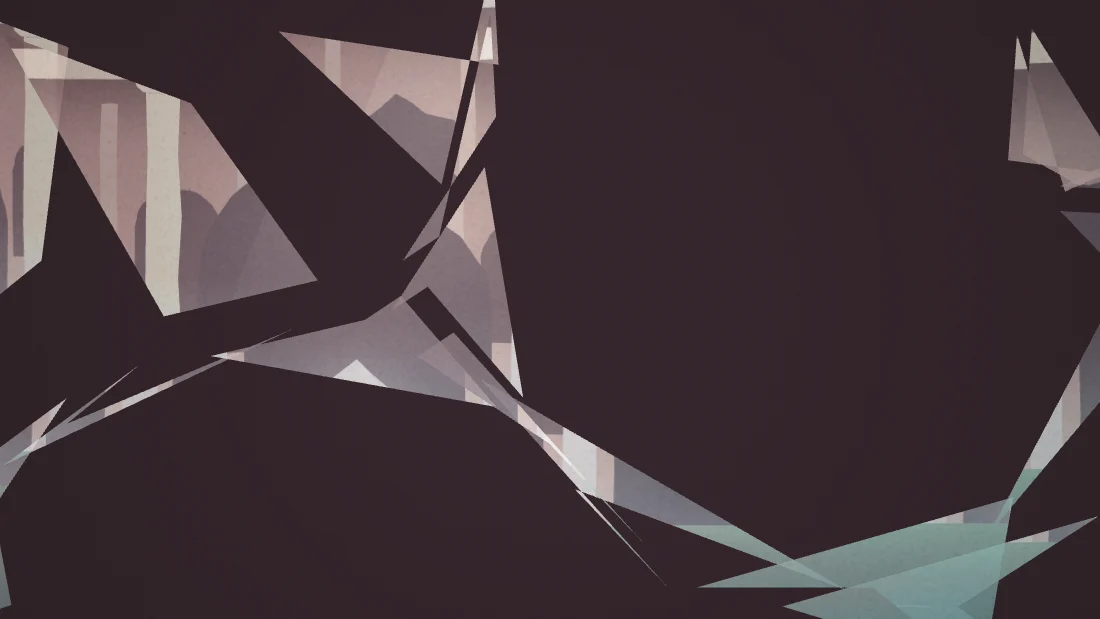
Fifty plates and fifty different buttons. The water comes up. A drawing becomes a painting. The colour plates slide out of register. The arcade falls one pier at a time. Fire takes it. No two do the same thing.
Series 22
Fifty Buttons
Fifty plates and fifty different buttons. The water comes up. A drawing becomes a painting. The colour plates slide out of register. The arcade falls one pier at a time. Fire takes it. No two do the same thing.
 Series 23
Ten Things, Five Times Each
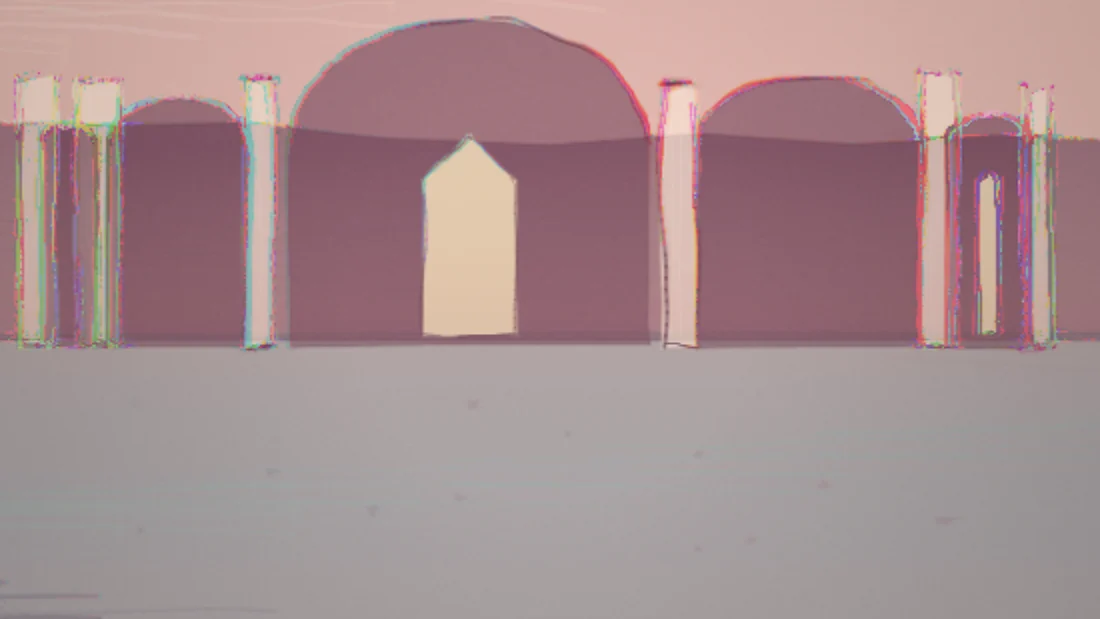
Ten dynamics, five plates each, and each of the five is a real improvement on the last. Every line is drawn rather than outlined — position, weight, darkness and wetness are four fields that never agree. Composed on phi.
Series 23
Ten Things, Five Times Each
Ten dynamics, five plates each, and each of the five is a real improvement on the last. Every line is drawn rather than outlined — position, weight, darkness and wetness are four fields that never agree. Composed on phi.
 Series 24
Ten Things, Five Times Each, Again
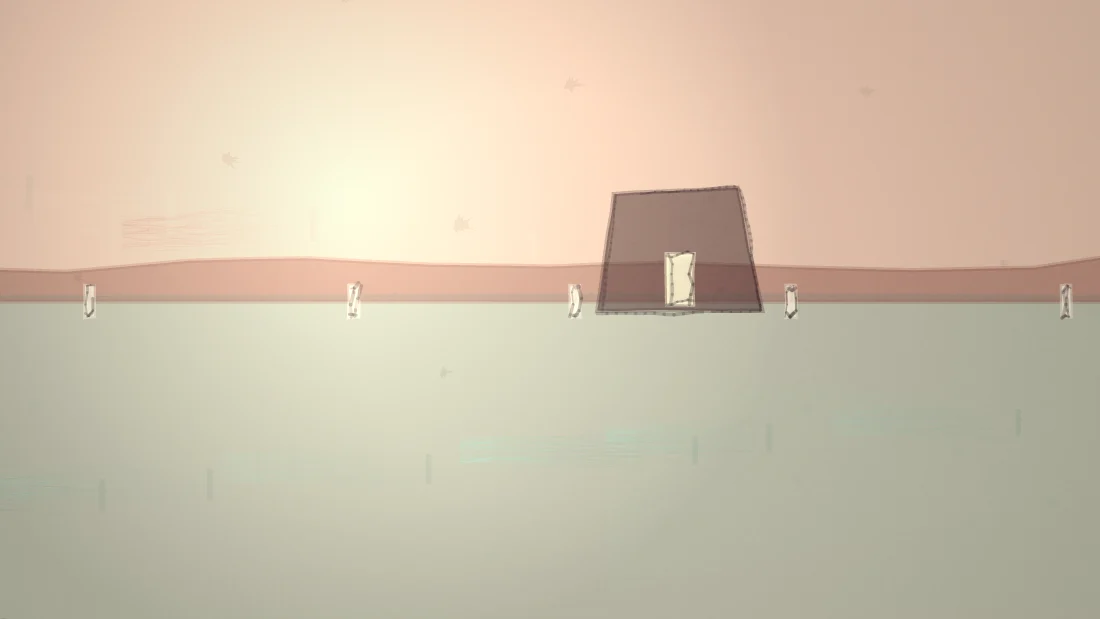
The same ladder, with the boil put on a frame clock — three drawings held eight frames each, three changes a second whatever the dial does — a brush that runs dry and piles paint where it lifted, and ten compositions instead of one.
Series 24
Ten Things, Five Times Each, Again
The same ladder, with the boil put on a frame clock — three drawings held eight frames each, three changes a second whatever the dial does — a brush that runs dry and piles paint where it lifted, and ten compositions instead of one.
 Series 25
The Country Again
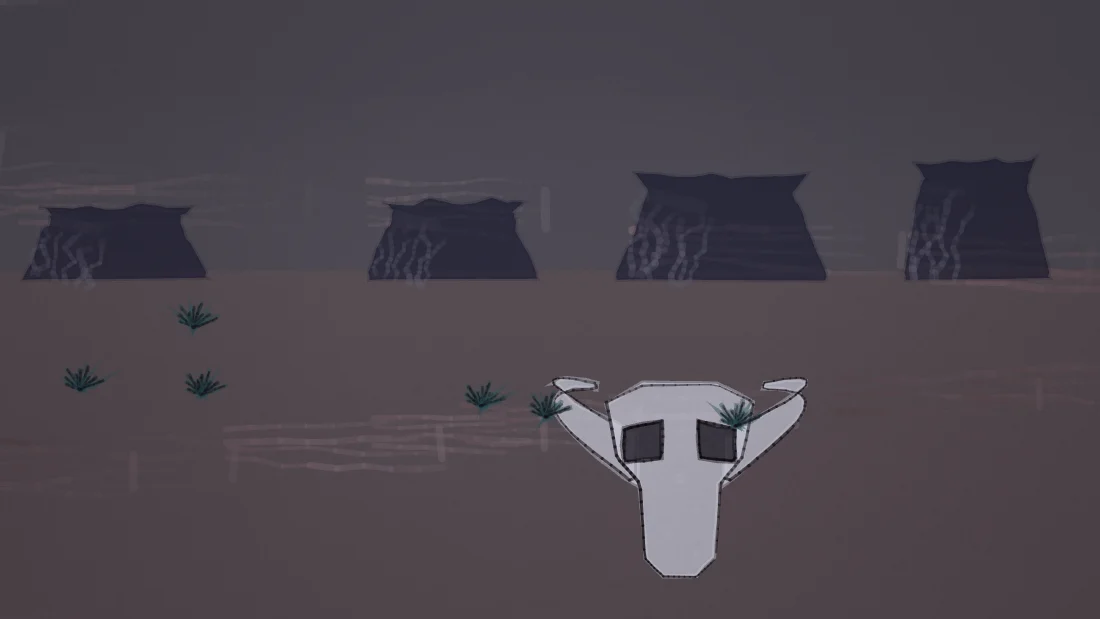
Back out of doors. Mesas at first light, a rider crossing thirty miles of nothing, a longhorn skull in the near grass, the dust coming. The boil is three tracings of one drawing rather than three different ones, and the brush skips where the paper is high.
Series 25
The Country Again
Back out of doors. Mesas at first light, a rider crossing thirty miles of nothing, a longhorn skull in the near grass, the dust coming. The boil is three tracings of one drawing rather than three different ones, and the brush skips where the paper is high.
 Series 26
Dry Goods
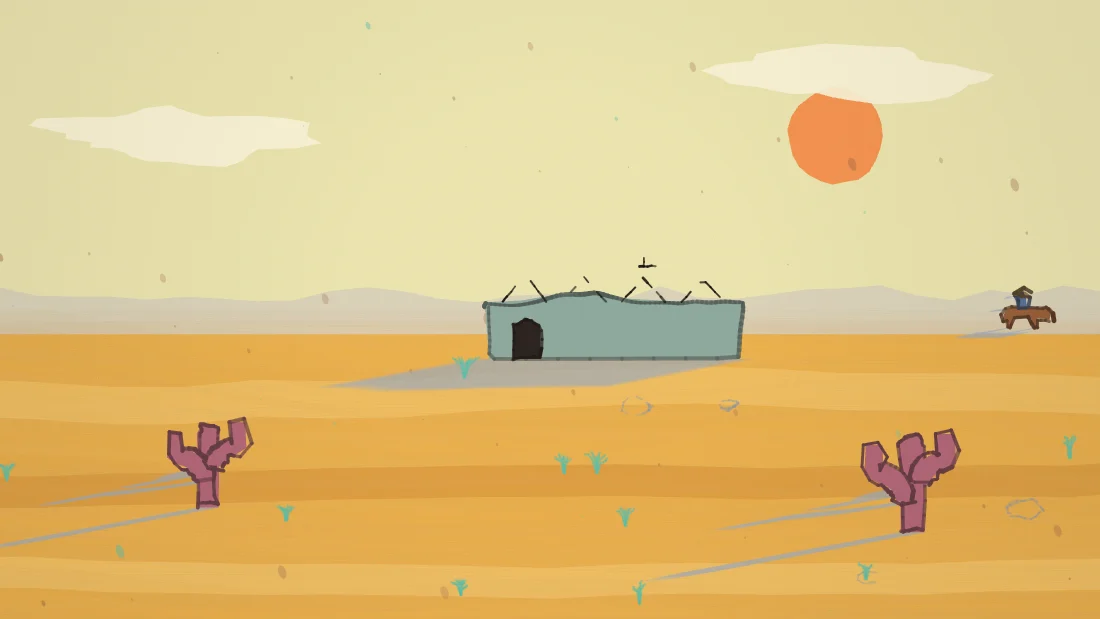
The materials. Flat saturated colour with hard edges, and all the richness moved inside the fields: a wood grain that is the contour set of a warped field, a spatter that behaves like flicked ink actually behaves, and graphite, wax, a steel nib and a coloured pencil that each meet the paper in their own way.
Series 26
Dry Goods
The materials. Flat saturated colour with hard edges, and all the richness moved inside the fields: a wood grain that is the contour set of a warped field, a spatter that behaves like flicked ink actually behaves, and graphite, wax, a steel nib and a coloured pencil that each meet the paper in their own way.
 Series 27
One Town, Ten Stations
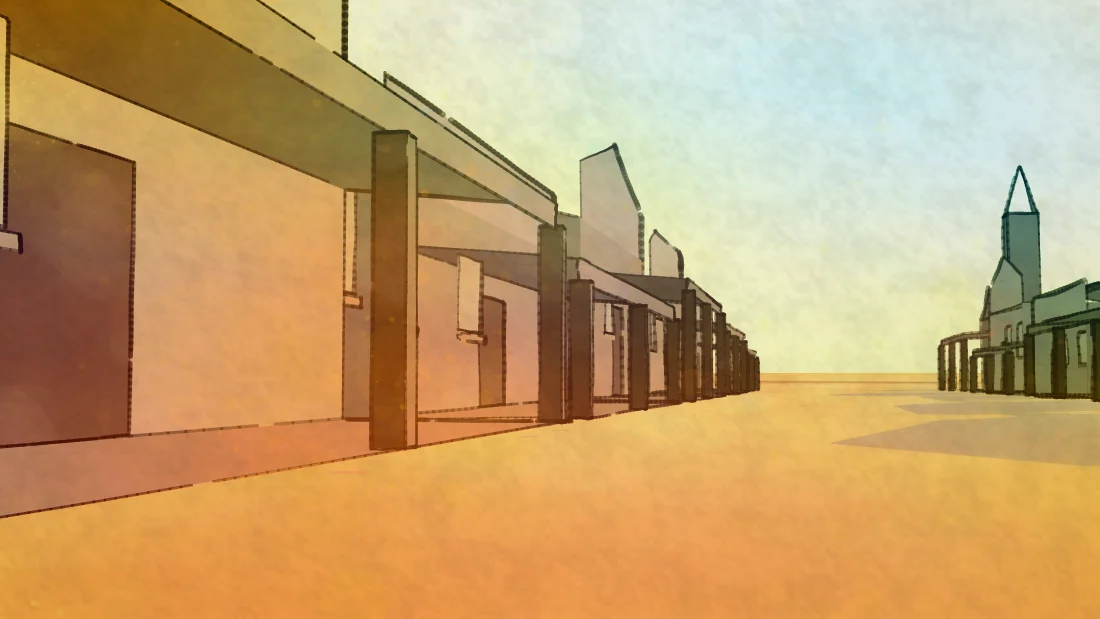
The first series that is a place rather than fifty pictures. One town on the Strip built in feet — a street fifty-two feet wide, fourteen buildings with real sheds behind their false fronts, a water tower, a wind pump, nine buttes. Ten camera stations, five lights, and the button moves the camera.
Series 27
One Town, Ten Stations
The first series that is a place rather than fifty pictures. One town on the Strip built in feet — a street fifty-two feet wide, fourteen buildings with real sheds behind their false fronts, a water tower, a wind pump, nine buttes. Ten camera stations, five lights, and the button moves the camera.
 Series 28
The Painted Country
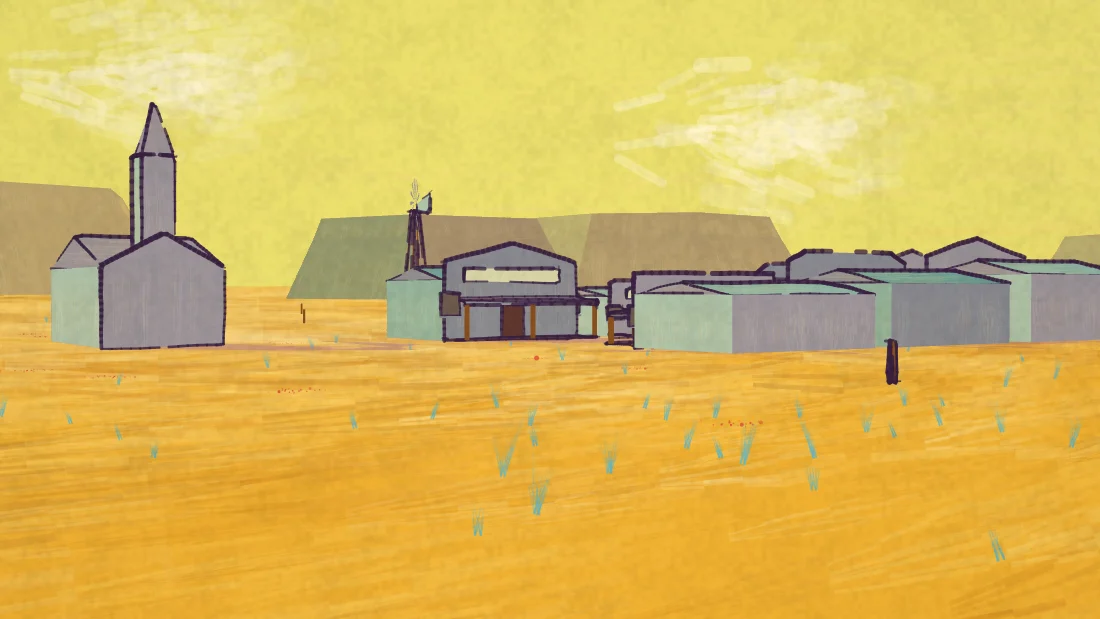
The world of 27, finally painted. Not one full-frame glaze: every colour was put there by a mark, and every mark is at a position in the country rather than in the frame — striations lying on the ground, spray in patches, and the same striations running up the boards of a wall in the wall’s own plane. Flat light, loose pencil, five materials.
Series 28
The Painted Country
The world of 27, finally painted. Not one full-frame glaze: every colour was put there by a mark, and every mark is at a position in the country rather than in the frame — striations lying on the ground, spray in patches, and the same striations running up the boards of a wall in the wall’s own plane. Flat light, loose pencil, five materials.
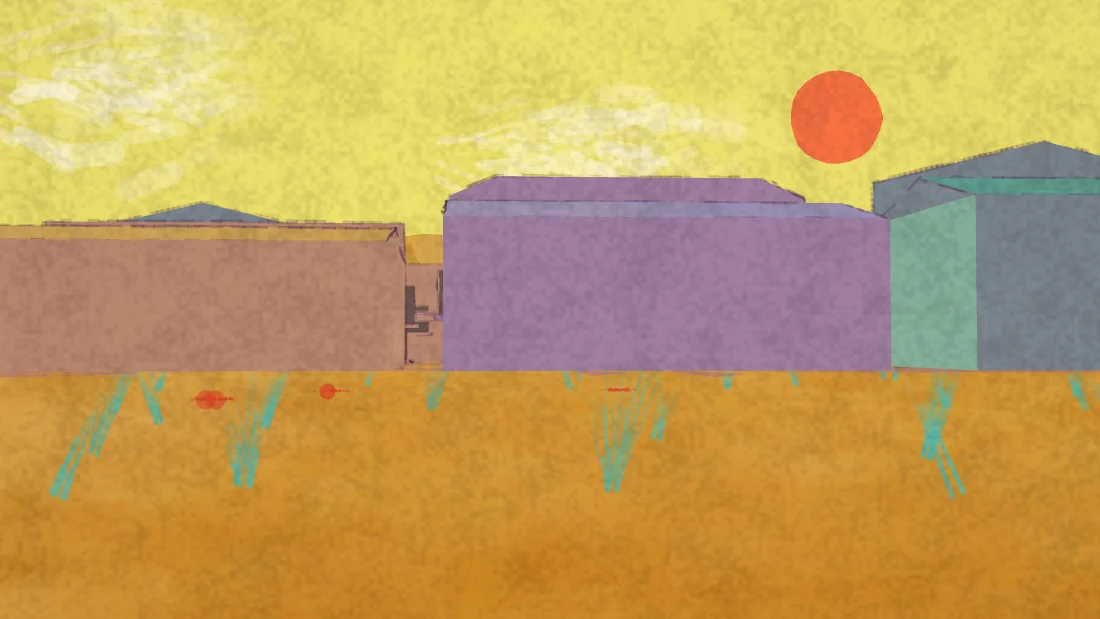 Series 29
Fourteen Inches to a Mile
The same country from five heights. The hue at a point is a function of the PLACE — zones hundreds of feet across, veins of caliche forty feet wide, a fleck the size one brush stroke sits inside. A mile up you see the zones, from fourteen inches the fleck, and it is the same colour in both. The button flies.
Series 29
Fourteen Inches to a Mile
The same country from five heights. The hue at a point is a function of the PLACE — zones hundreds of feet across, veins of caliche forty feet wide, a fleck the size one brush stroke sits inside. A mile up you see the zones, from fourteen inches the fleck, and it is the same colour in both. The button flies.
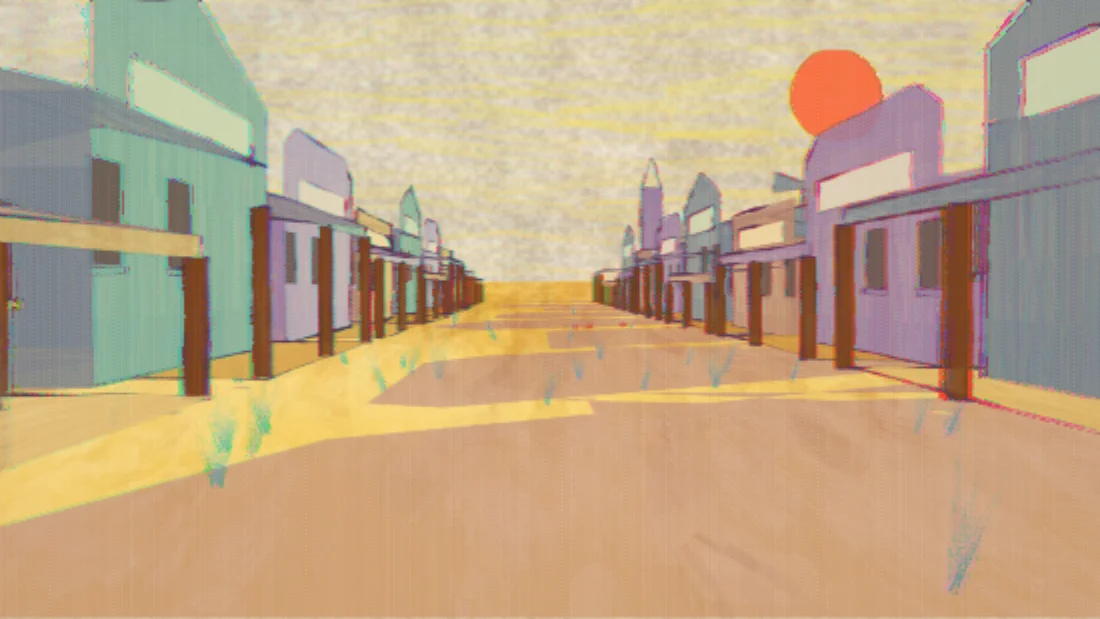 Series 30
The Sheet Underneath
The paper goes underneath instead of over the top. The sheet is the bottom layer, the painting sits on it, and what you see of the paper is what the brush missed — every mark asks the same tooth field the sheet was made from. The line tapers instead of chunking. And film moves again: grain, gate weave, colour at the corners.
Series 30
The Sheet Underneath
The paper goes underneath instead of over the top. The sheet is the bottom layer, the painting sits on it, and what you see of the paper is what the brush missed — every mark asks the same tooth field the sheet was made from. The line tapers instead of chunking. And film moves again: grain, gate weave, colour at the corners.
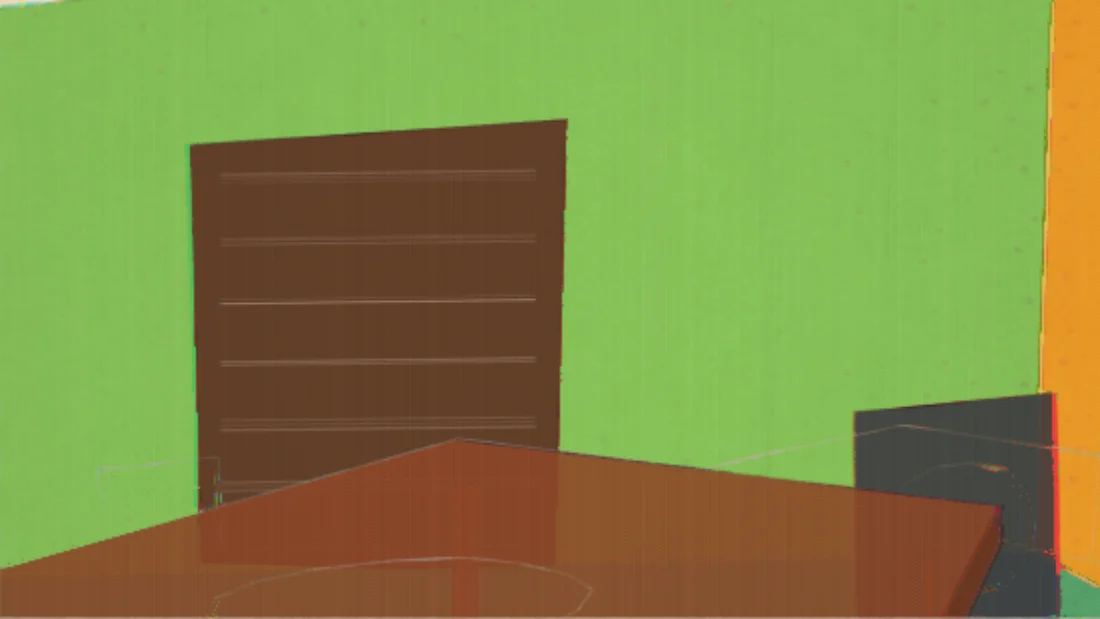 Series 31
Rooms That Are Not Boxes
Interiors, and not one right angle in them — four floor corners dropped anywhere and four top corners leaning their own ways, so the floor is a trapezoid and every window is a rhombus. The chair, the plate, the fork and the glass are drawn in line over the flat colour and turn with the room. Five new sheets.
Series 31
Rooms That Are Not Boxes
Interiors, and not one right angle in them — four floor corners dropped anywhere and four top corners leaning their own ways, so the floor is a trapezoid and every window is a rhombus. The chair, the plate, the fork and the glass are drawn in line over the flat colour and turn with the room. Five new sheets.
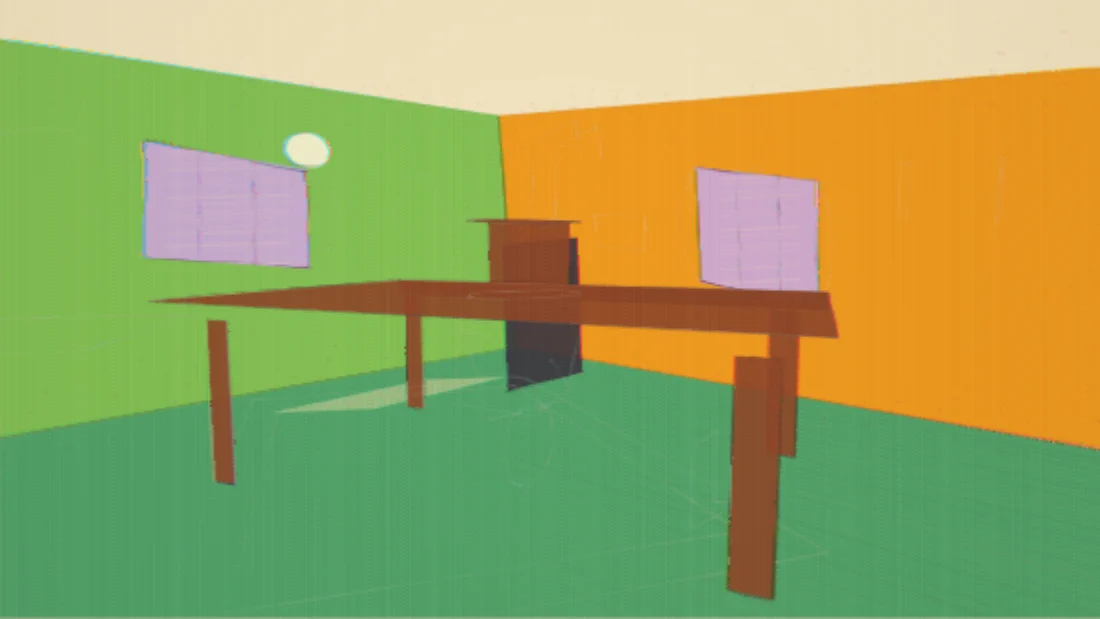 Series 32
Everything In The Room
The rooms got deep enough to read. Every camera stands in a corner on a wide lens looking at the opposite one, and there are eighteen kinds of drawn thing in them instead of six — hats on pegs, a stove pipe through the ceiling, a scalloped curtain, boots, a cake with nine candles, a cat. The window light lands on the floor.
Series 32
Everything In The Room
The rooms got deep enough to read. Every camera stands in a corner on a wide lens looking at the opposite one, and there are eighteen kinds of drawn thing in them instead of six — hats on pegs, a stove pipe through the ceiling, a scalloped curtain, boots, a cake with nine candles, a cat. The window light lands on the floor.
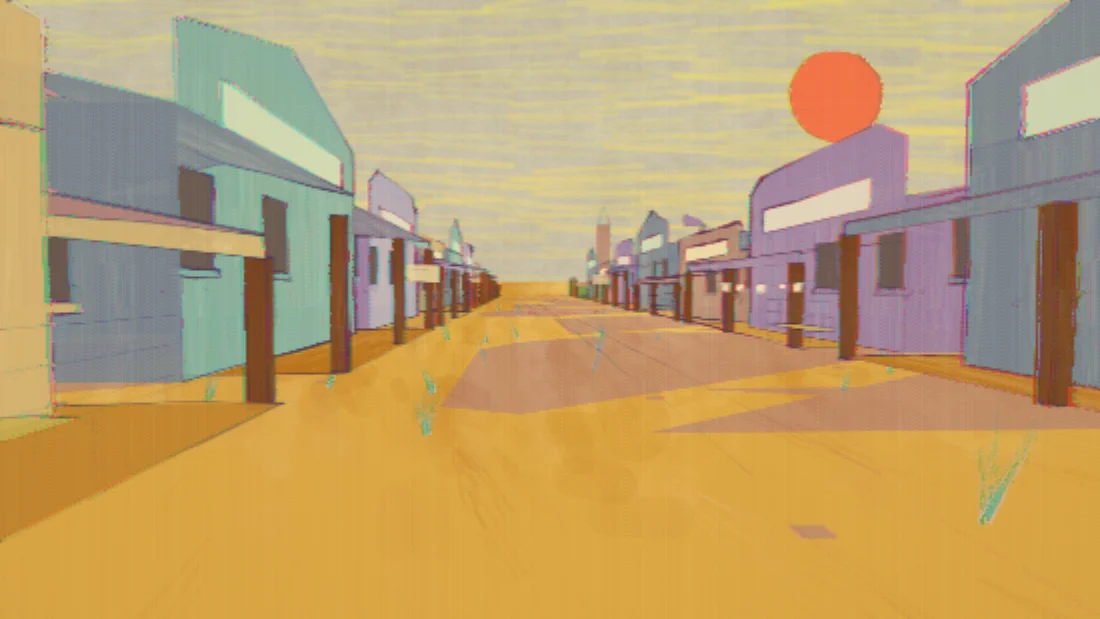 Series 33
The Street, Furnished
The lesson of the interiors taken back outdoors. The street gets furnished: hitching rails, a trough, a barrel, a wagon wheel somebody leaned and forgot, laundry on a line, a bench, a lamp post, crates, weeds and the ruts down the middle. Three hundred and seventy-eight drawn things, all in feet, all turning with the camera.
Series 33
The Street, Furnished
The lesson of the interiors taken back outdoors. The street gets furnished: hitching rails, a trough, a barrel, a wagon wheel somebody leaned and forgot, laundry on a line, a bench, a lamp post, crates, weeds and the ruts down the middle. Three hundred and seventy-eight drawn things, all in feet, all turning with the camera.
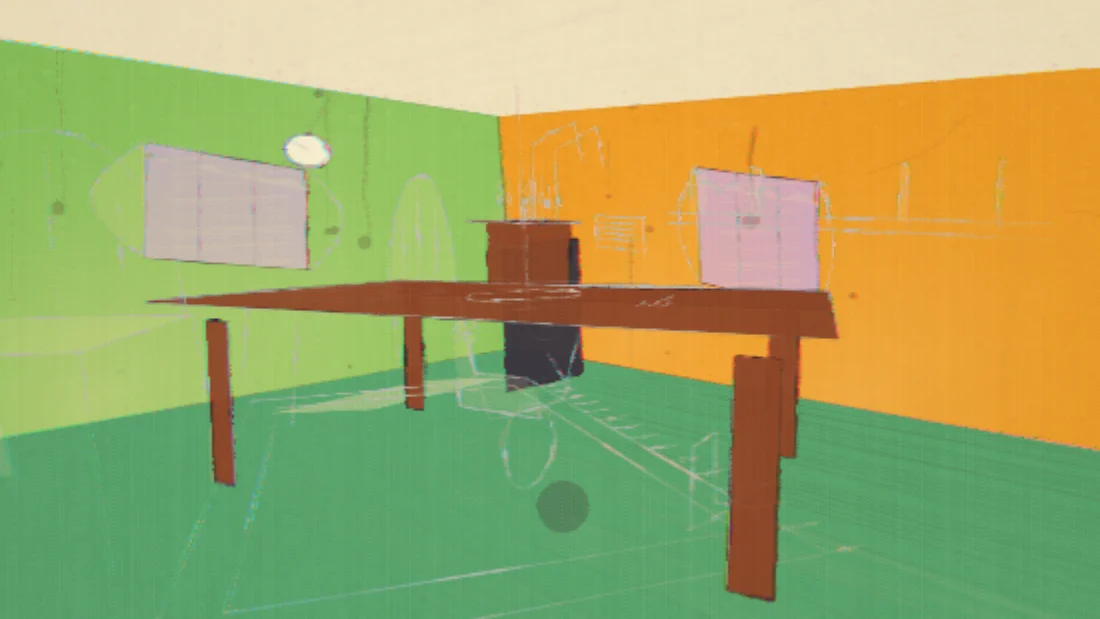 Series 34
The Accidents Left In
The rooms with the accidents left in. The drawn things stopped being vector — two passes out of register, pressure at the corners, an overrun at the end, a soft patch of paint under a third of them. Gradient patches laid inside each plane. And drips, rings, scuffs, a hairline crack, crumbs.
Series 34
The Accidents Left In
The rooms with the accidents left in. The drawn things stopped being vector — two passes out of register, pressure at the corners, an overrun at the end, a soft patch of paint under a third of them. Gradient patches laid inside each plane. And drips, rings, scuffs, a hairline crack, crumbs.
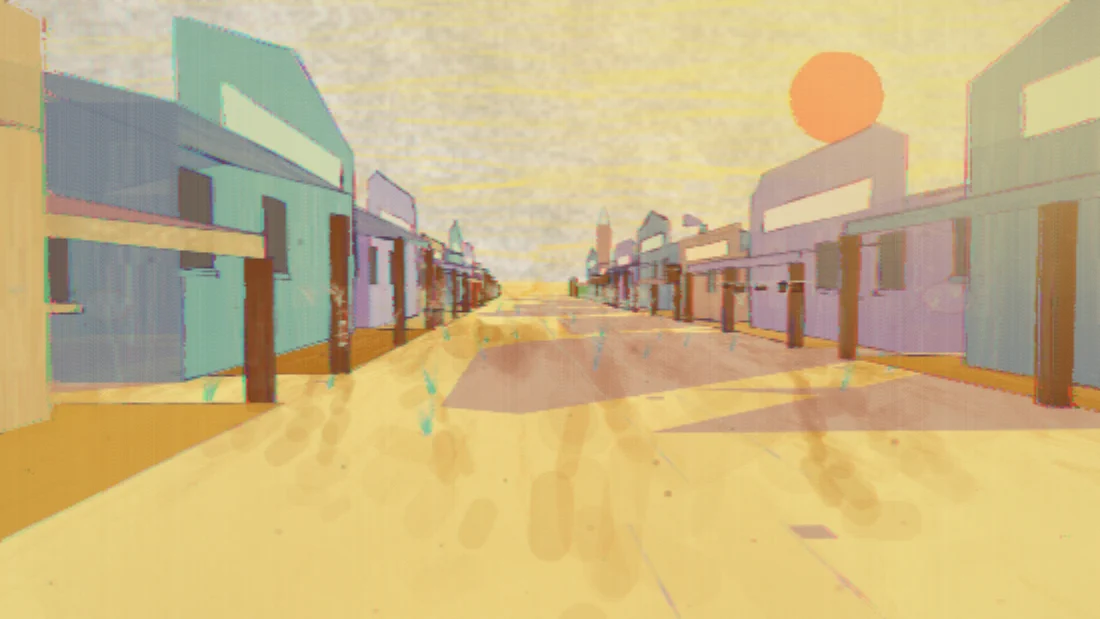 Series 35
The Street, Untidy
The same three fixes outdoors, made at the same time so both halves learn from each other. Painterly drawing on the rails and the trough, patches of soft colour in the sky and the ground, and a road that is not tidy.
Series 35
The Street, Untidy
The same three fixes outdoors, made at the same time so both halves learn from each other. Painterly drawing on the rails and the trough, patches of soft colour in the sky and the ground, and a road that is not tidy.
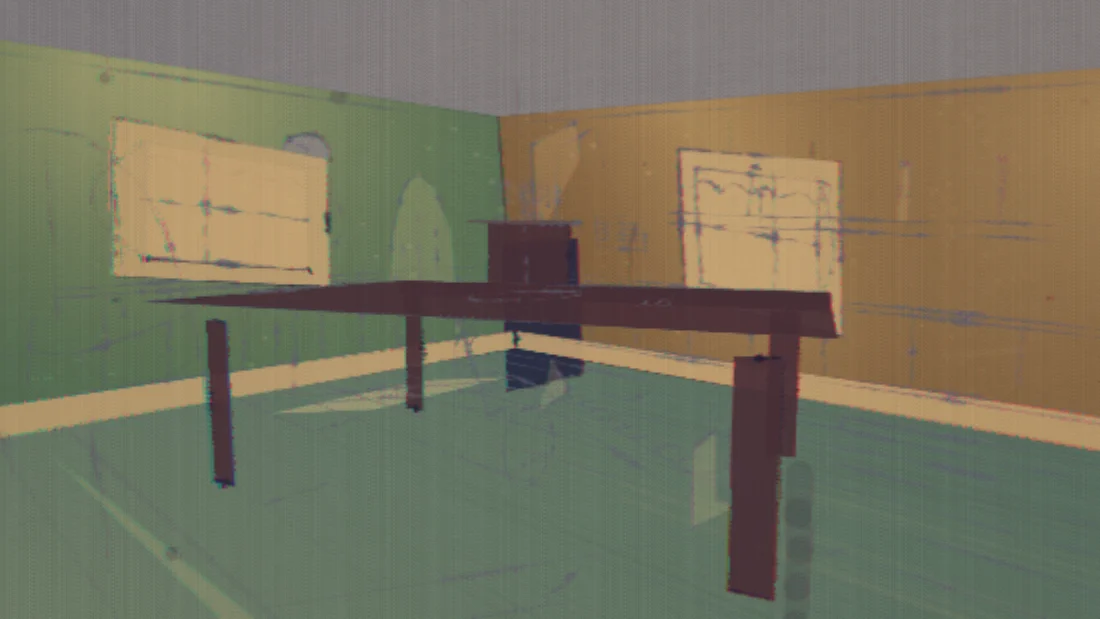 Series 36
Weather Indoors
Weather indoors, and chalk that is actually chalk — a granular deposit on the peaks of the tooth with paper showing through the middle of every line. The rooms are built now: skirting, chair rail, wainscot, cornice, a cased door ajar, a window with a sill and bars, floorboards butt-jointed and nailed in pairs.
Series 36
Weather Indoors
Weather indoors, and chalk that is actually chalk — a granular deposit on the peaks of the tooth with paper showing through the middle of every line. The rooms are built now: skirting, chair rail, wainscot, cornice, a cased door ajar, a window with a sill and bars, floorboards butt-jointed and nailed in pairs.
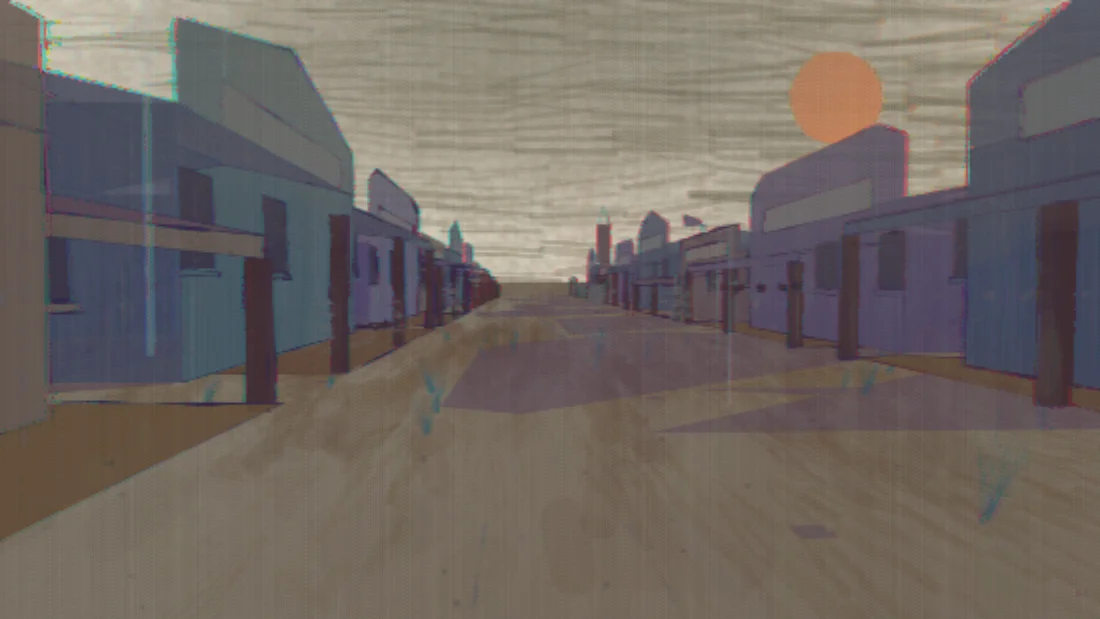 Series 37
Weather Outdoors
Weather outdoors, on the third rule: paint is fixed, film moves on the glass, and weather moves in the WORLD. Rain falls at eleven feet a second on a lattice round the camera, near drops sweeping past while far ones barely move; snow at a fifth of that; lightning relighting the whole street twice a strike.
Series 37
Weather Outdoors
Weather outdoors, on the third rule: paint is fixed, film moves on the glass, and weather moves in the WORLD. Rain falls at eleven feet a second on a lattice round the camera, near drops sweeping past while far ones barely move; snow at a fifth of that; lightning relighting the whole street twice a strike.
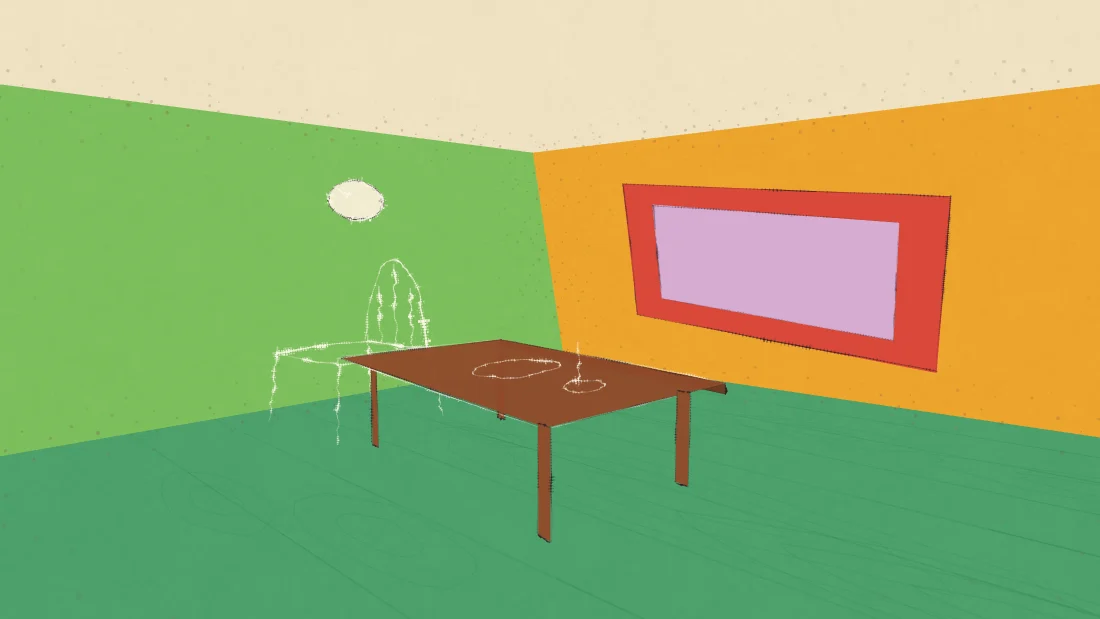 Series 38
Six Things In A Room
The rooms emptied out. The reference interior has six things in it — two flat colour walls, a plank floor, two fat-framed windows, a table, a chair and a clock — and the previous ones had two hundred and seventy-four marks. No skirting, no cornice, no nails, and the film switched off, because grain and fringing are not the texture. Thirty-one marks per room.
Series 38
Six Things In A Room
The rooms emptied out. The reference interior has six things in it — two flat colour walls, a plank floor, two fat-framed windows, a table, a chair and a clock — and the previous ones had two hundred and seventy-four marks. No skirting, no cornice, no nails, and the film switched off, because grain and fringing are not the texture. Thirty-one marks per room.
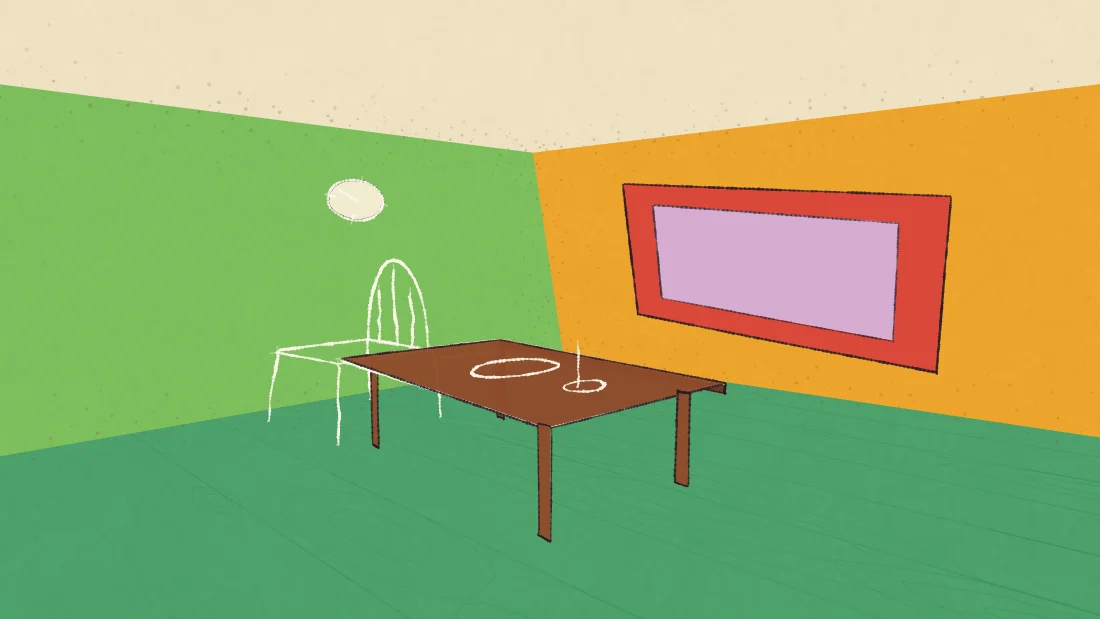 Series 39
Amplitude Falls As Frequency Rises
The one line of physics every mark in this project was missing: amplitude falls as frequency rises. Every wobbling line here was white noise — full amplitude at every frequency — which is why the chalk came out jagged. A hand is 1/f: a slow drift, a wobble at a third of it, a tremor at a third again.
Series 39
Amplitude Falls As Frequency Rises
The one line of physics every mark in this project was missing: amplitude falls as frequency rises. Every wobbling line here was white noise — full amplitude at every frequency — which is why the chalk came out jagged. A hand is 1/f: a slow drift, a wobble at a third of it, a tremor at a third again.
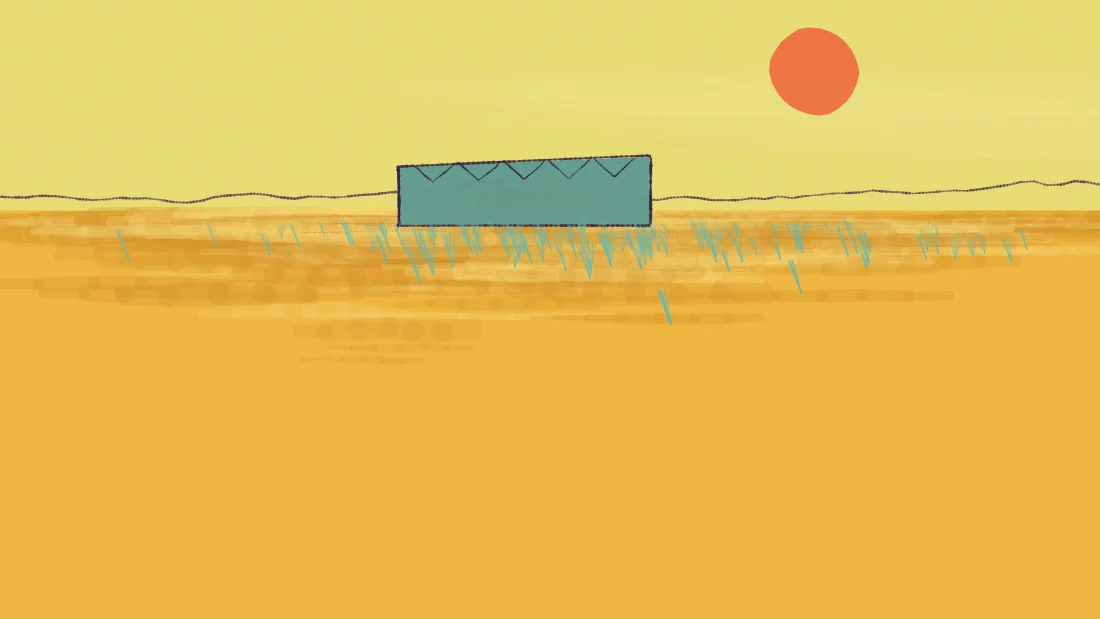 Series 40
One Over F, Everywhere
One over f, everywhere, with the exponent itself as the axis. Beta 0 is white noise — equal power at every frequency, which is what this project ran on for thirty-nine series. Beta 1 is a hand. Beta 2 is a drunk walk. Same country, five exponents, and the parameters are correlated too, so the strokes come in passages.
Series 40
One Over F, Everywhere
One over f, everywhere, with the exponent itself as the axis. Beta 0 is white noise — equal power at every frequency, which is what this project ran on for thirty-nine series. Beta 1 is a hand. Beta 2 is a drunk walk. Same country, five exponents, and the parameters are correlated too, so the strokes come in passages.
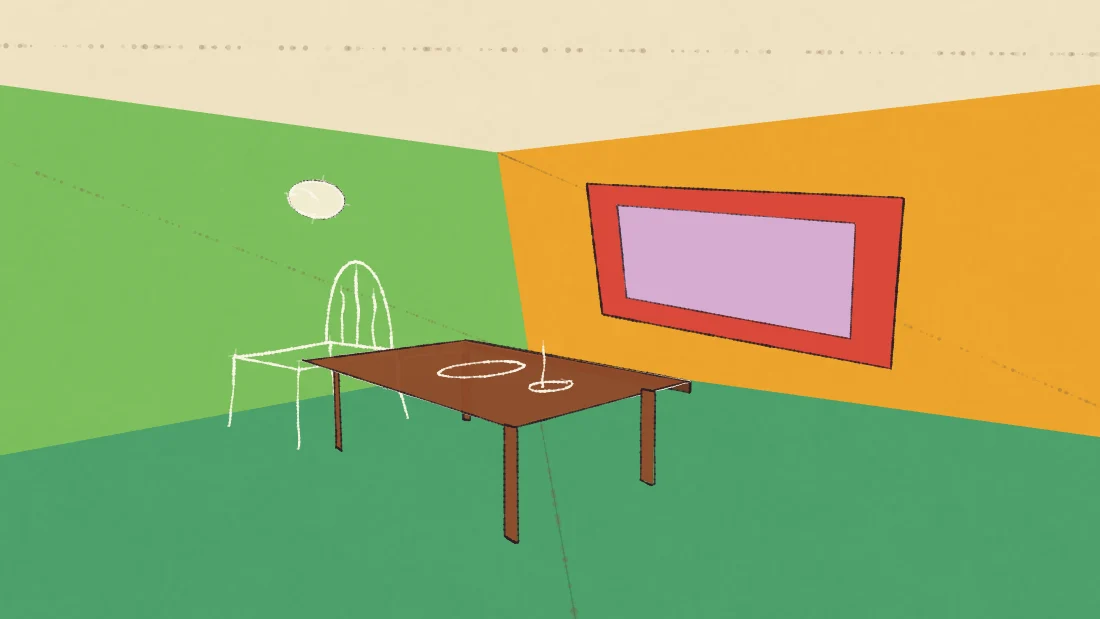 Series 41
No Straight Line In It
Interiors with no straight line in them. Every edge is a bowed curve whose sag is a fraction of its own run, the ceiling arcs up through its middle, the floorboards bend with the floor they lie on, and the window heads are round, ogee or shouldered.
Series 41
No Straight Line In It
Interiors with no straight line in them. Every edge is a bowed curve whose sag is a fraction of its own run, the ceiling arcs up through its middle, the floorboards bend with the floor they lie on, and the window heads are round, ogee or shouldered.
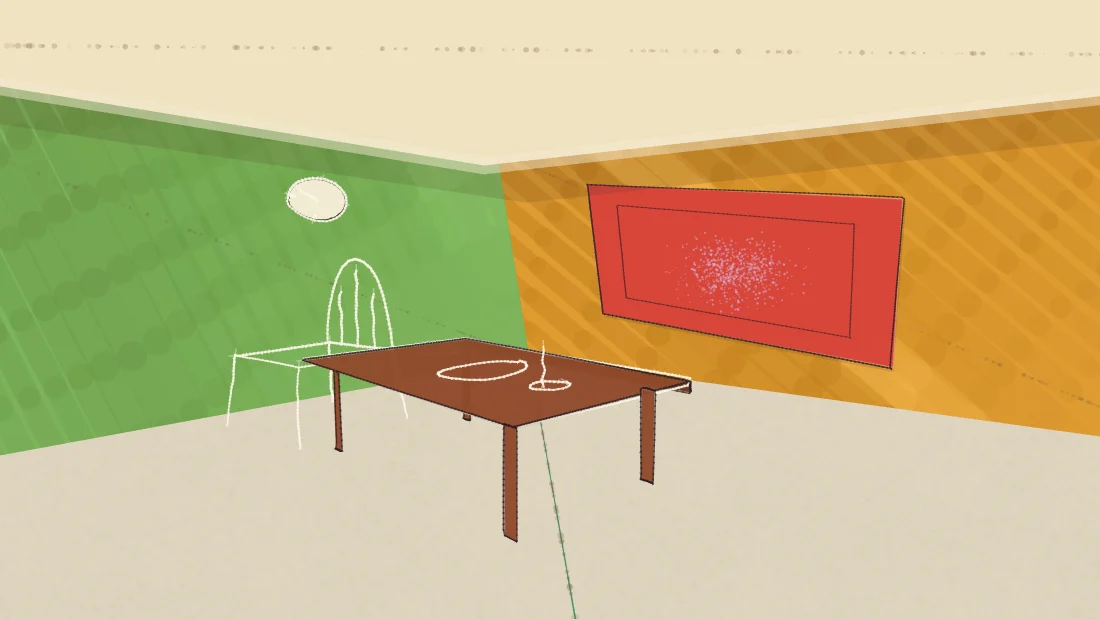 Series 42
More Than One Material
More than one material in a single picture. The medium is a property of a shape rather than of a series: any polygon can be gouache, a wash with a tideline at its rim, oil in directional strokes, a chalk deposit with no fill at all, graphite hatching where the paper is the light, stipple, or torn paper with pale fibre along the tear.
Series 42
More Than One Material
More than one material in a single picture. The medium is a property of a shape rather than of a series: any polygon can be gouache, a wash with a tideline at its rim, oil in directional strokes, a chalk deposit with no fill at all, graphite hatching where the paper is the light, stipple, or torn paper with pale fibre along the tear.
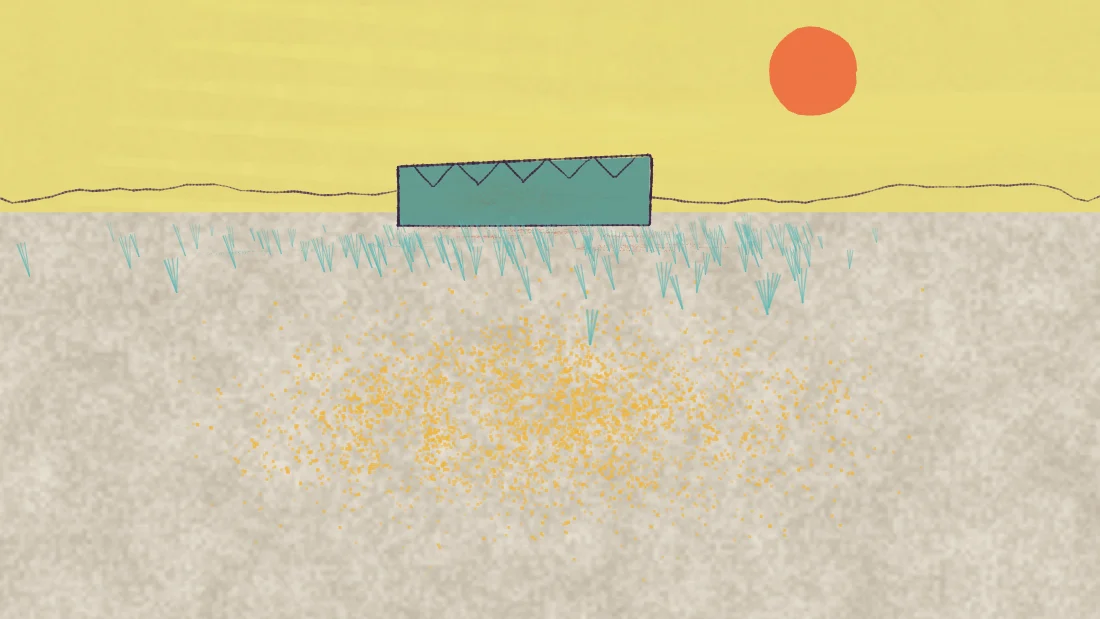 Series 43
More Than One Material, Outdoors
The same seven mediums taken to the country. A washed ground has no striations in it because a wash has no strokes; an oiled one has hundreds. The medium decides which marks are even possible.
Series 43
More Than One Material, Outdoors
The same seven mediums taken to the country. A washed ground has no striations in it because a wash has no strokes; an oiled one has hundreds. The medium decides which marks are even possible.
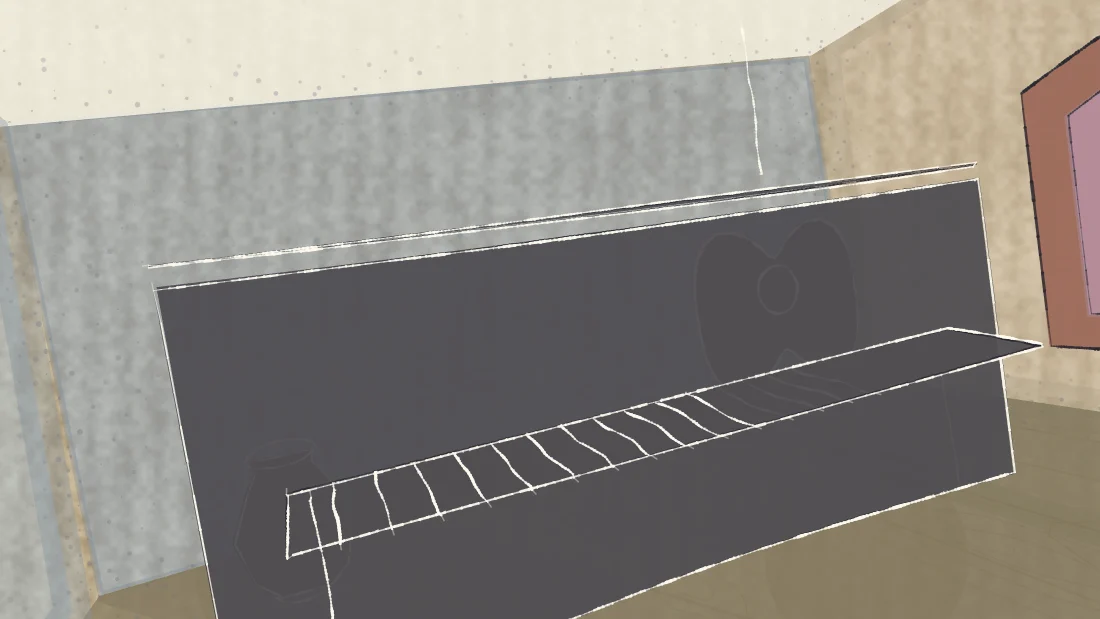 Series 44
Ten Places Nobody Paints
Ten places nobody paints, from angles nobody uses — behind a bar, a printing office, a hay barn, a dugout, a stage stop at three in the morning. The curve went back where it belongs: the walls are flat and the THINGS are round, built as surfaces of revolution. And the five across each row are five decisions about what a picture is about, not five settings of a number.
Series 44
Ten Places Nobody Paints
Ten places nobody paints, from angles nobody uses — behind a bar, a printing office, a hay barn, a dugout, a stage stop at three in the morning. The curve went back where it belongs: the walls are flat and the THINGS are round, built as surfaces of revolution. And the five across each row are five decisions about what a picture is about, not five settings of a number.
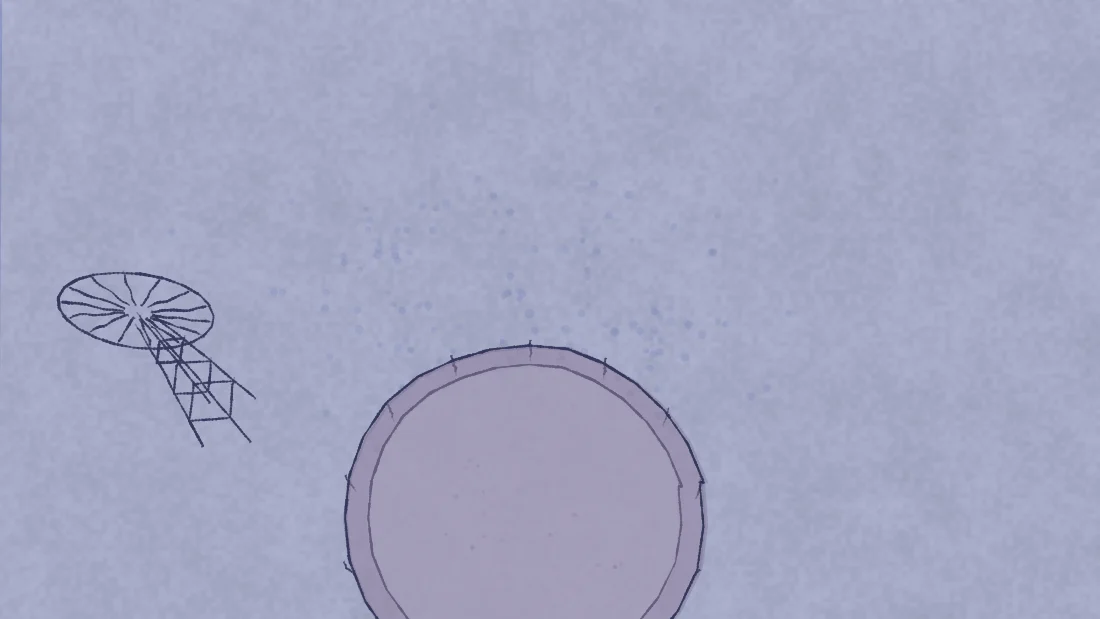 Series 45
Ten Pieces Of Country Nobody Paints
The outdoor half brought up to the same standard — a ford at low water, boot hill, a stock tank seen straight down, a burned homestead, a salt flat, a rimrock, a loading chute, a dry lake, a line camp, a crossroads. The horizon stays flat and the OBJECTS do the curving. And every plate in the project now has a GIF of its own turn you can copy straight out.
Series 45
Ten Pieces Of Country Nobody Paints
The outdoor half brought up to the same standard — a ford at low water, boot hill, a stock tank seen straight down, a burned homestead, a salt flat, a rimrock, a loading chute, a dry lake, a line camp, a crossroads. The horizon stays flat and the OBJECTS do the curving. And every plate in the project now has a GIF of its own turn you can copy straight out.
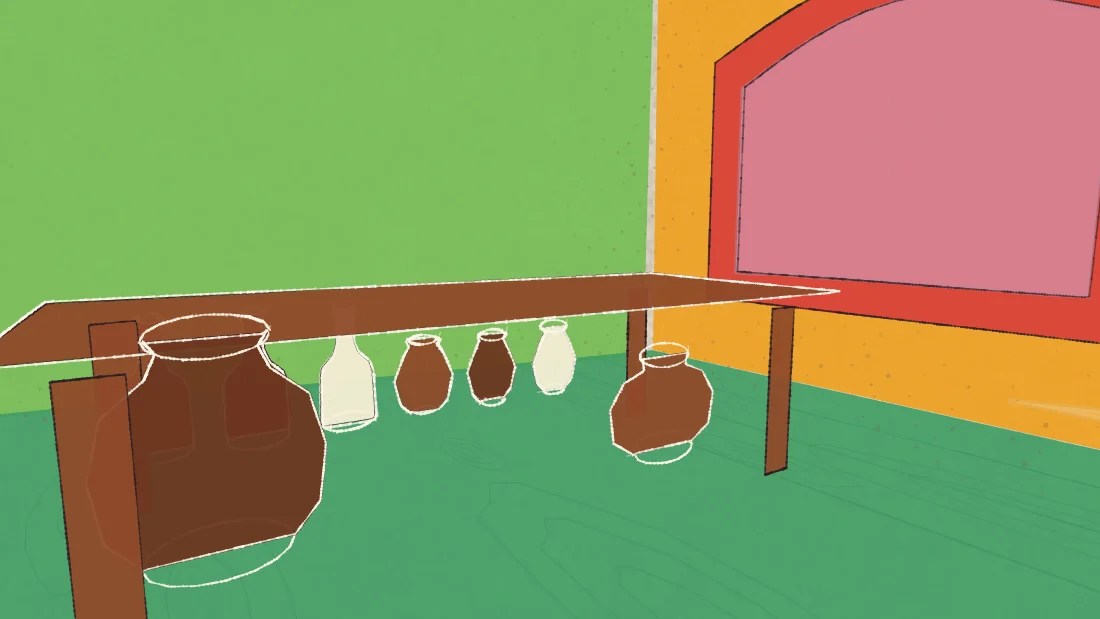 Series 46
Light Is A Shape
Light is a shape, not a shading term. A painter does not shade a floor — they draw the patch the window throws on it and fill it, with the bars of the window lying IN the patch. Ten new rooms: a bakehouse, an assay office, a telegraph office, a vestry, a wash house, a corridor, a surgery, a gun shop, a millinery, a cell.
Series 46
Light Is A Shape
Light is a shape, not a shading term. A painter does not shade a floor — they draw the patch the window throws on it and fill it, with the bars of the window lying IN the patch. Ten new rooms: a bakehouse, an assay office, a telegraph office, a vestry, a wash house, a corridor, a surgery, a gun shop, a millinery, a cell.
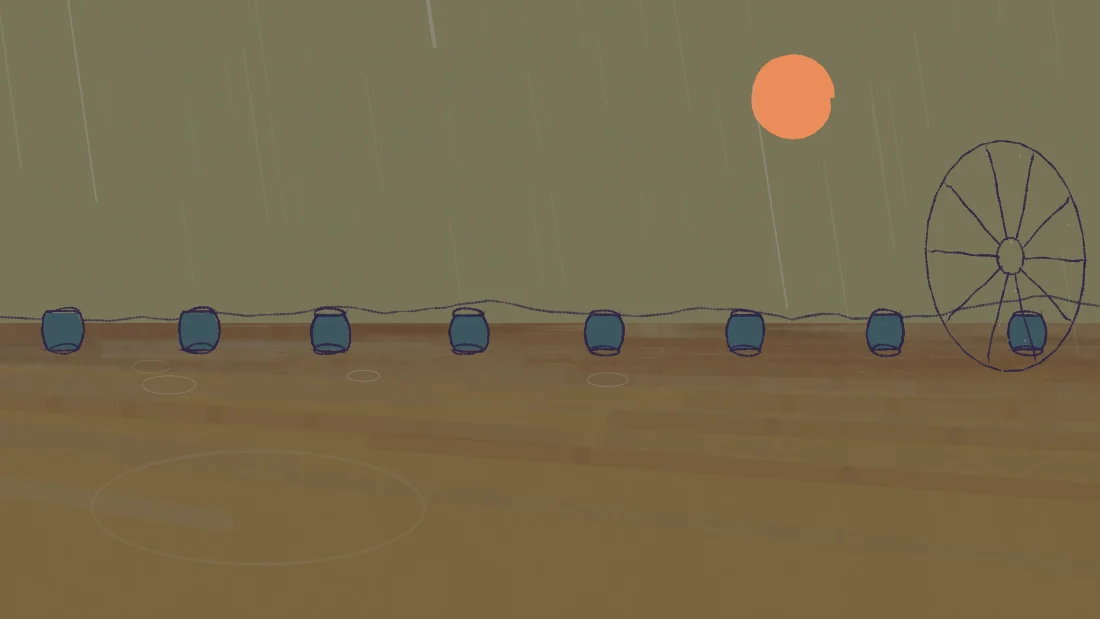 Series 47
Weather That Lands
Weather with consequences. Rain lands — every drop opens a ring that grows and fades in a third of a second, and the eaves drip on a slower clock. Snow settles as a cap on every up-facing surface and builds over the plate. And a bolt is a light AT A PLACE, so shadows point at where the strike was and swing when the next one lands.
Series 47
Weather That Lands
Weather with consequences. Rain lands — every drop opens a ring that grows and fades in a third of a second, and the eaves drip on a slower clock. Snow settles as a cap on every up-facing surface and builds over the plate. And a bolt is a light AT A PLACE, so shadows point at where the strike was and swing when the next one lands.
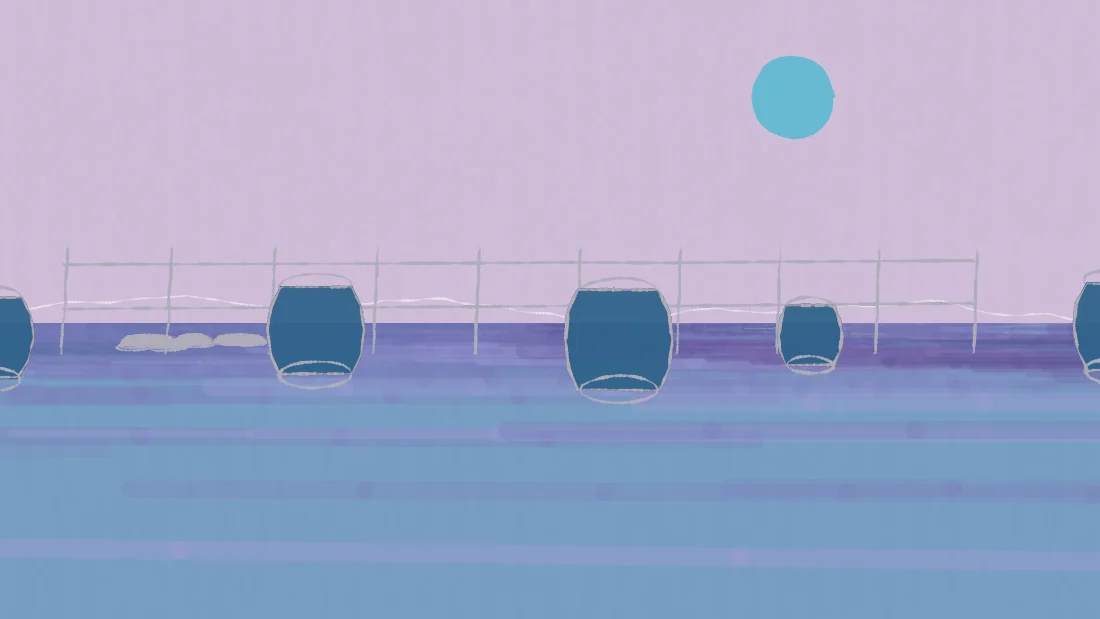 Series 48
Turn The Wheel
The scheme is relationships; the hue can go anywhere. An analogous ground family, a sky which is that family pulled to cream, ONE accent at the complement, structures a third of the way round, a line nearly black. Hold those and turn the whole wheel: every colour changes and not one relationship does. Five rotations a row. And the boil is on TWO frames — three cels read as a crawl the moment the camera pans.
Series 48
Turn The Wheel
The scheme is relationships; the hue can go anywhere. An analogous ground family, a sky which is that family pulled to cream, ONE accent at the complement, structures a third of the way round, a line nearly black. Hold those and turn the whole wheel: every colour changes and not one relationship does. Five rotations a row. And the boil is on TWO frames — three cels read as a crawl the moment the camera pans.
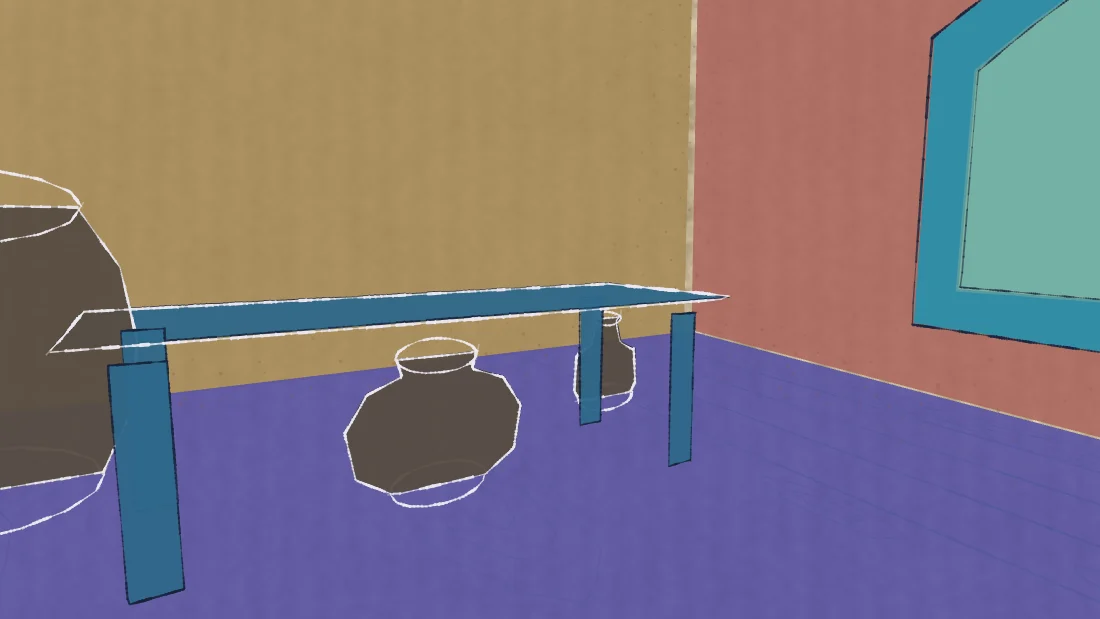 Series 49
Turn The Wheel, Indoors
The same rotation indoors. The walls, floor, joinery, glass and the shape the light throws are no longer five chosen colours but five offsets from one number, so the wheel moves all of them together and the ink stays nearly black however far round it goes.
Series 49
Turn The Wheel, Indoors
The same rotation indoors. The walls, floor, joinery, glass and the shape the light throws are no longer five chosen colours but five offsets from one number, so the wheel moves all of them together and the ink stays nearly black however far round it goes.
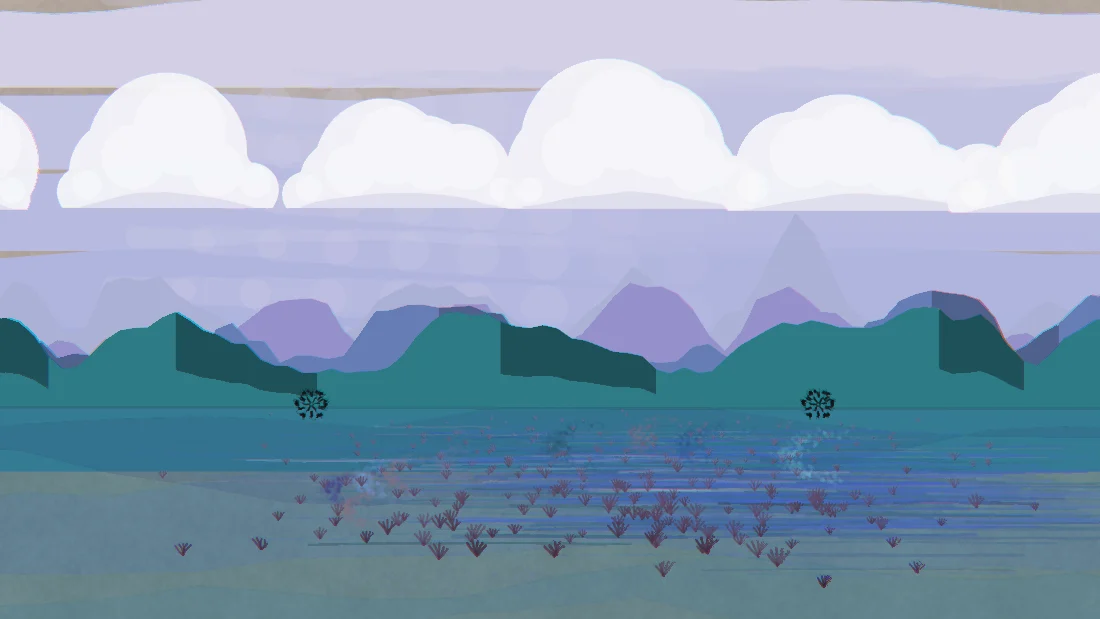 Series 50
Fifty Pictures
No rows. Forty-nine series were ten places seen five ways, which guarantees that four plates in five are a variation on the last. Fifty subjects, fifty compositions, fifty base hues, and four named materials in every one.
Series 50
Fifty Pictures
No rows. Forty-nine series were ten places seen five ways, which guarantees that four plates in five are a variation on the last. Fifty subjects, fifty compositions, fifty base hues, and four named materials in every one.
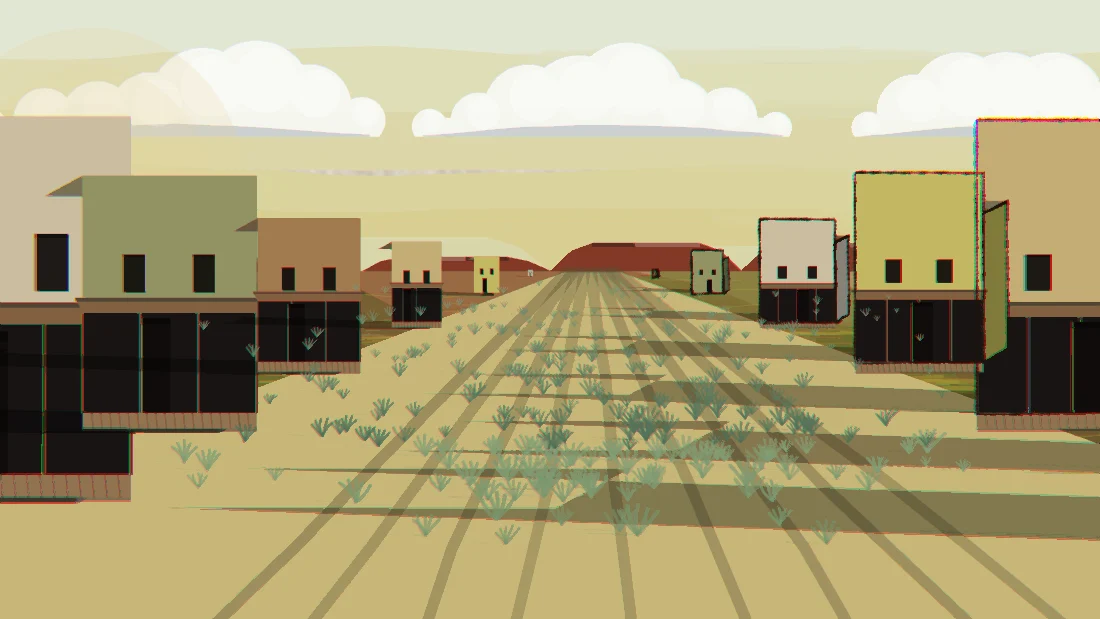 Series 52
The Sun Is A Direction
Measured rather than guessed: from Series 38 on, the outdoor plates ran nought to two per cent dark where the early ones ran twenty to thirty-seven. So every plate here makes one decision — where the sun is — and everything in it answers to that.
Series 52
The Sun Is A Direction
Measured rather than guessed: from Series 38 on, the outdoor plates ran nought to two per cent dark where the early ones ran twenty to thirty-seven. So every plate here makes one decision — where the sun is — and everything in it answers to that.
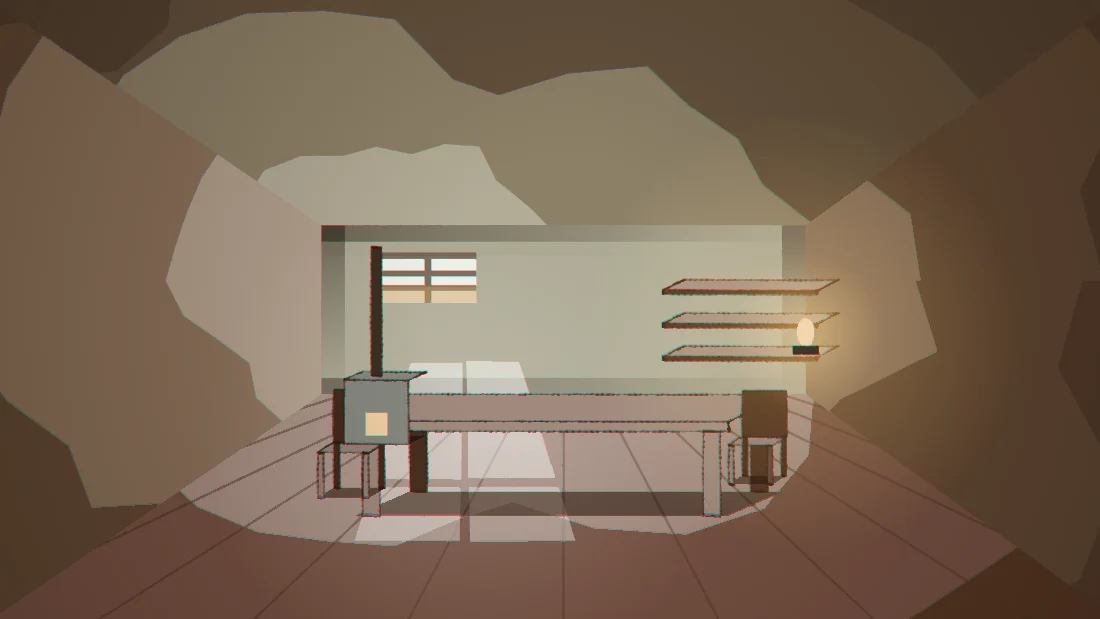 Series 53
A Room Is Lit By Its Openings
A room is not a box with colours on it. It is a dark volume with one or two holes in it, and everything you can see is a report on how much of those holes it can see.
Series 53
A Room Is Lit By Its Openings
A room is not a box with colours on it. It is a dark volume with one or two holes in it, and everything you can see is a report on how much of those holes it can see.
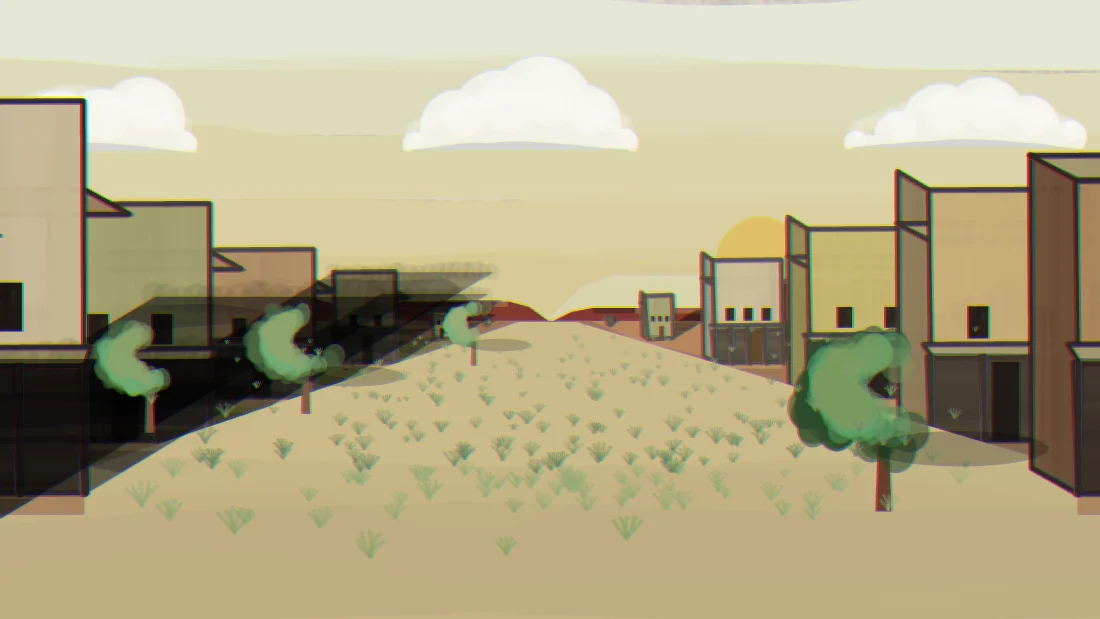 Series 54
Out Of Register
The line boil and the chromatic aberration were never two effects. They are one fact — misregistration — three stones printed in turn onto a sheet that lands somewhere new on every pull.
Series 54
Out Of Register
The line boil and the chromatic aberration were never two effects. They are one fact — misregistration — three stones printed in turn onto a sheet that lands somewhere new on every pull.
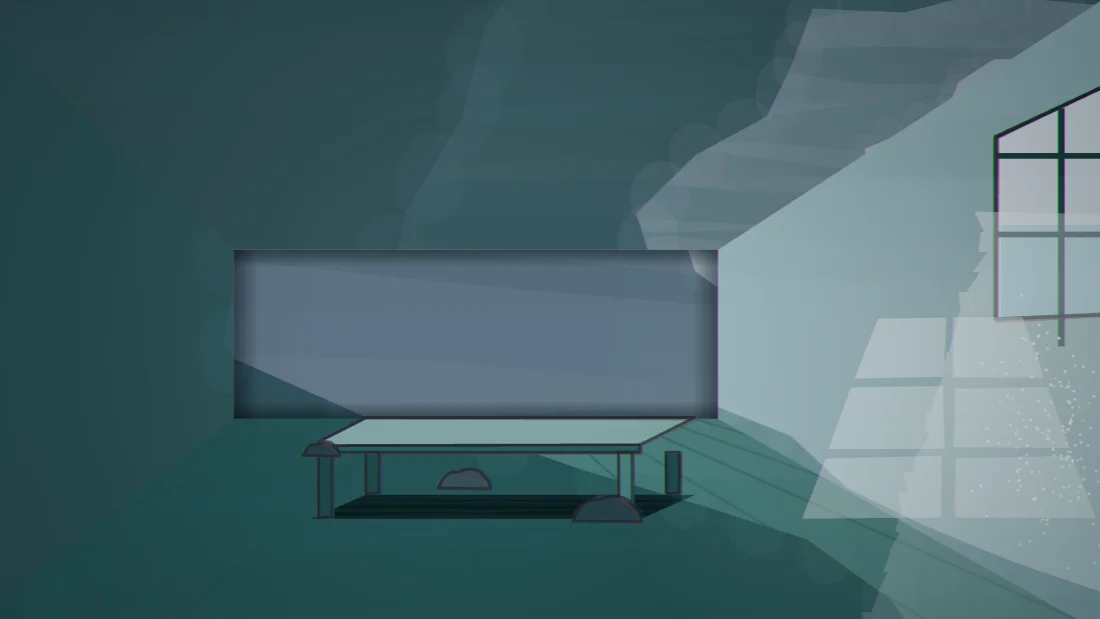 Series 55
The Air In The Room
Outdoors the air between you and a thing takes colour out of it. Indoors the air gives light back: flour in a kitchen, sawdust in a store, chalk in a schoolroom, and a shaft of window light crossing it.
Series 55
The Air In The Room
Outdoors the air between you and a thing takes colour out of it. Indoors the air gives light back: flour in a kitchen, sawdust in a store, chalk in a schoolroom, and a shaft of window light crossing it.
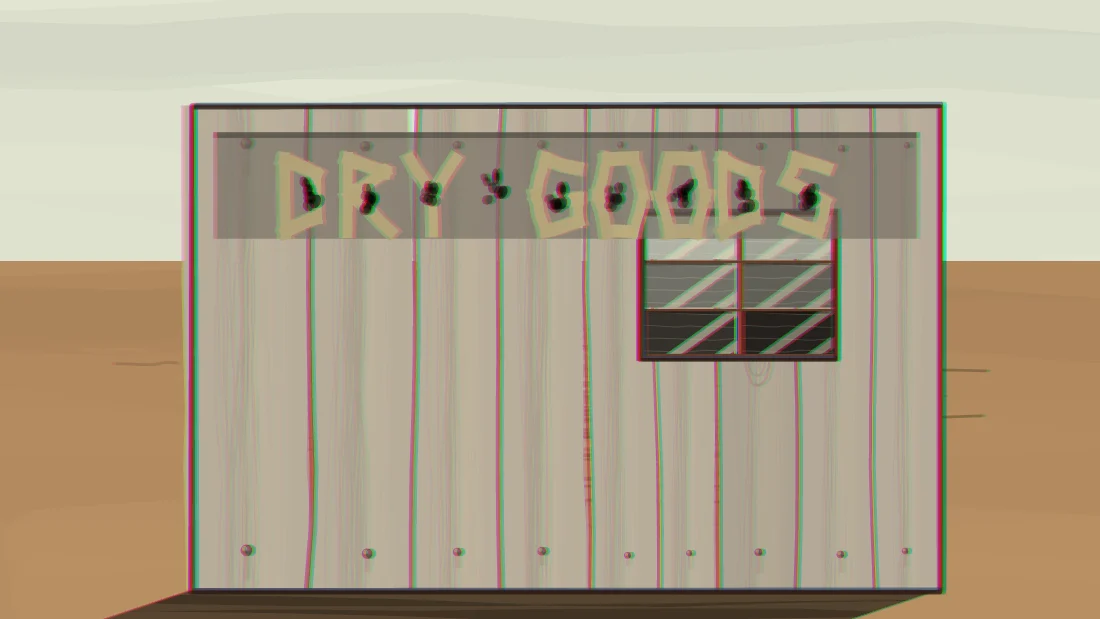 Series 56
Close Enough To Read
Detail is a hierarchy, not a density — the form, the parts it is made of, and the marks left on them, each about three times finer than the one above and carrying a third of its contrast. And twelve of these can be read.
Series 56
Close Enough To Read
Detail is a hierarchy, not a density — the form, the parts it is made of, and the marks left on them, each about three times finer than the one above and carrying a third of its contrast. And twelve of these can be read.
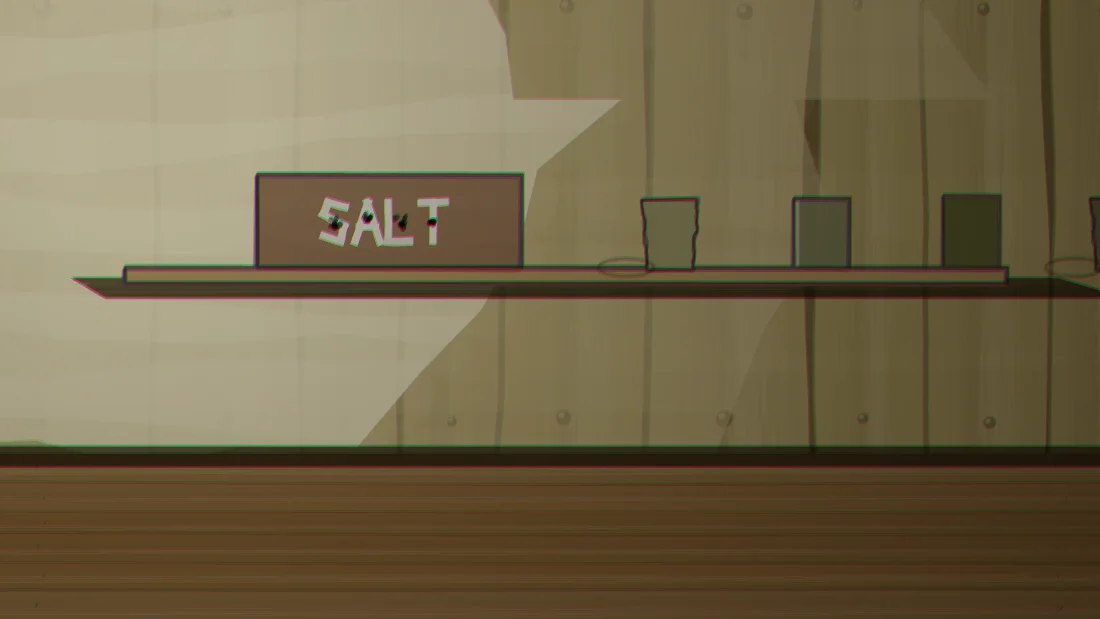 Series 57
Somebody Lives Here
Outdoors a close view tells you what a thing is made of. Indoors it tells you what somebody did. Nobody is drawn: the person is entirely what they put down and never picked up again.
Series 57
Somebody Lives Here
Outdoors a close view tells you what a thing is made of. Indoors it tells you what somebody did. Nobody is drawn: the person is entirely what they put down and never picked up again.
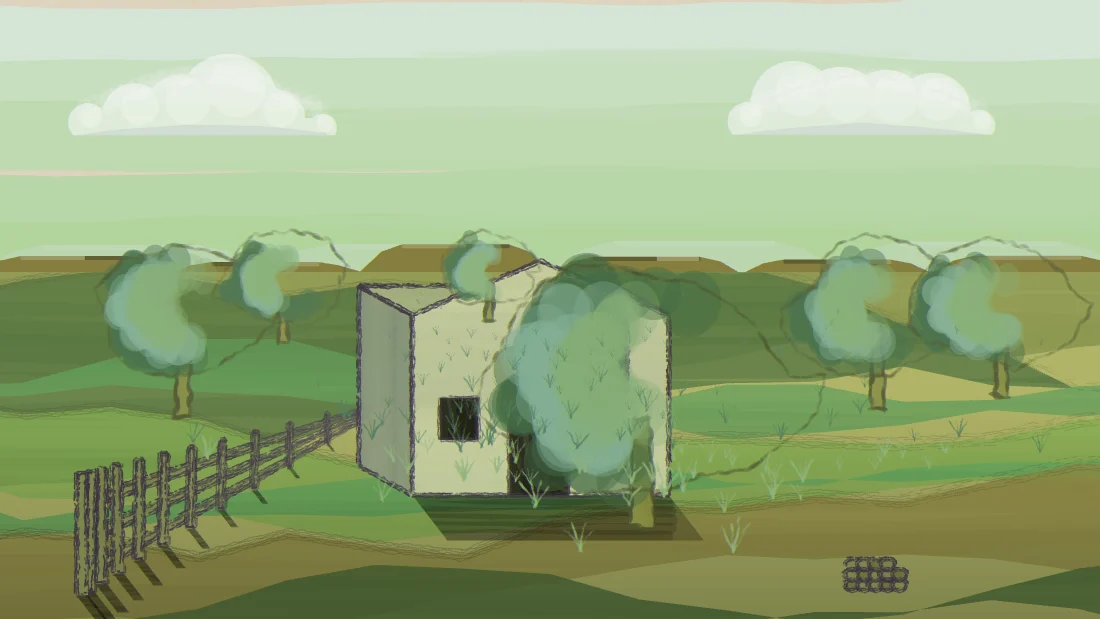 Series 58
Several Hands On One Sheet
Seven line materials on one sheet, and what matters about each is what it will not do. Chalk cannot make a continuous dark, and silverpoint cannot be pressed harder.
Series 58
Several Hands On One Sheet
Seven line materials on one sheet, and what matters about each is what it will not do. Chalk cannot make a continuous dark, and silverpoint cannot be pressed harder.
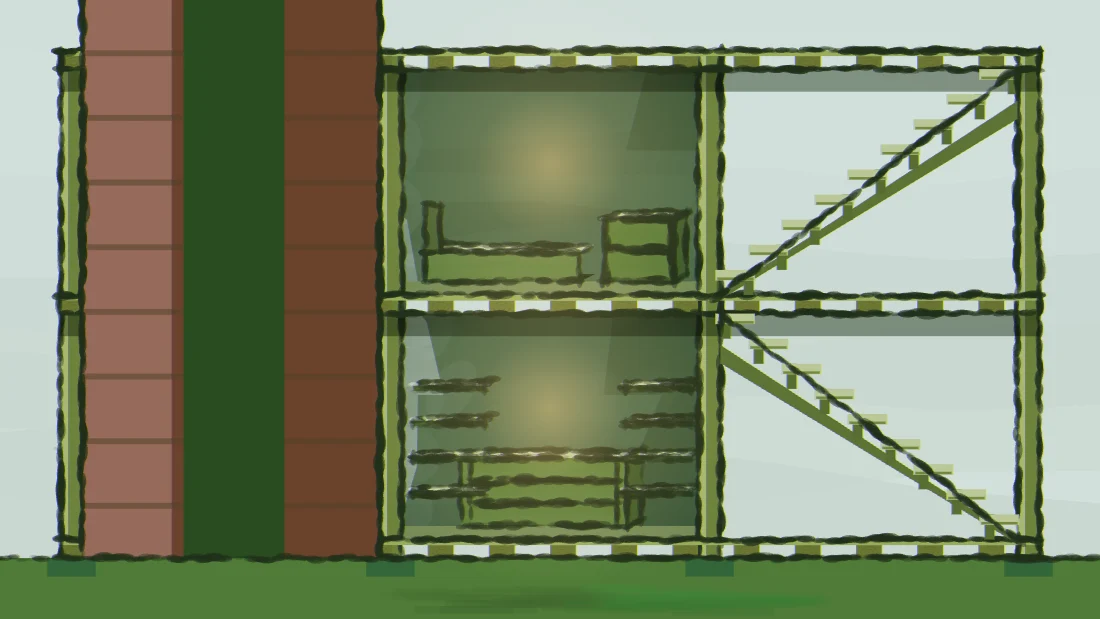 Series 59
The Front Wall Taken Off
The front wall taken off. The kitchen is under the bedroom, the stair eats the corner of both, and the chimney is the only thing that passes through everything — none of which can be photographed.
Series 59
The Front Wall Taken Off
The front wall taken off. The kitchen is under the bedroom, the stair eats the corner of both, and the chimney is the only thing that passes through everything — none of which can be photographed.
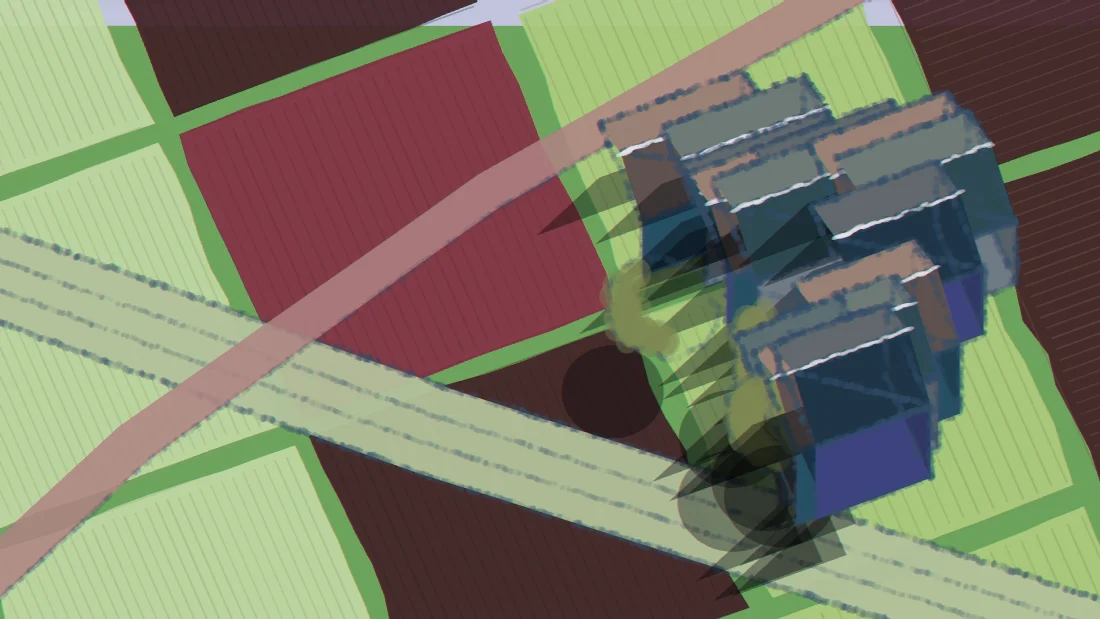 Series 60
Eight Hundred Feet Up
Fifty-nine series kept the camera five and a half feet off the ground. Take it up and there is no horizon, so the whole frame is country: the roofs, the furrows, the ruts, and the survey grid.
Series 60
Eight Hundred Feet Up
Fifty-nine series kept the camera five and a half feet off the ground. Take it up and there is no horizon, so the whole frame is country: the roofs, the furrows, the ruts, and the survey grid.
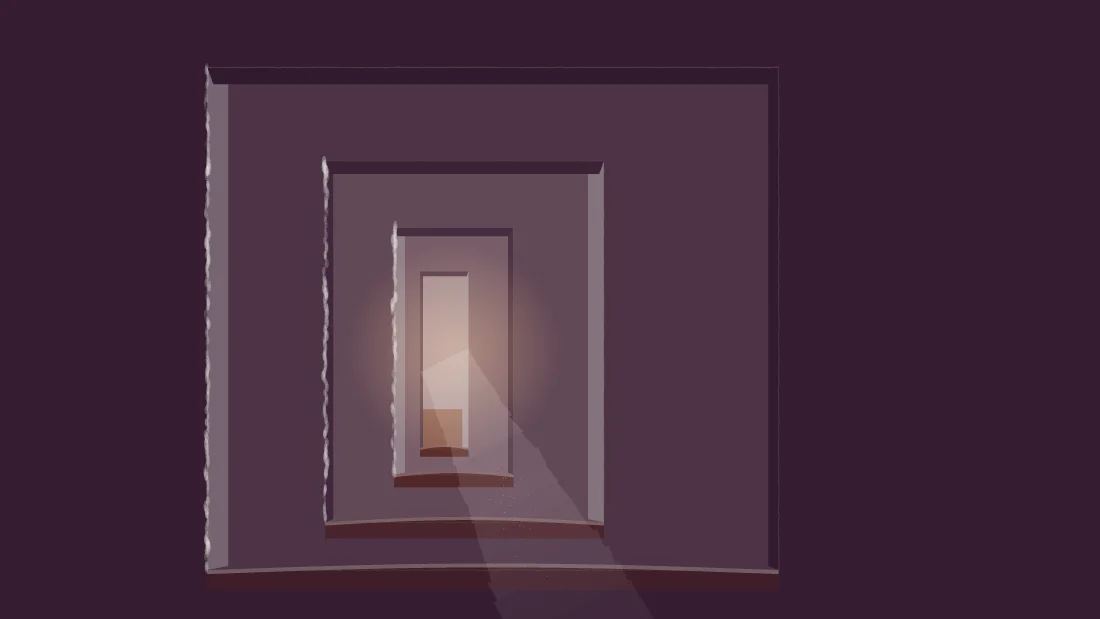 Series 61
From Outside, Looking In
From inside a room the darkest thing you can see is a far corner. From a doorway it is the jamb six inches from your face — and every value decision becomes easy the moment something is genuinely black at the front.
Series 61
From Outside, Looking In
From inside a room the darkest thing you can see is a far corner. From a doorway it is the jamb six inches from your face — and every value decision becomes easy the moment something is genuinely black at the front.
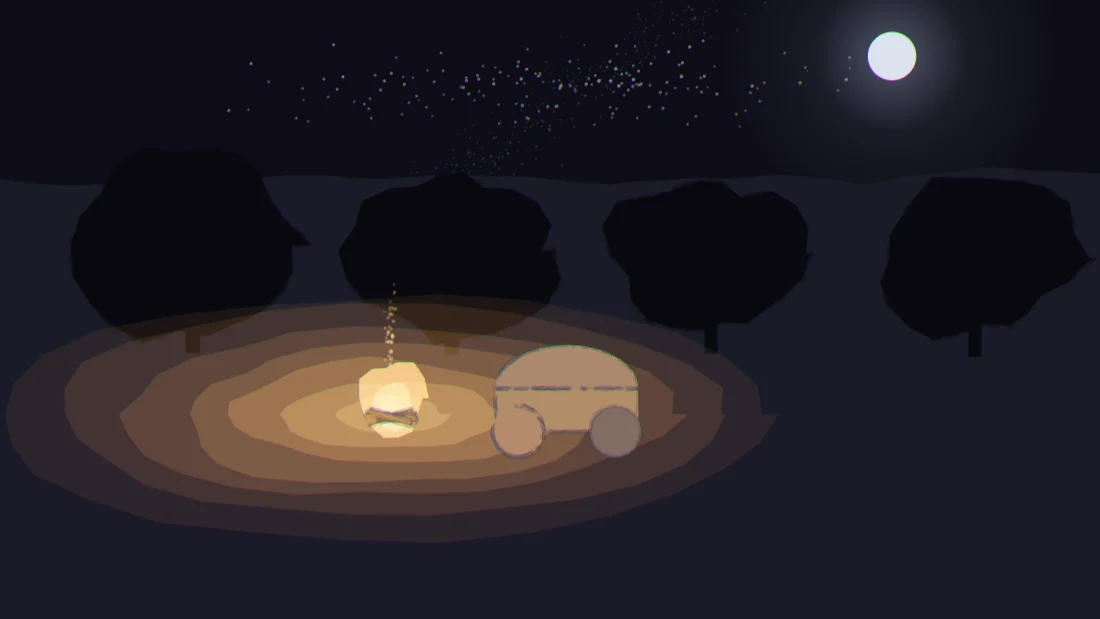 Series 62
Nothing But What Burns
Take the sun away and none of it survives. There is no local colour at midnight and no horizon to build perspective on, so depth is the inverse square and nothing else.
Series 62
Nothing But What Burns
Take the sun away and none of it survives. There is no local colour at midnight and no horizon to build perspective on, so depth is the inverse square and nothing else.
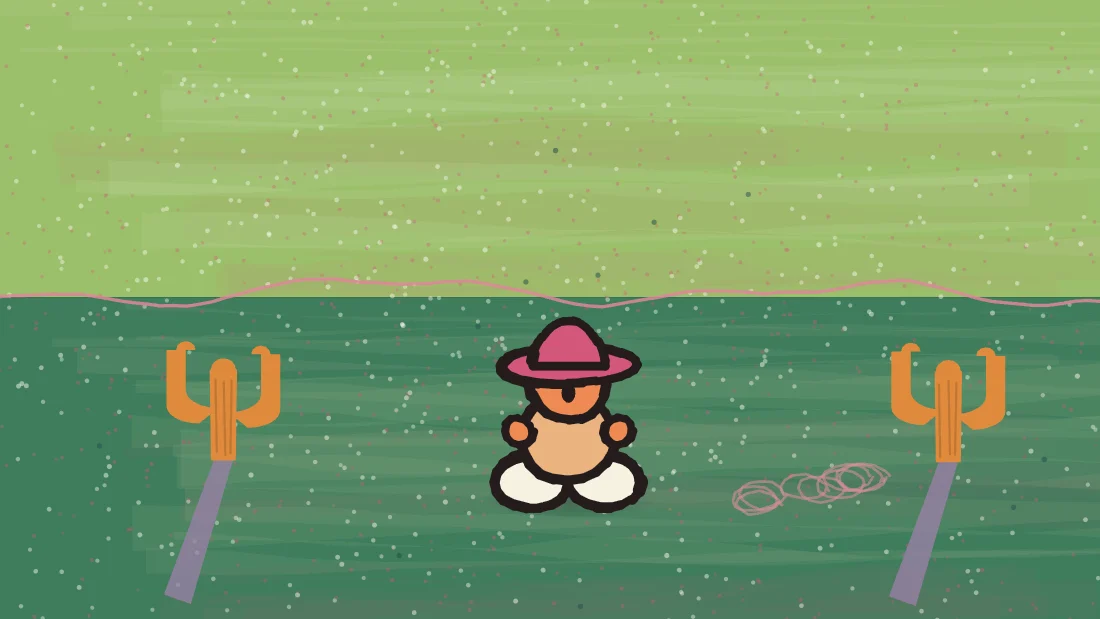 Series 63
Five Colours And A White Line
The actual look, finally. Flat saturated fields, no value modelling, and the black line ONLY on the subject — plus the white one, the light scribble on top of the colour that furnishes a whole room without modelling a single object in it.
Series 63
Five Colours And A White Line
The actual look, finally. Flat saturated fields, no value modelling, and the black line ONLY on the subject — plus the white one, the light scribble on top of the colour that furnishes a whole room without modelling a single object in it.
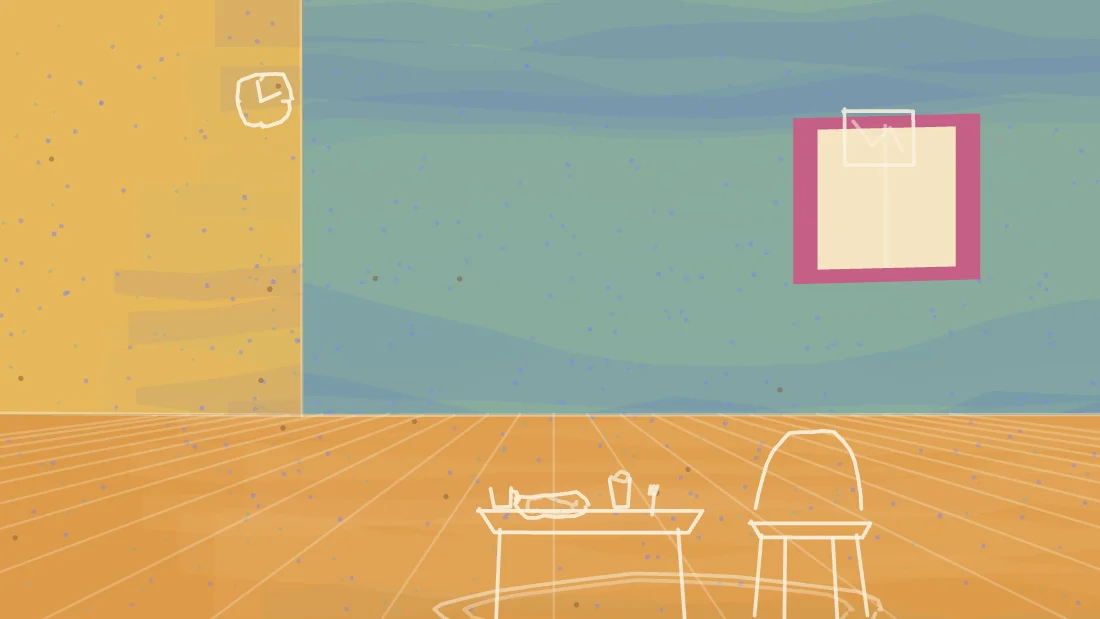 Series 64
Everything In It Drawn In White
A room is three flat fields and two hard edges. Everything standing in it is a ghost — thin light scribbles with nothing filled behind them — and the only saturated shape in the plate is the window.
Series 64
Everything In It Drawn In White
A room is three flat fields and two hard edges. Everything standing in it is a ghost — thin light scribbles with nothing filled behind them — and the only saturated shape in the plate is the window.
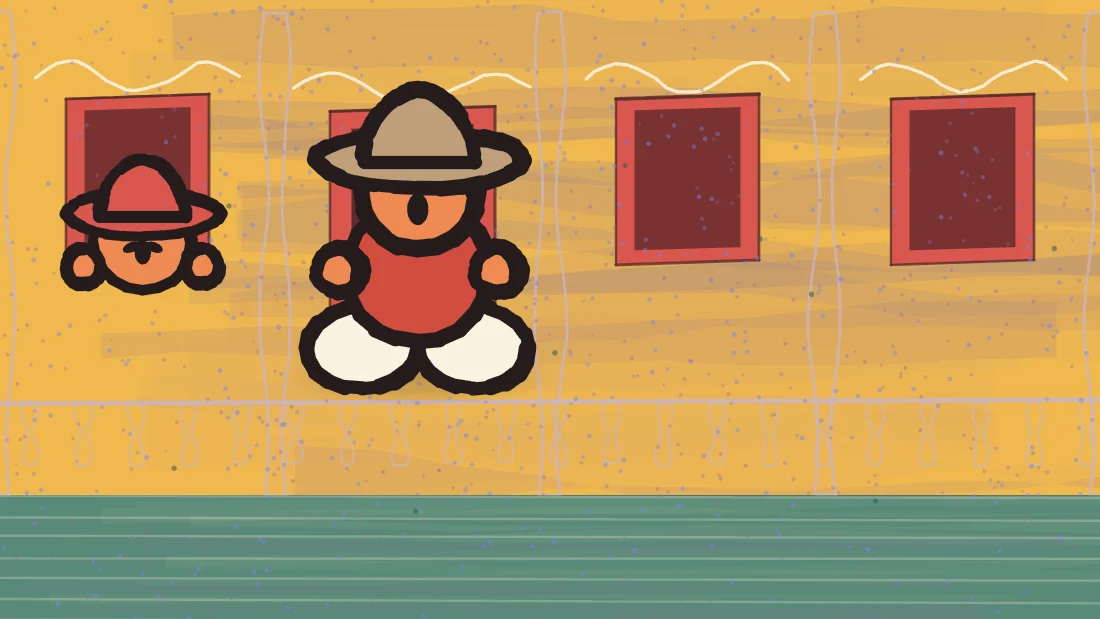 Series 65
Somebody At Every Window
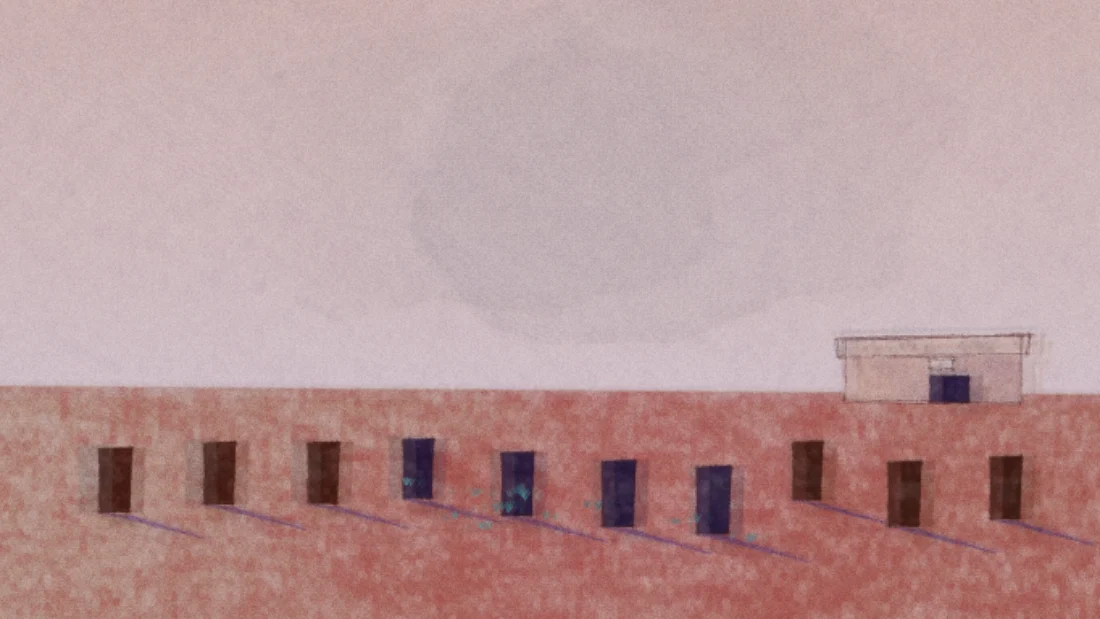
A building filling the whole frame, flat and pink, with a head in every opening. Nobody is doing anything. The picture is the arrangement of their hats.
Series 65
Somebody At Every Window
A building filling the whole frame, flat and pink, with a head in every opening. Nobody is doing anything. The picture is the arrangement of their hats.
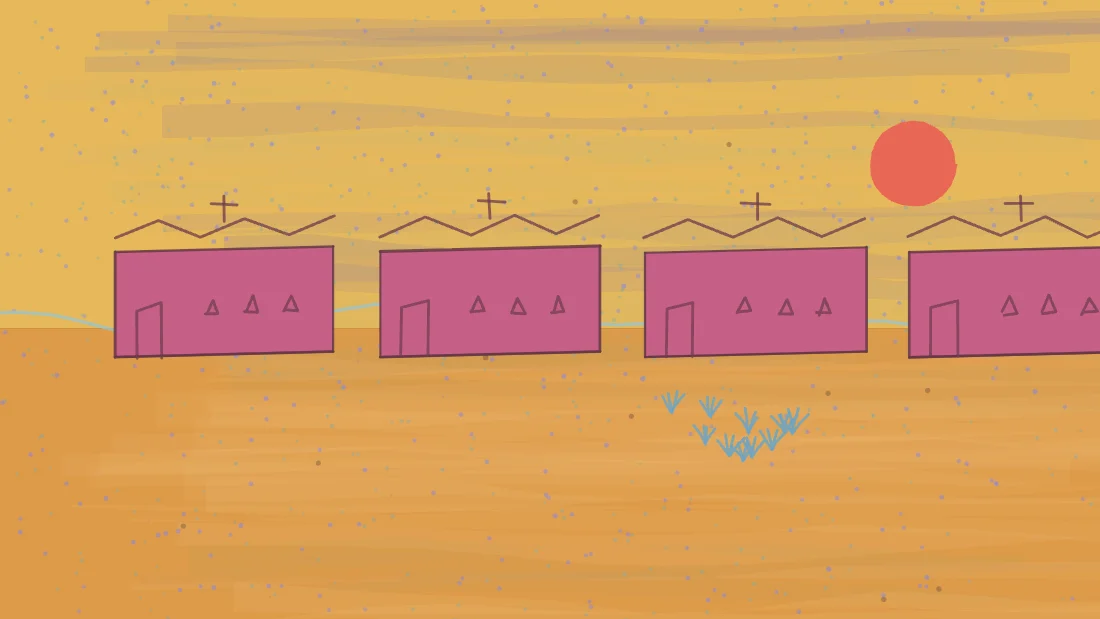 Series 66
How Little It Takes
Two flat fields, a squiggle for the hills, a disc for the sun, and one small thing with a line on it. The cactus shadow is blue and lies flat like cut paper, which no lighting model would ever produce.
Series 66
How Little It Takes
Two flat fields, a squiggle for the hills, a disc for the sun, and one small thing with a line on it. The cactus shadow is blue and lies flat like cut paper, which no lighting model would ever produce.
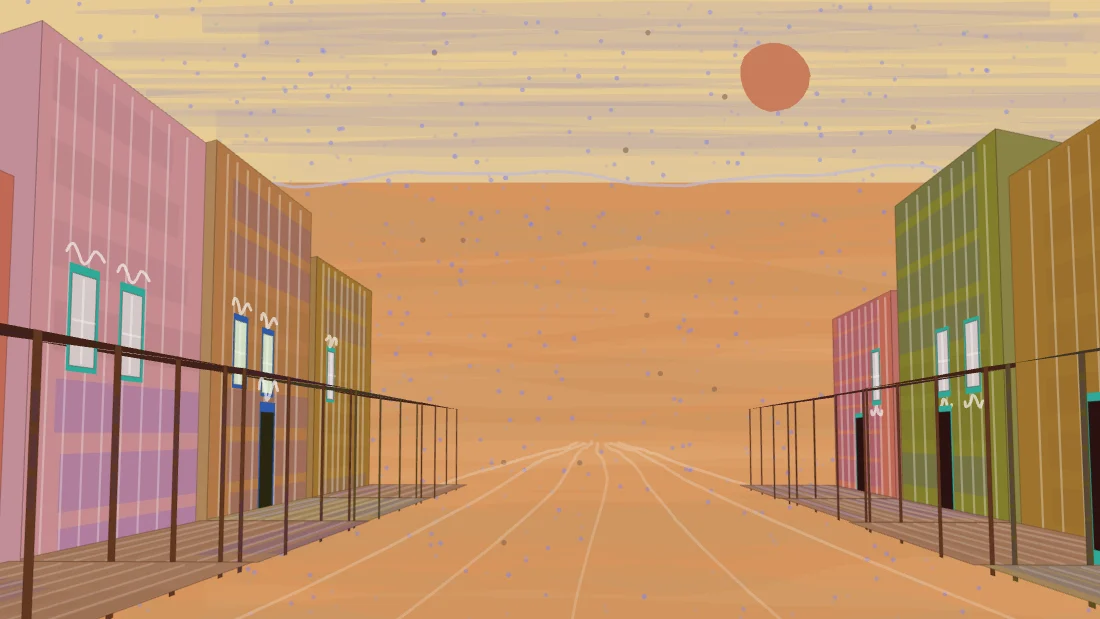 Series 67
A Place You Could Walk Down
A town in feet you can walk down, and no assets at all — no meshes, no textures, no image files, only arithmetic. Every mark is laid out in its wall’s own coordinates, so when the camera moves the paint stays on the building.
Series 67
A Place You Could Walk Down
A town in feet you can walk down, and no assets at all — no meshes, no textures, no image files, only arithmetic. Every mark is laid out in its wall’s own coordinates, so when the camera moves the paint stays on the building.
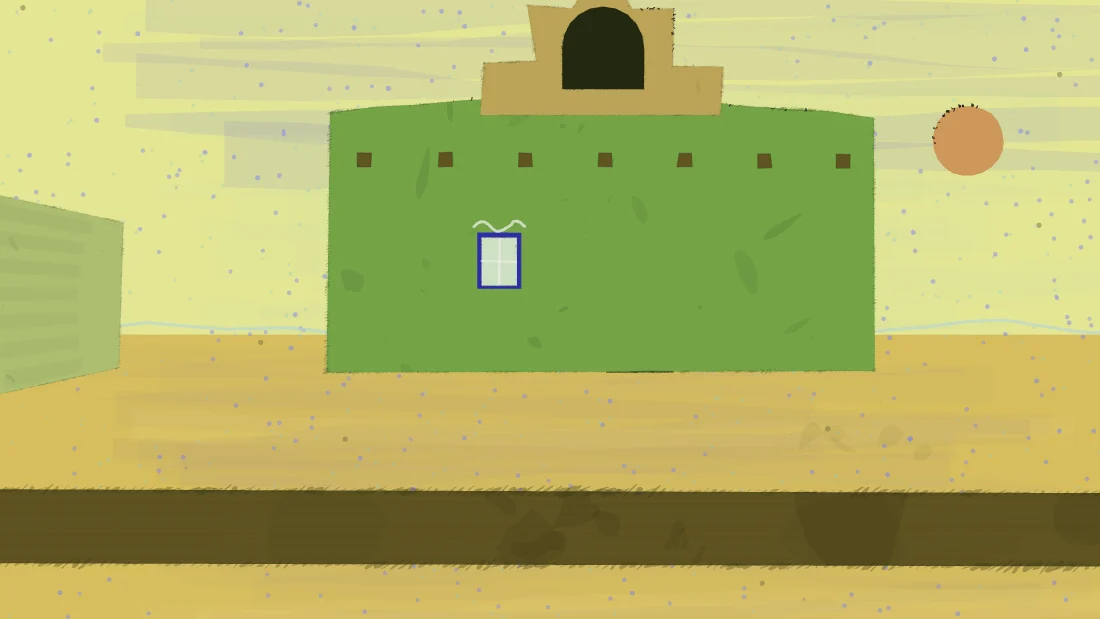 Series 68
Fifty Places, Printed
Ten kinds of place and fifty different ones. And a real false front is SHAPED — stepped, curved, scalloped, standing proud of the gable behind it — with brushes measured off 170,802 real vector paths rather than invented.
Series 68
Fifty Places, Printed
Ten kinds of place and fifty different ones. And a real false front is SHAPED — stepped, curved, scalloped, standing proud of the gable behind it — with brushes measured off 170,802 real vector paths rather than invented.
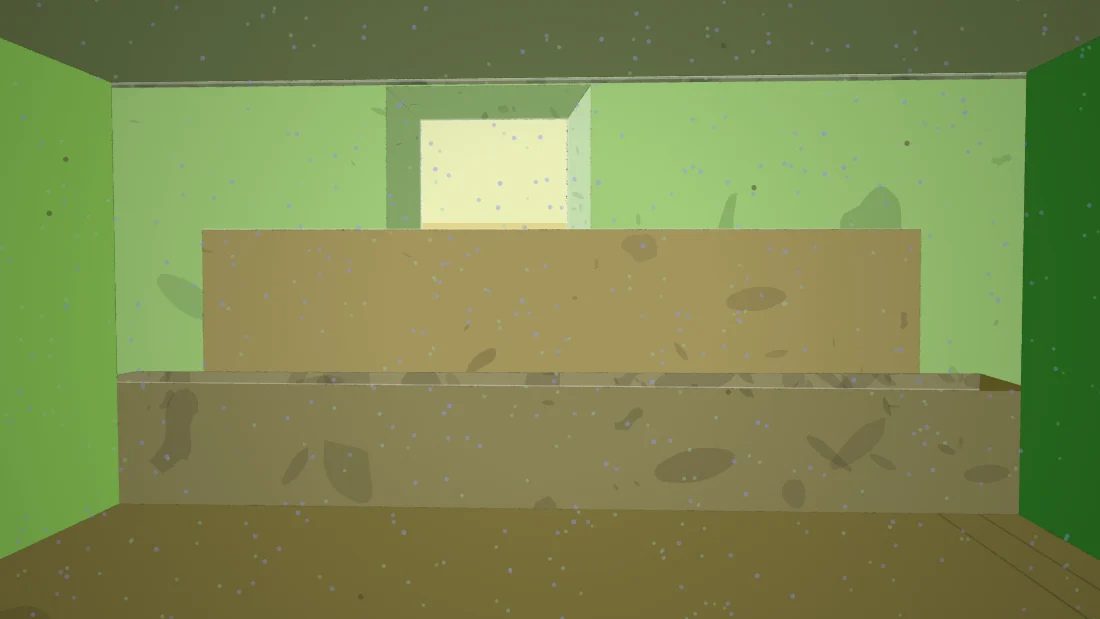 Series 69
Inside The Same Buildings
The same buildings from six feet further in, in the same feet and inches and the same camera as the street. Six earlier interior series each had their own. The window is a hole with thickness, and it is the only reason anything is visible.
Series 69
Inside The Same Buildings
The same buildings from six feet further in, in the same feet and inches and the same camera as the street. Six earlier interior series each had their own. The window is a hole with thickness, and it is the only reason anything is visible.
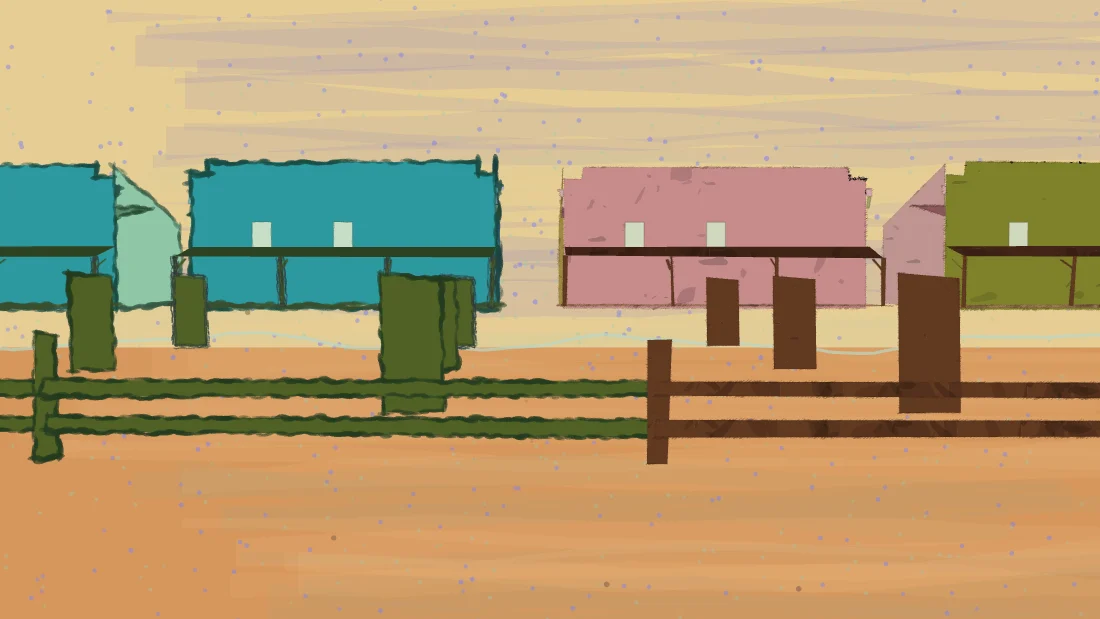 Series 70
Quarters
Not all of a world has to look the same. The ground is divided into quarters and each is painted in a different treatment, so the street runs out of one hand and into the next without one thing about the geometry changing.
Series 70
Quarters
Not all of a world has to look the same. The ground is divided into quarters and each is painted in a different treatment, so the street runs out of one hand and into the next without one thing about the geometry changing.
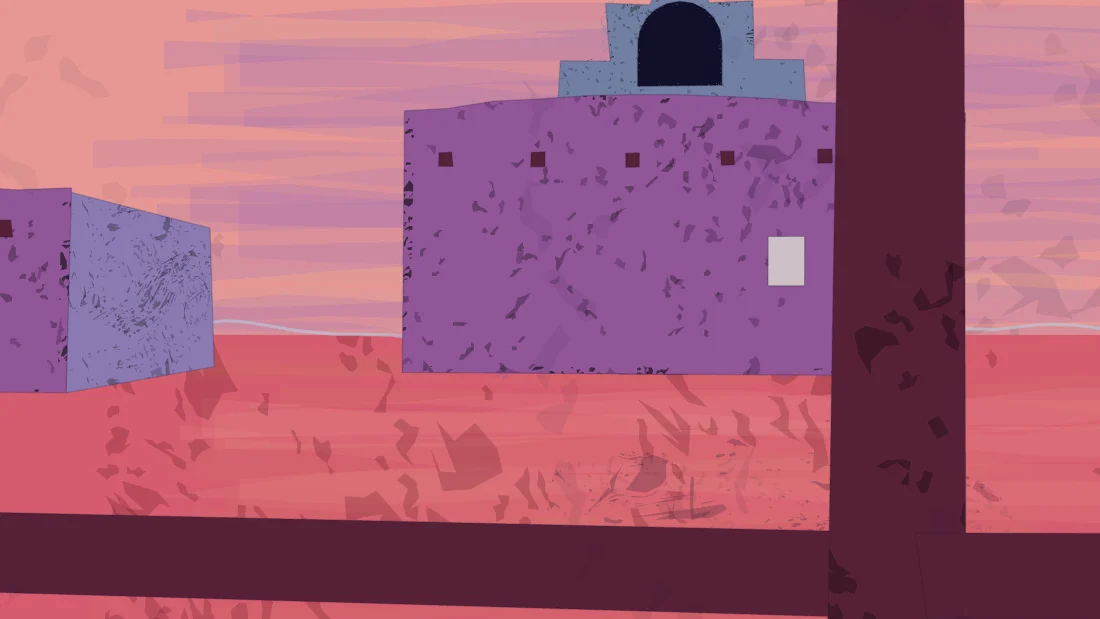 Series 71
Printed With The Real Thing
Textured with the real vector geometry rather than with marks generated to match its statistics. Scattering a library reproduces the statistics of a texture; lifting a patch reproduces the texture.
Series 71
Printed With The Real Thing
Textured with the real vector geometry rather than with marks generated to match its statistics. Scattering a library reproduces the statistics of a texture; lifting a patch reproduces the texture.
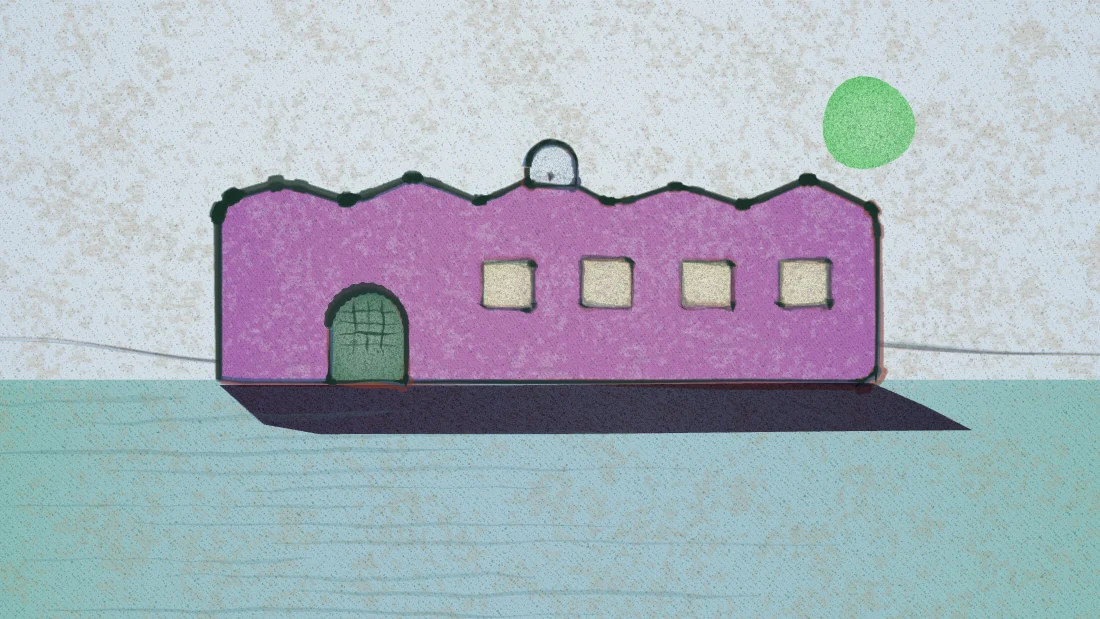 Series 72
Every System At Once
Everything the seventy-one before it learned, at the same time. The paper at the bottom, a fill that fails to cover it, the line as a material inside a clip, three impressions out of register — and a room that is five leaning quads with no right angle anywhere in it.
Series 72
Every System At Once
Everything the seventy-one before it learned, at the same time. The paper at the bottom, a fill that fails to cover it, the line as a material inside a clip, three impressions out of register — and a room that is five leaning quads with no right angle anywhere in it.
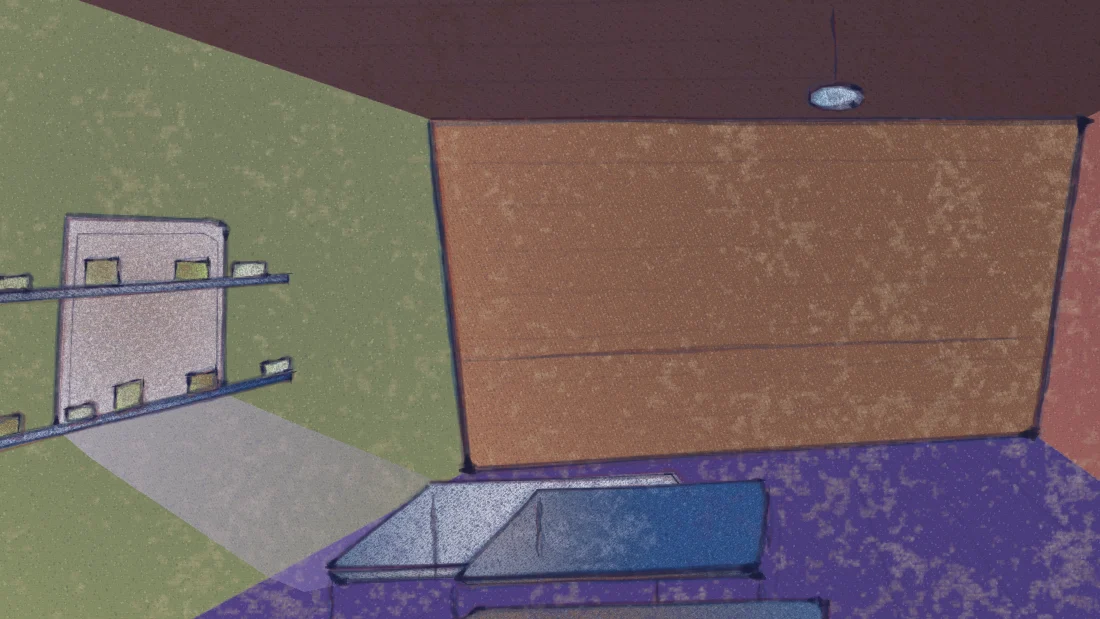 Series 73
Twelve Rooms From Somewhere Else
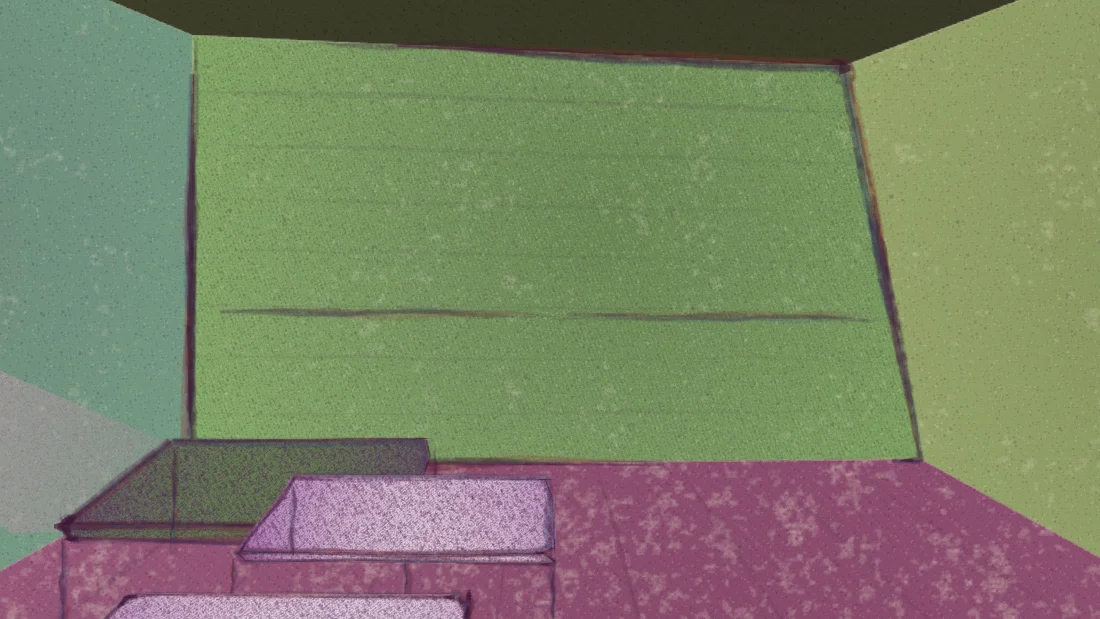
What changes between plates is not the furniture but where the painter was standing. Two rooms of identical construction seen from two stations are two pictures.
Series 73
Twelve Rooms From Somewhere Else
What changes between plates is not the furniture but where the painter was standing. Two rooms of identical construction seen from two stations are two pictures.
 Series 74
Twelve Fronts, Twelve Stations
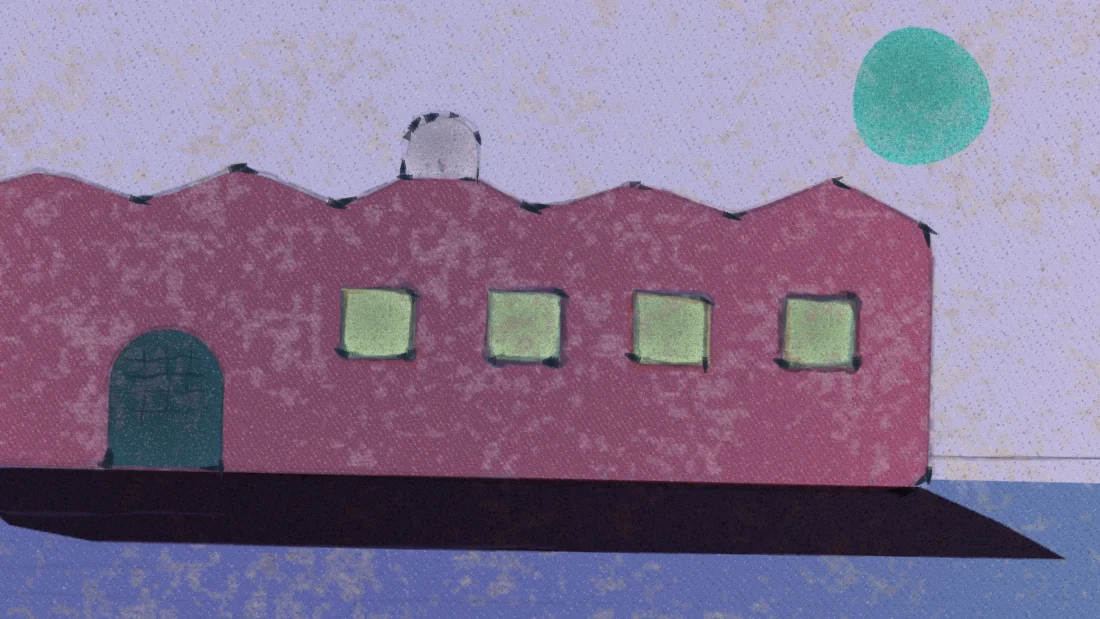
The same argument outdoors: the building is not the subject, the VIEW of it is. Close under a water tank, oblique across a yard, or far back with most of the sheet given to nothing at all.
Series 74
Twelve Fronts, Twelve Stations
The same argument outdoors: the building is not the subject, the VIEW of it is. Close under a water tank, oblique across a yard, or far back with most of the sheet given to nothing at all.
 Series 75
The Contour Is An Argument
No hand has ever drawn a contour once, all the way round. There are four or five overlapping attempts, and where they disagree is the whole difference between an edge somebody searched for and one that was specified.
Series 75
The Contour Is An Argument
No hand has ever drawn a contour once, all the way round. There are four or five overlapping attempts, and where they disagree is the whole difference between an edge somebody searched for and one that was specified.
 Series 76
Searching For The Building
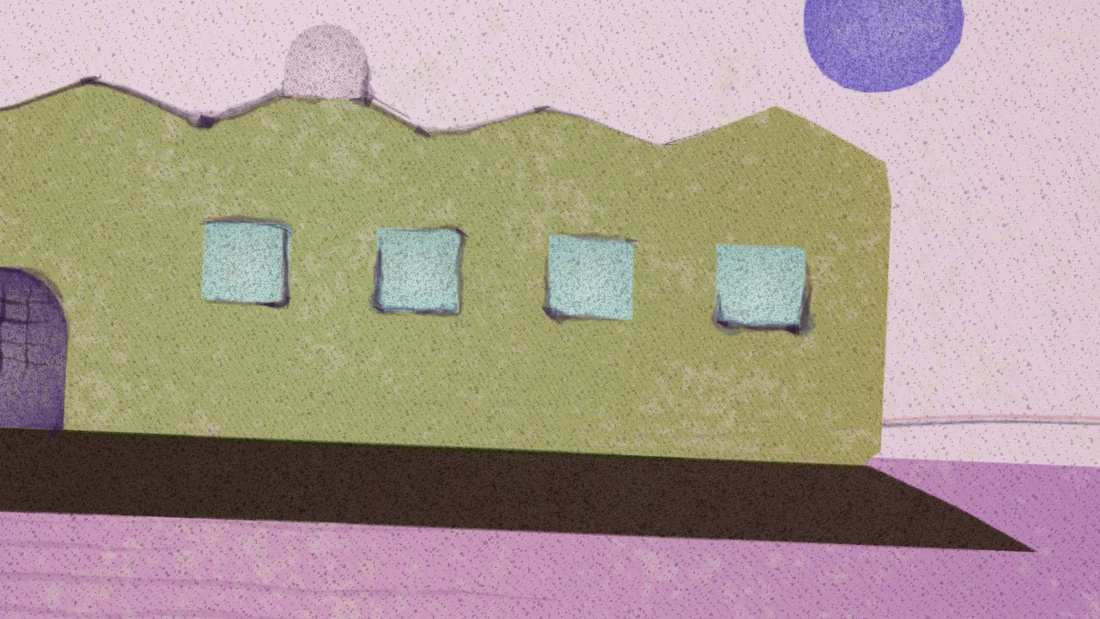
The searched contour on a building, where it tells most at the roofline and the corners of a false front. Only the first pass carries the three stones — three misregistered impressions of five overlapping passes is mud.
Series 76
Searching For The Building
The searched contour on a building, where it tells most at the roofline and the corners of a false front. Only the first pass carries the three stones — three misregistered impressions of five overlapping passes is mud.
 Series 77
The Paint Does Not Move
Measured off the film instead of guessed. Two consecutive frames differ by 19 per cent of their pixels, almost none of it by much, and the difference is flat corner to corner. That is grain: nothing in the painting was redrawn.
Series 77
The Paint Does Not Move
Measured off the film instead of guessed. Two consecutive frames differ by 19 per cent of their pixels, almost none of it by much, and the difference is flat corner to corner. That is grain: nothing in the painting was redrawn.
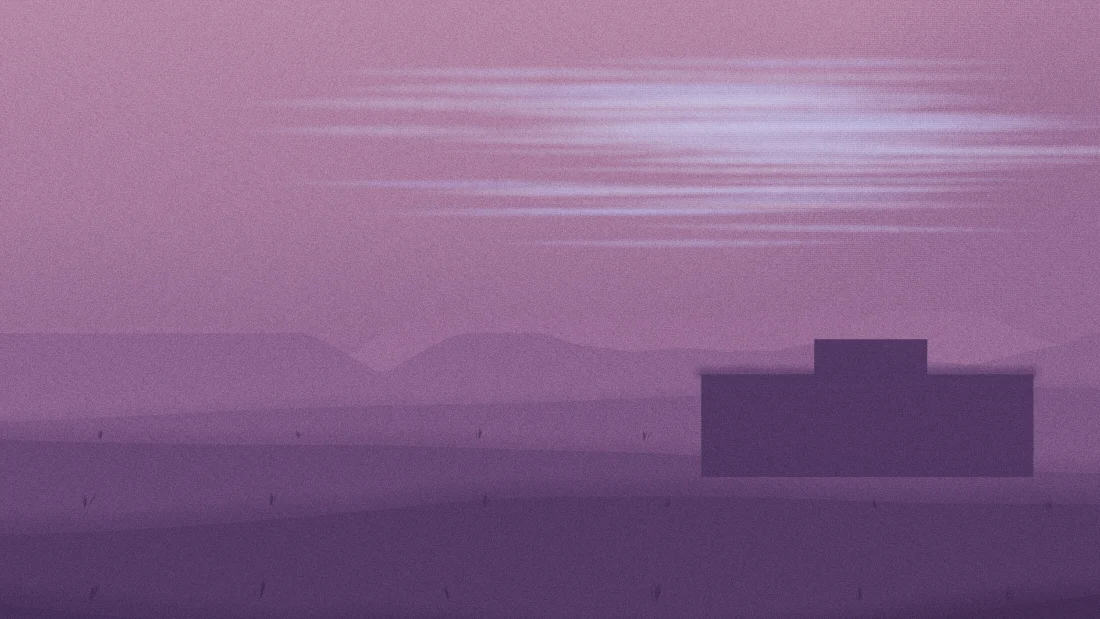 Series 78
The Sky Is All Strokes
The background has no line in it. Not a thin one — none. The mark is a tapered soft stroke that comes to nothing at both ends, and the depth is atmospheric fade.
Series 78
The Sky Is All Strokes
The background has no line in it. Not a thin one — none. The mark is a tapered soft stroke that comes to nothing at both ends, and the depth is atmospheric fade.
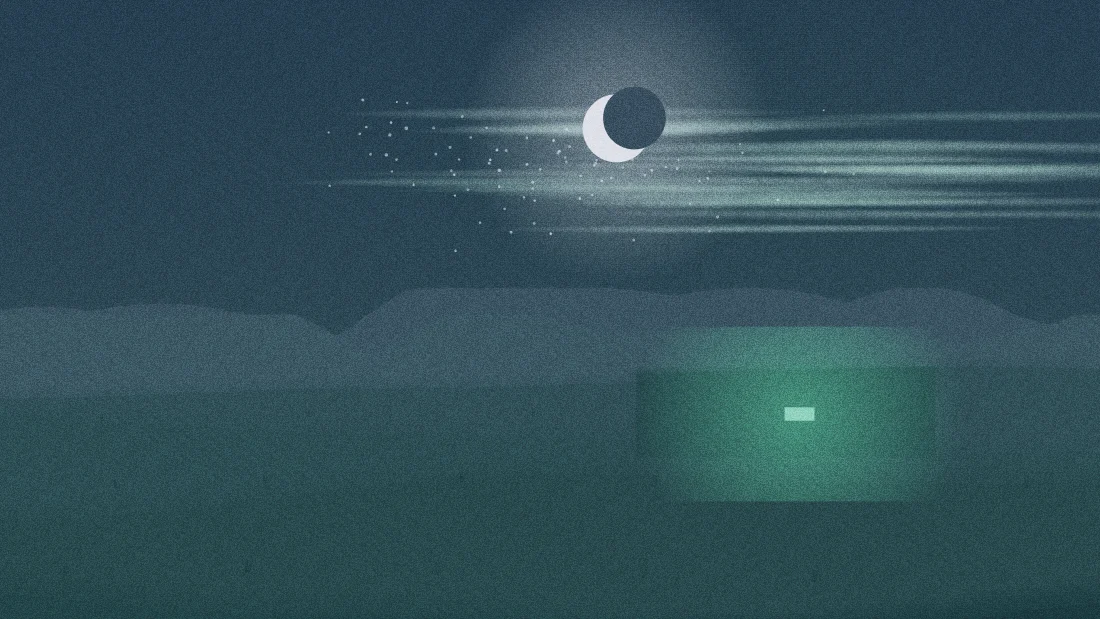 Series 79
Night, And What It Takes
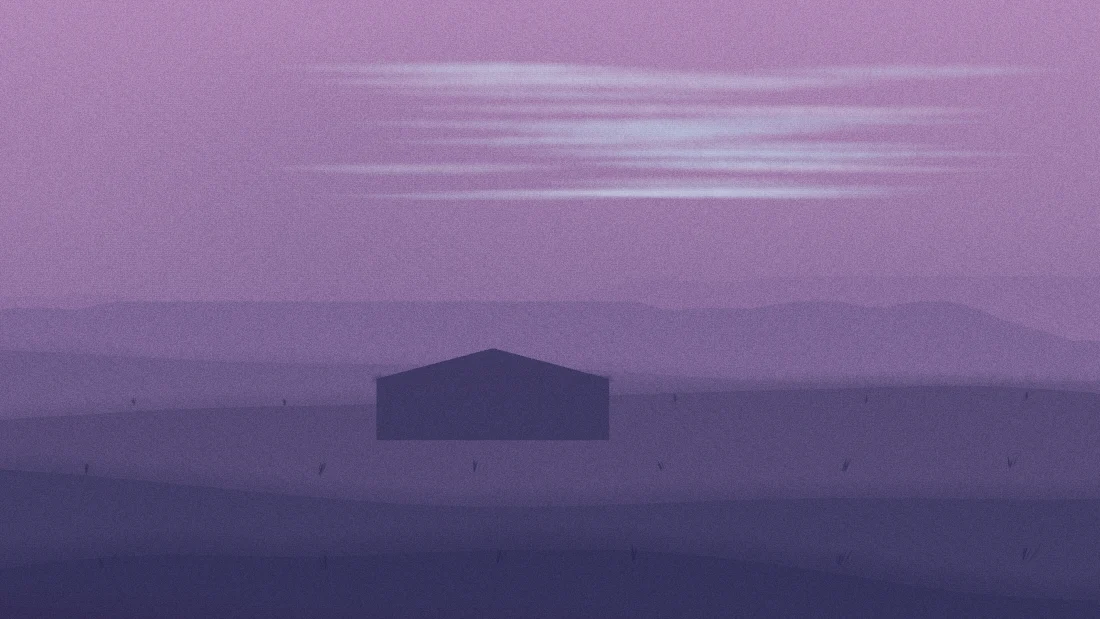
Night takes four things: a moon with a real glow, three receding bands of silhouette that fade toward the SKY rather than toward black, a near dune almost at ink, and one warm lit window miles off.
Series 79
Night, And What It Takes
Night takes four things: a moon with a real glow, three receding bands of silhouette that fade toward the SKY rather than toward black, a near dune almost at ink, and one warm lit window miles off.
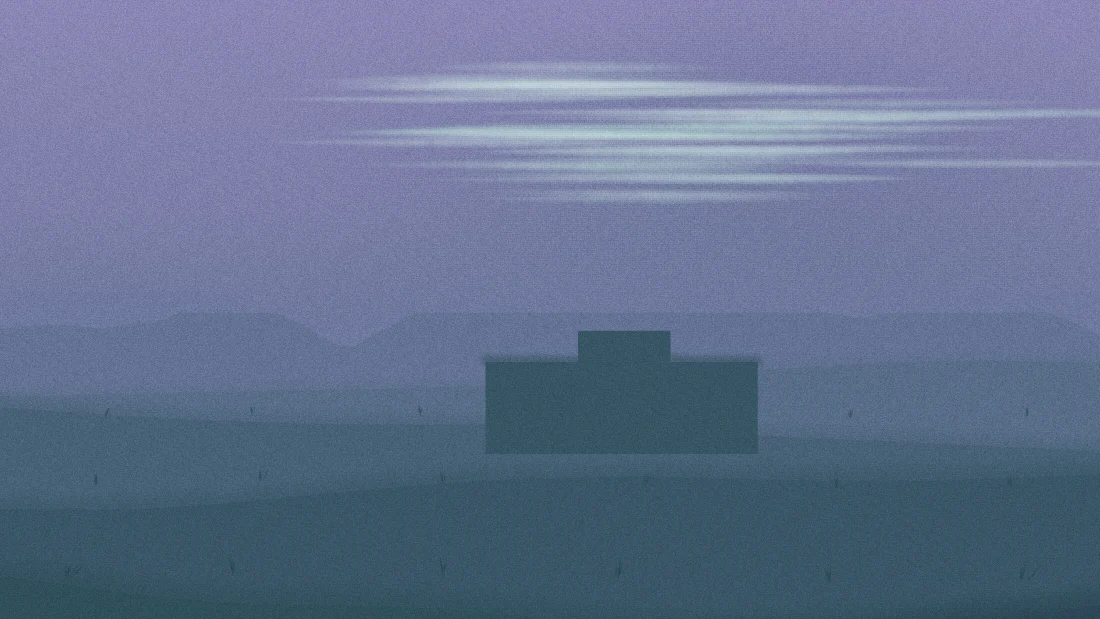 Series 80
Six Planes Deep
The multiplane camera, which is what the second button was always for. Every layer is authored at its own depth and travels at its own rate — no geometry, and it has to work before anybody can walk around inside one.
Series 80
Six Planes Deep
The multiplane camera, which is what the second button was always for. Every layer is authored at its own depth and travels at its own rate — no geometry, and it has to work before anybody can walk around inside one.
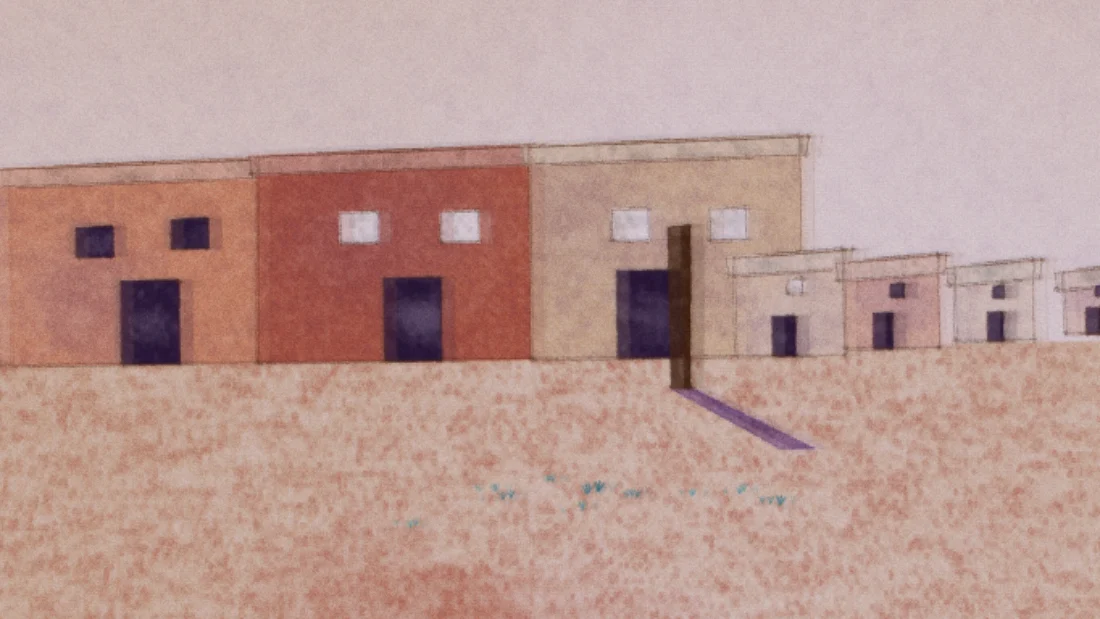 Series 81
From Above, And Warm
Four series measured the held paint correctly and made soft grey gradients out of it. The touch is a stick rather than a pen — pressure at the corners, an overrun at the end, two passes out of register — and the view is from above, so the ground has something to do.
Series 81
From Above, And Warm
Four series measured the held paint correctly and made soft grey gradients out of it. The touch is a stick rather than a pen — pressure at the corners, an overrun at the end, two passes out of register — and the view is from above, so the ground has something to do.
 Series 82
Only The Fringing Moves
The boil, isolated. Two passes about a pixel apart, warm and cool, and the distance between them is the only thing that changes from cel to cel. Nothing is redrawn.
Series 82
Only The Fringing Moves
The boil, isolated. Two passes about a pixel apart, warm and cool, and the distance between them is the only thing that changes from cel to cel. Nothing is redrawn.
 Series 83
The Edge Is A Scatter
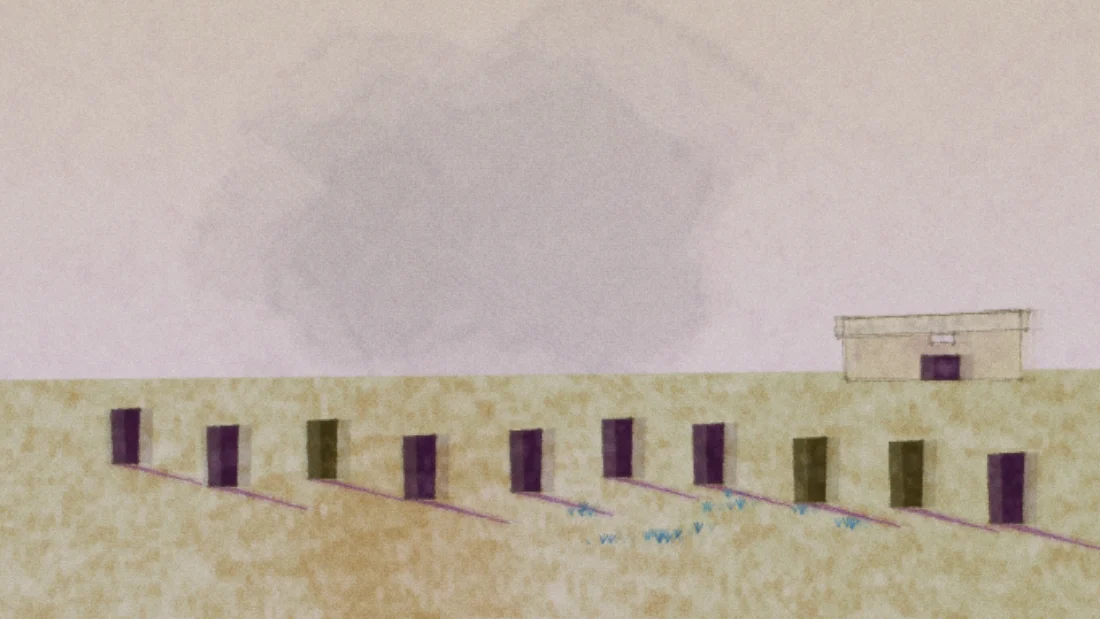
The edge, isolated. A flat colour meeting another along an exact boundary is a vector illustration; in the film it is a scatter — dense at the line, thinning outward, and neither colour owns it.
Series 83
The Edge Is A Scatter
The edge, isolated. A flat colour meeting another along an exact boundary is a vector illustration; in the film it is a scatter — dense at the line, thinning outward, and neither colour owns it.
 Series 84
Drawn With A Stick
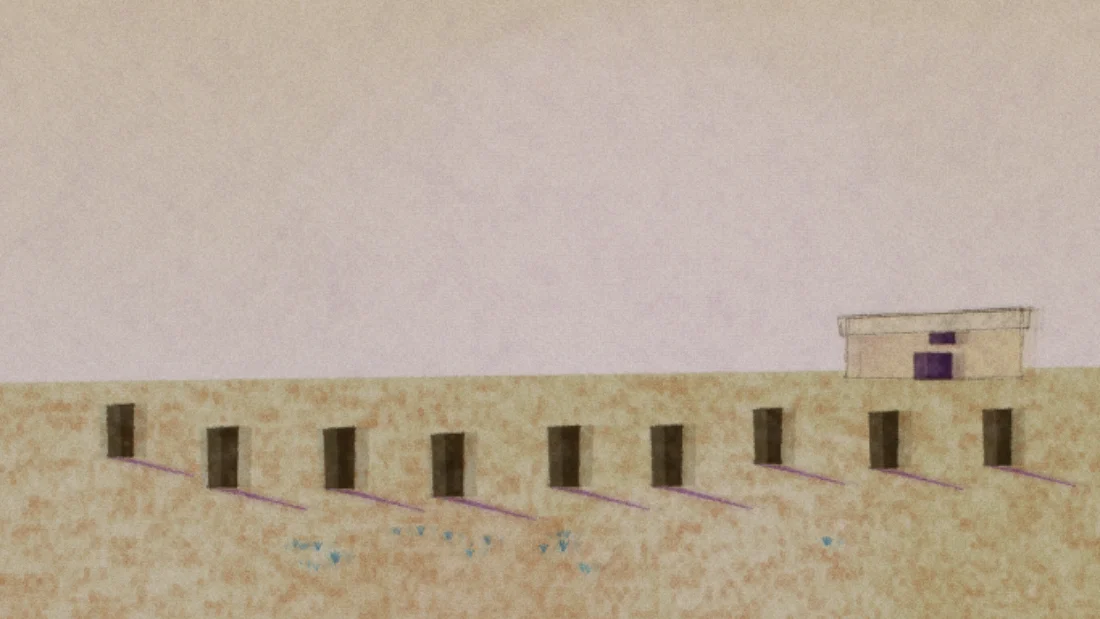
The line, isolated, and it is a coloured pencil rather than a pen: never black, always a much darker version of what it bounds. It skips, it presses where the hand slows at a corner, and it overruns past the form and comes back.
Series 84
Drawn With A Stick
The line, isolated, and it is a coloured pencil rather than a pen: never black, always a much darker version of what it bounds. It skips, it presses where the hand slows at a corner, and it overruns past the form and comes back.
 Series 85
Cactus Country
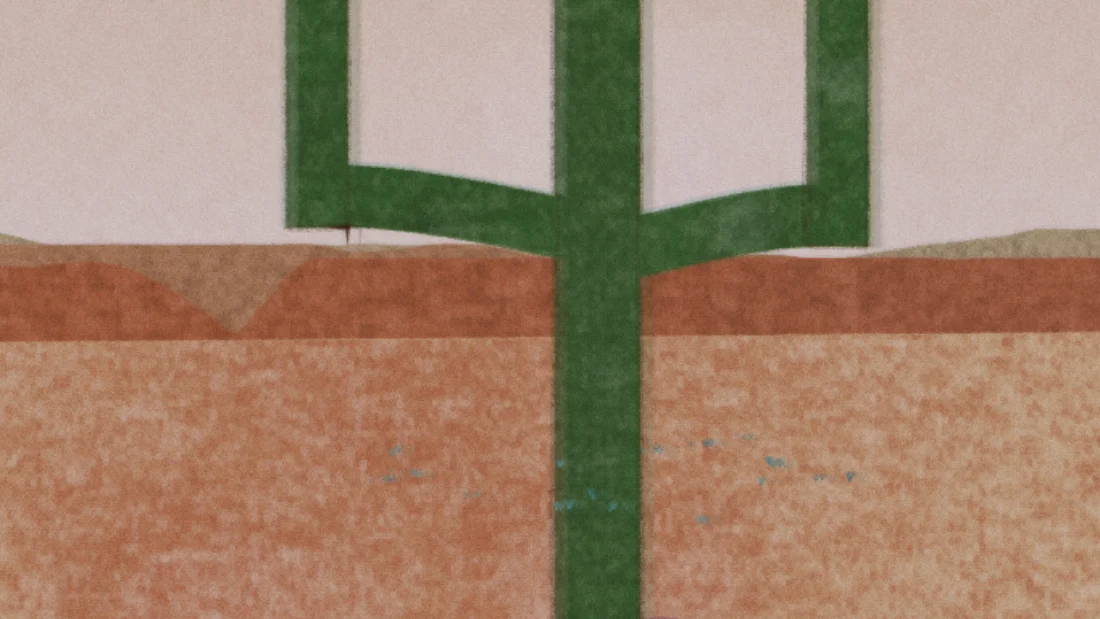
Cactus country, where there is no architecture to hang the darks on. And the forms are built rather than scattered — a saguaro has a trunk, arms that leave it at a height, and fluting. Drawing it as a blob is what makes generated desert look like clip art.
Series 85
Cactus Country
Cactus country, where there is no architecture to hang the darks on. And the forms are built rather than scattered — a saguaro has a trunk, arms that leave it at a height, and fluting. Drawing it as a blob is what makes generated desert look like clip art.
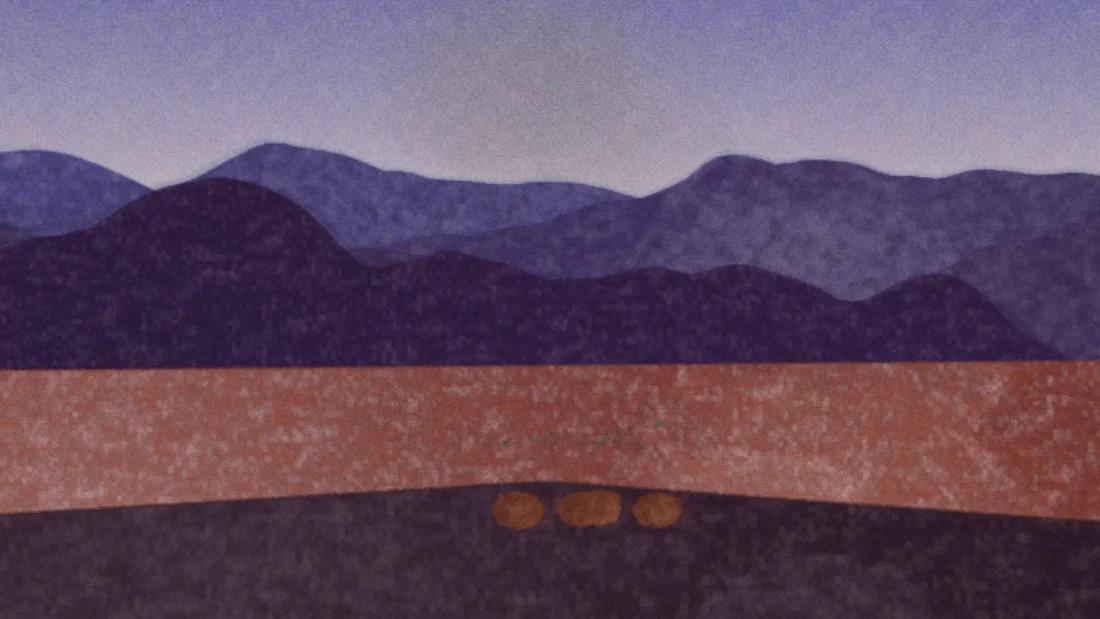 Series 86
The Summit
Up high, where the value structure is the whole picture. The air goes cold and the distance goes blue — the one place this project leaves the warm band — and the far ranges fade toward the AIR, never toward black.
Series 86
The Summit
Up high, where the value structure is the whole picture. The air goes cold and the distance goes blue — the one place this project leaves the warm band — and the far ranges fade toward the AIR, never toward black.
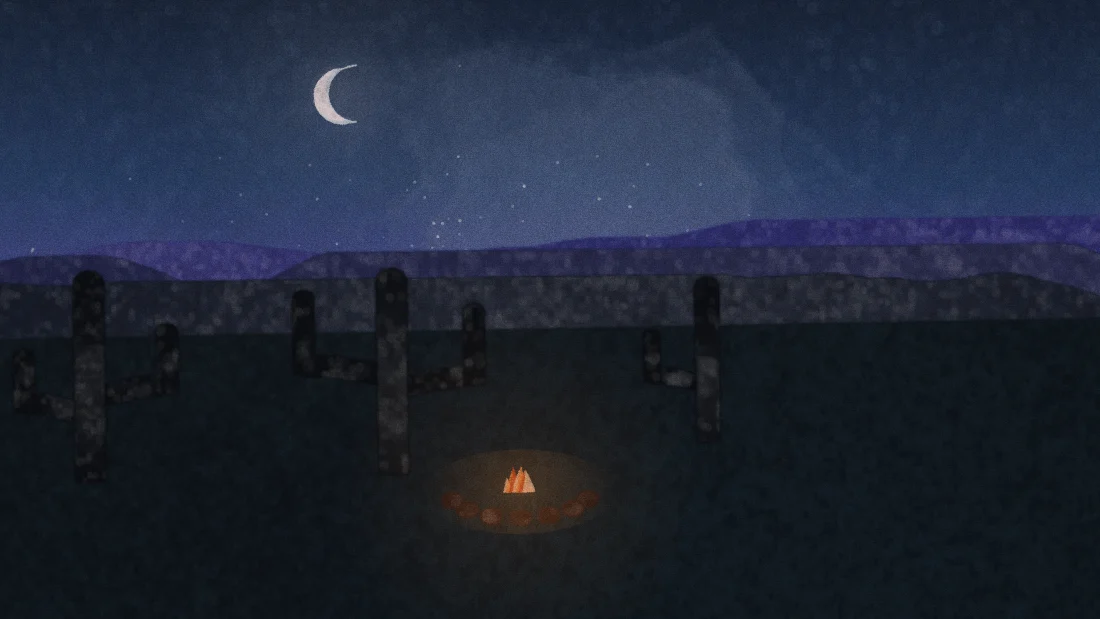 Series 87
The Paint Holds, The Light Does Not
The first series that properly animates, and everything moving in it is a LIGHT or a rotation rather than a redrawn mark. The sky turns, the fire breathes, lightning relights the country in four stages, and the paint underneath never moves.
Series 87
The Paint Holds, The Light Does Not
The first series that properly animates, and everything moving in it is a LIGHT or a rotation rather than a redrawn mark. The sky turns, the fire breathes, lightning relights the country in four stages, and the paint underneath never moves.
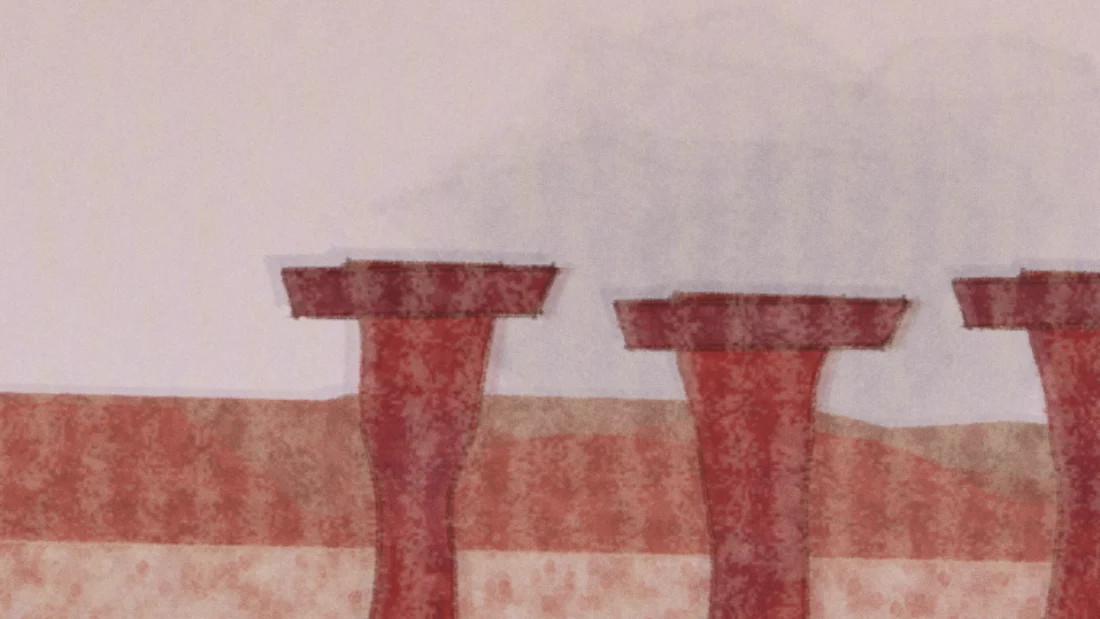 Series 88
On A Sheet
The sheet is the point. The paper is painted first, at the bottom; the picture goes on a transparent layer above it; the tooth is taken back OUT, and what shows through the holes is the sheet. Grain on top darkens the pits — this lightens them.
Series 88
On A Sheet
The sheet is the point. The paper is painted first, at the bottom; the picture goes on a transparent layer above it; the tooth is taken back OUT, and what shows through the holes is the sheet. Grain on top darkens the pits — this lightens them.
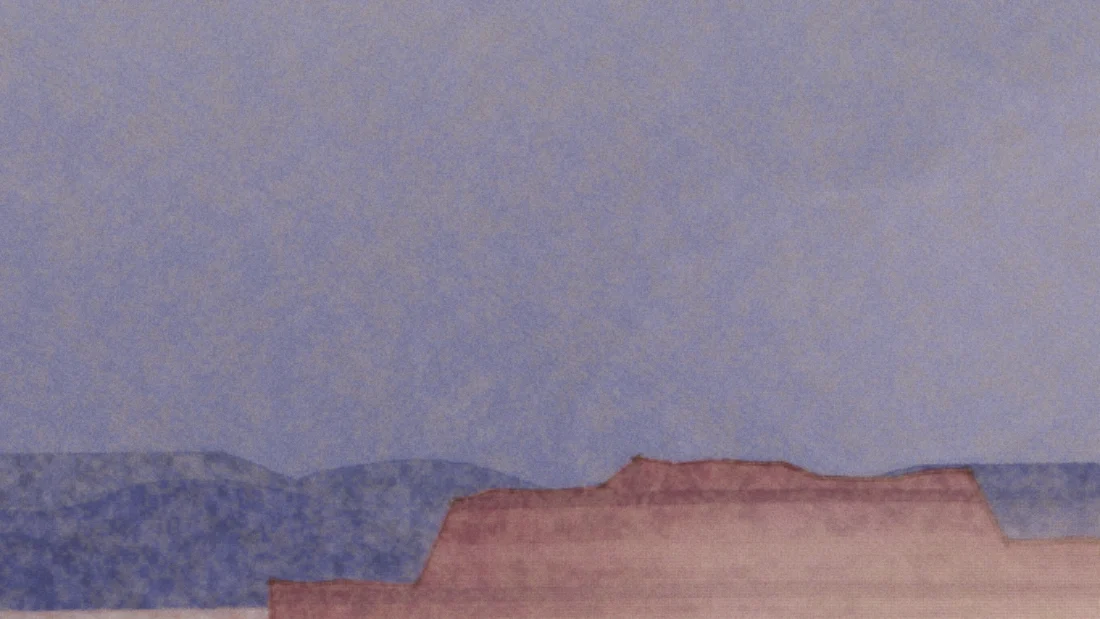 Series 89
Weather Moves In World Space
Weather moves in WORLD space. Rain does not drift across the screen, it falls through the country: four depths of it, near bands sweeping past while far ones barely move, and a wall standing in front of one and not the other.
Series 89
Weather Moves In World Space
Weather moves in WORLD space. Rain does not drift across the screen, it falls through the country: four depths of it, near bands sweeping past while far ones barely move, and a wall standing in front of one and not the other.
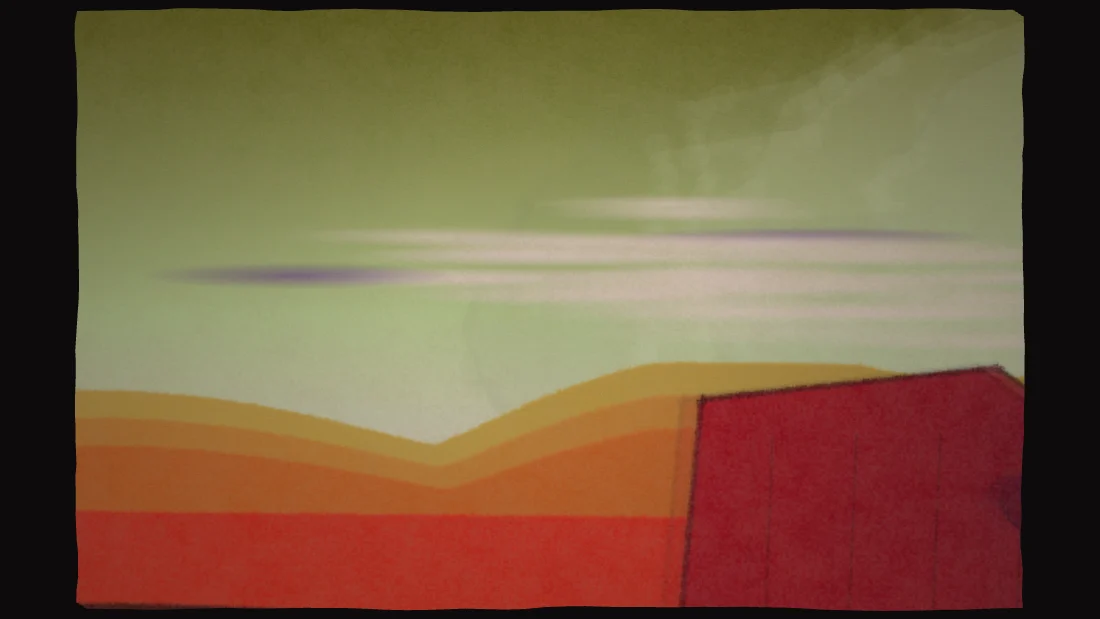 Series 90
Ten Scenes, One Look
The first series whose LOOK IS DATA. The painter knows how to build a ford and a fallen barn; it does not know what colour anything is or how hard the paper bites. And the look is tuned to a measured standard — ten frames off the films, which corrected me on three counts.
Series 90
Ten Scenes, One Look
The first series whose LOOK IS DATA. The painter knows how to build a ford and a fallen barn; it does not know what colour anything is or how hard the paper bites. And the look is tuned to a measured standard — ten frames off the films, which corrected me on three counts.
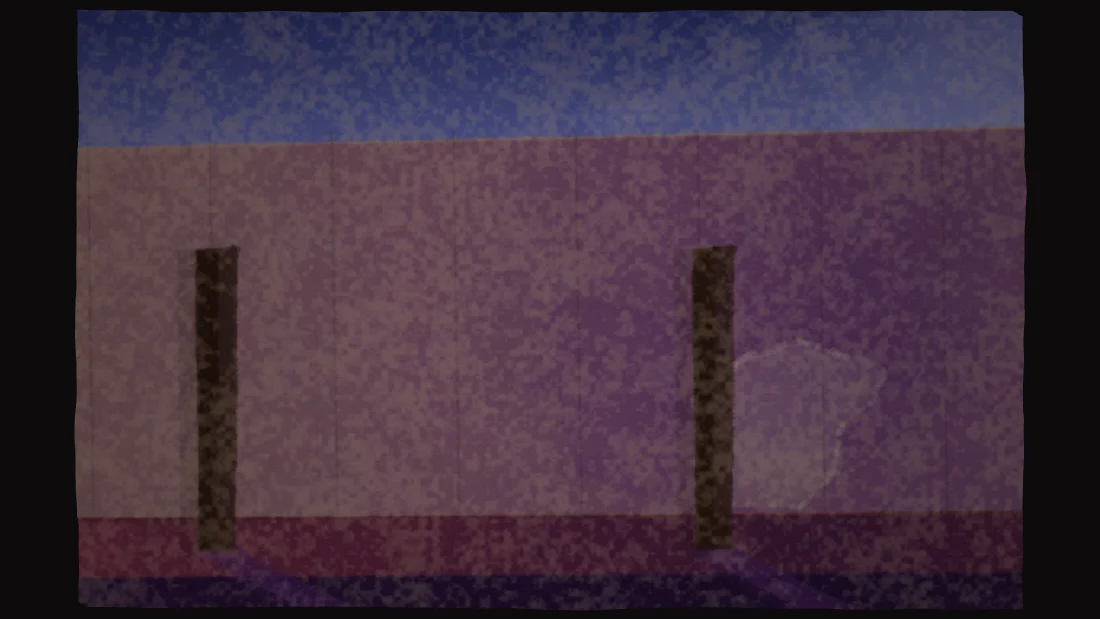 Series 91
The Same Ten, Thin Air
The same ten scenes with not one line of the painter changed — only the look object. If they read as a different set of pictures rather than as Series 90 with the colours nudged, the abstraction is real.
Series 91
The Same Ten, Thin Air
The same ten scenes with not one line of the painter changed — only the look object. If they read as a different set of pictures rather than as Series 90 with the colours nudged, the abstraction is real.
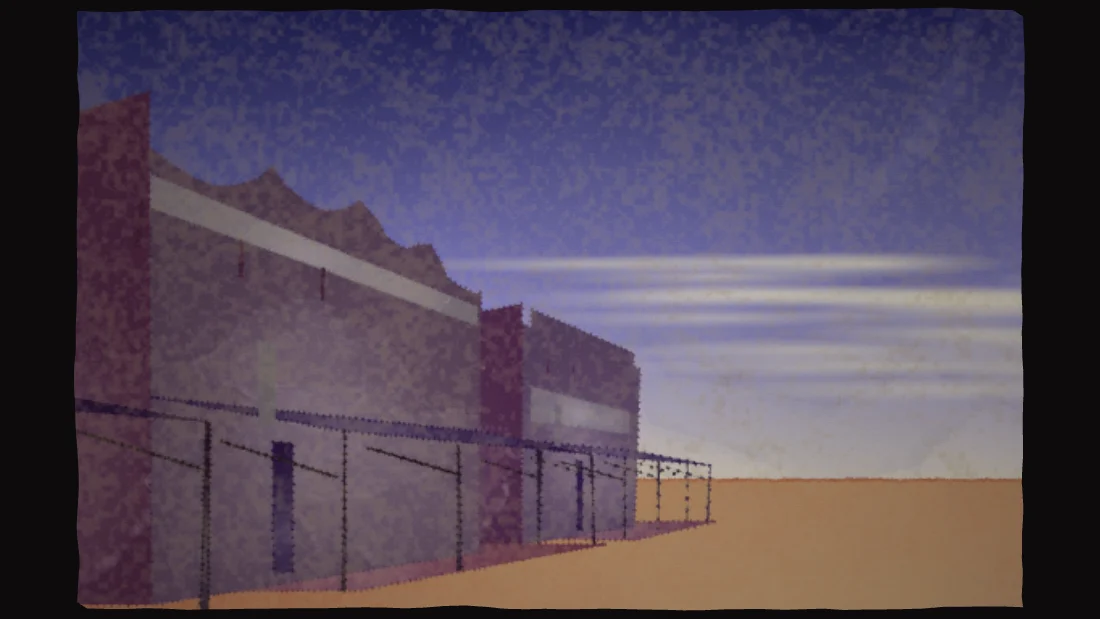 Series 92
Ten Places, Walked
Real three-dimensional places, painted in the look instead of in grit. And the light is a DIRECTION: a face takes its value from its own normal against a sun, not from what the thing is called.
Series 92
Ten Places, Walked
Real three-dimensional places, painted in the look instead of in grit. And the light is a DIRECTION: a face takes its value from its own normal against a sun, not from what the thing is called.
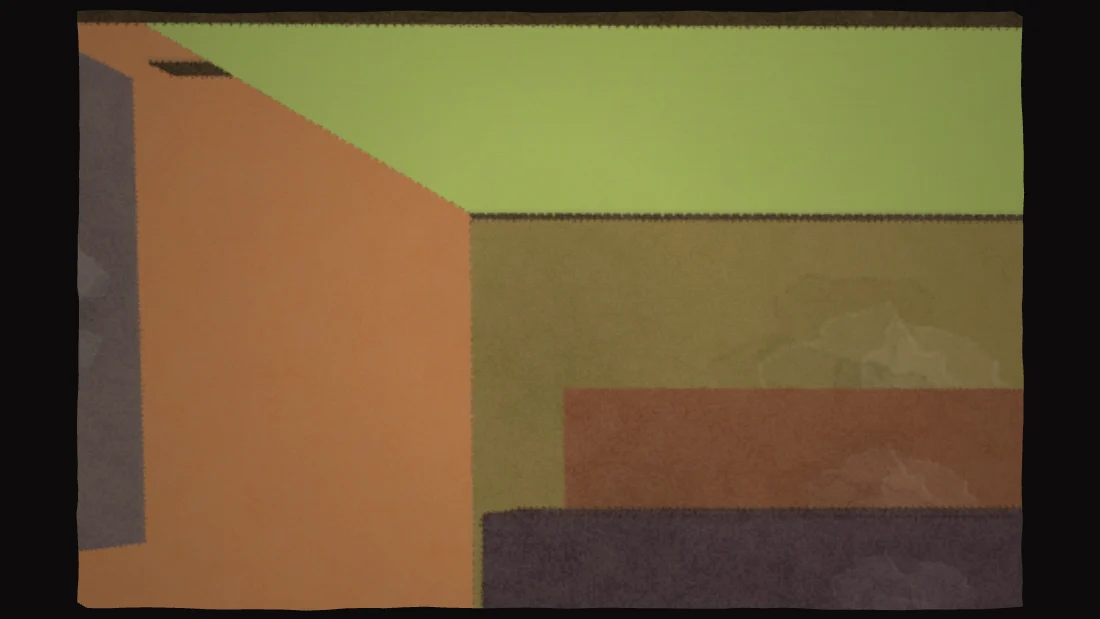 Series 93
Ten Rooms You Could Walk Into
Interiors in the same world and the same units as the town outside, so a doorway is a thing you could walk through. Indoors the backface rule inverts, and there is no sun — the light is the opening, measured in world feet.
Series 93
Ten Rooms You Could Walk Into
Interiors in the same world and the same units as the town outside, so a doorway is a thing you could walk through. Indoors the backface rule inverts, and there is no sun — the light is the opening, measured in world feet.
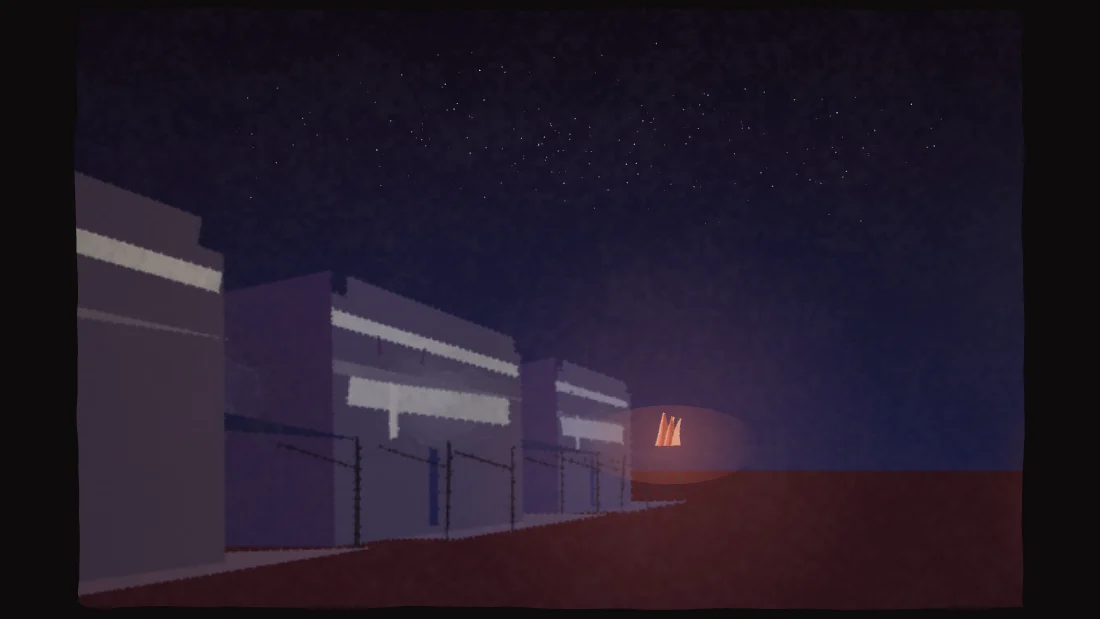 Series 94
The Same Ten, After Dark
The same ten places after dark, and the night palette is the day palette pulled cold rather than a second one written by hand. The moon is the light, and the one warm window in each plate is what makes the blue read cold.
Series 94
The Same Ten, After Dark
The same ten places after dark, and the night palette is the day palette pulled cold rather than a second one written by hand. The moon is the light, and the one warm window in each plate is what makes the blue read cold.
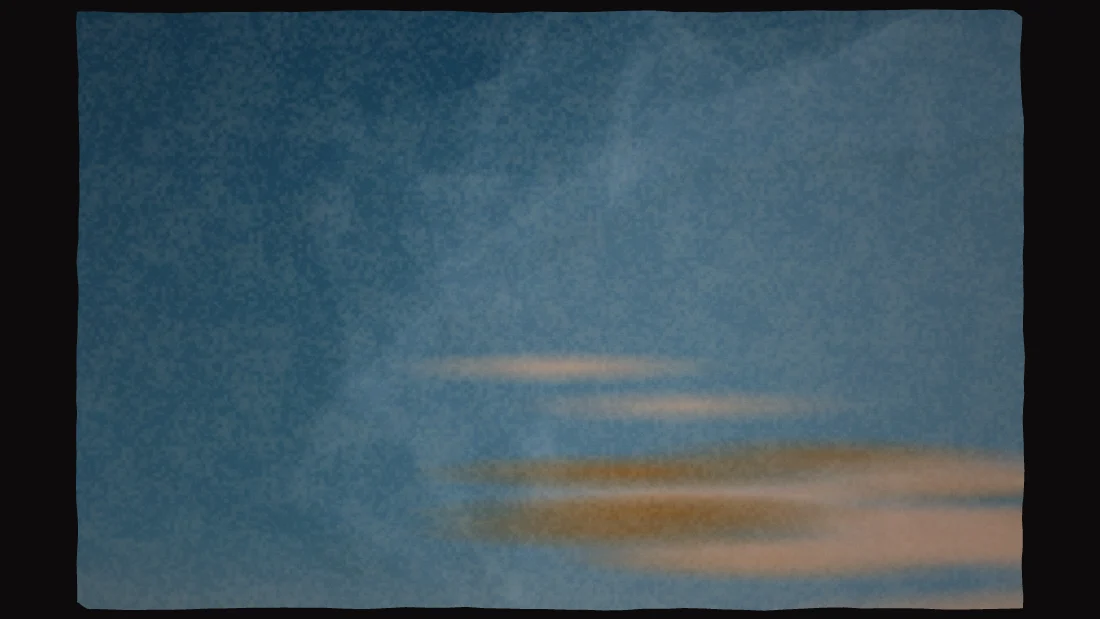 Series 95
The Horizon Goes Down
Ninety-four series put the horizon across the middle of the frame, which halves every picture and leaves the sky with nothing to do but be pale. The films put it in the bottom fifth — in one of them the sky is ninety-two per cent of the picture. So the horizon drops and the sky takes the plate: a dark saturated zenith falling to a hot band at the ground line, with a field of long soft ribbons lying across it.
Series 95
The Horizon Goes Down
Ninety-four series put the horizon across the middle of the frame, which halves every picture and leaves the sky with nothing to do but be pale. The films put it in the bottom fifth — in one of them the sky is ninety-two per cent of the picture. So the horizon drops and the sky takes the plate: a dark saturated zenith falling to a hot band at the ground line, with a field of long soft ribbons lying across it.
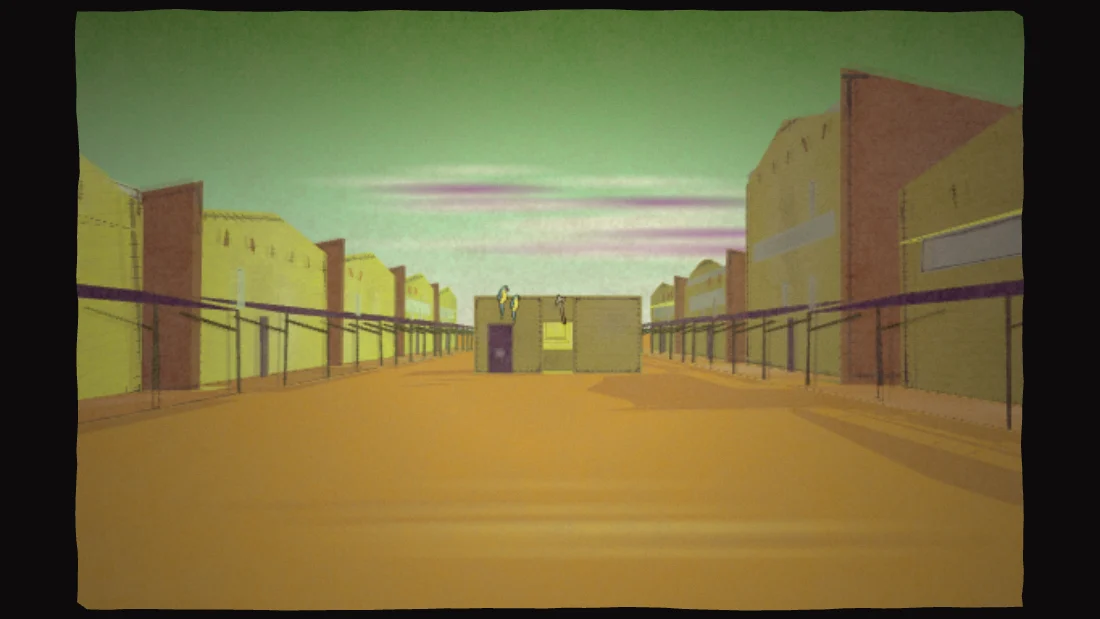 Series 97
Ten Stations In The Walked World
NOT TEN PICTURES OF A PLACE. Ten positions and headings inside the geometry you can drive at westernart96 — same feet, same camera, same faces. Every plate is somewhere you could go and stand, and its notes give the coordinates. And two marks change: the boundary walk is jittered, because a fixed step put every dab on a regular lattice and a five-pixel comb along a silhouette is what jagged looks like; and the contour gets a continuous core, because every line in the reference films runs unbroken.
Series 97
Ten Stations In The Walked World
NOT TEN PICTURES OF A PLACE. Ten positions and headings inside the geometry you can drive at westernart96 — same feet, same camera, same faces. Every plate is somewhere you could go and stand, and its notes give the coordinates. And two marks change: the boundary walk is jittered, because a fixed step put every dab on a regular lattice and a five-pixel comb along a silhouette is what jagged looks like; and the contour gets a continuous core, because every line in the reference films runs unbroken.
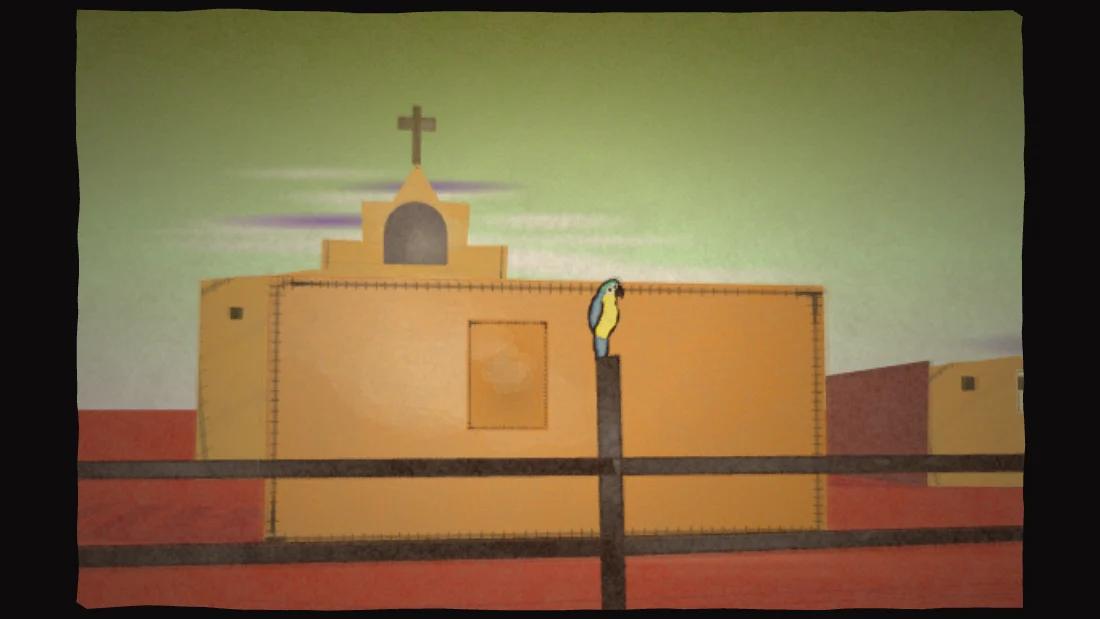 Series 98
The Wall Carries Its Own Boards
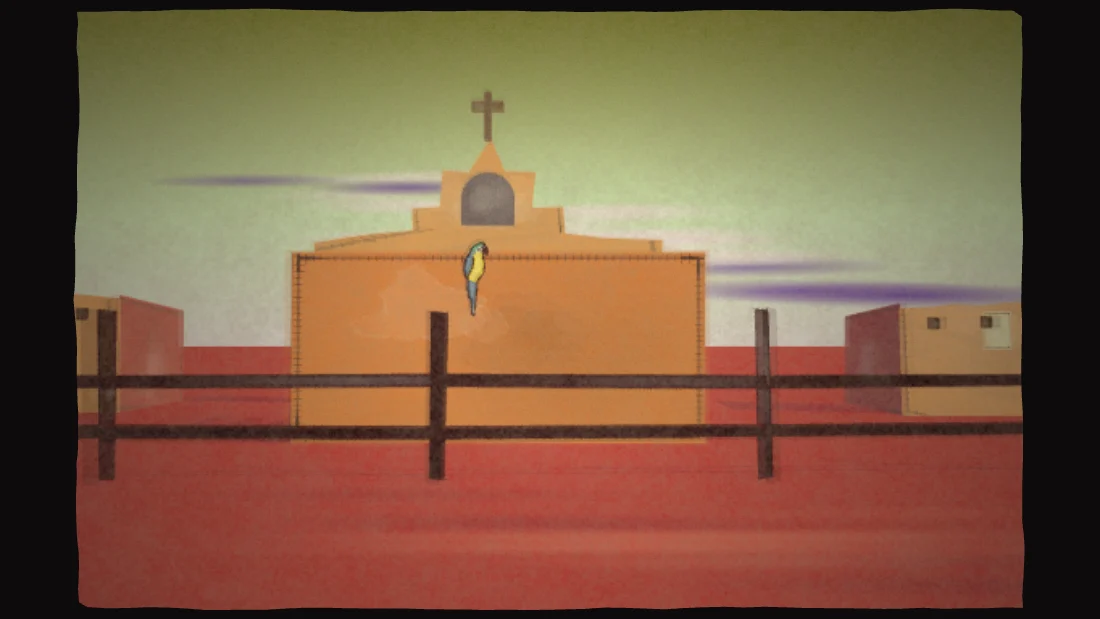
THE PAINT STOPPED BEING REMADE. Every face in the walkable world is painted ONCE into its own texture, in the wall’s own coordinates at a resolution set by its size in feet, and mapped onto the projected quad from then on — identical pixels moving or standing still, because they are the same pixels. And that is what surface space is for: sawn boards on the fronts, courses on the adobe, battens across the roofs, all authored in feet on the wall itself so they stay where they were put however you walk past. These ten stand close and oblique, the only distance at which the claim can be checked.
Series 98
The Wall Carries Its Own Boards
THE PAINT STOPPED BEING REMADE. Every face in the walkable world is painted ONCE into its own texture, in the wall’s own coordinates at a resolution set by its size in feet, and mapped onto the projected quad from then on — identical pixels moving or standing still, because they are the same pixels. And that is what surface space is for: sawn boards on the fronts, courses on the adobe, battens across the roofs, all authored in feet on the wall itself so they stay where they were put however you walk past. These ten stand close and oblique, the only distance at which the claim can be checked.
 Series 99
Nine Places, Nine Hours
THE QUALITY STOPPED BEING A COMPROMISE. Face textures are chosen at a resolution set by how big the face is ON SCREEN, in powers of two — forty-eight pixels a foot on a wall you stand in front of, three on the same wall two hundred feet off, for a sixteenth of the cost and no difference anybody can see. And the film goes on the WORLD: paper, grain, gate weave and a torn gate, at sixty frames a second over a place you drive. Every place keeps its own hour, so walking from the street to the pens changes the light and not only the geometry.
Series 99
Nine Places, Nine Hours
THE QUALITY STOPPED BEING A COMPROMISE. Face textures are chosen at a resolution set by how big the face is ON SCREEN, in powers of two — forty-eight pixels a foot on a wall you stand in front of, three on the same wall two hundred feet off, for a sixteenth of the cost and no difference anybody can see. And the film goes on the WORLD: paper, grain, gate weave and a torn gate, at sixty frames a second over a place you drive. Every place keeps its own hour, so walking from the street to the pens changes the light and not only the geometry.
 Series 100
The Macaw
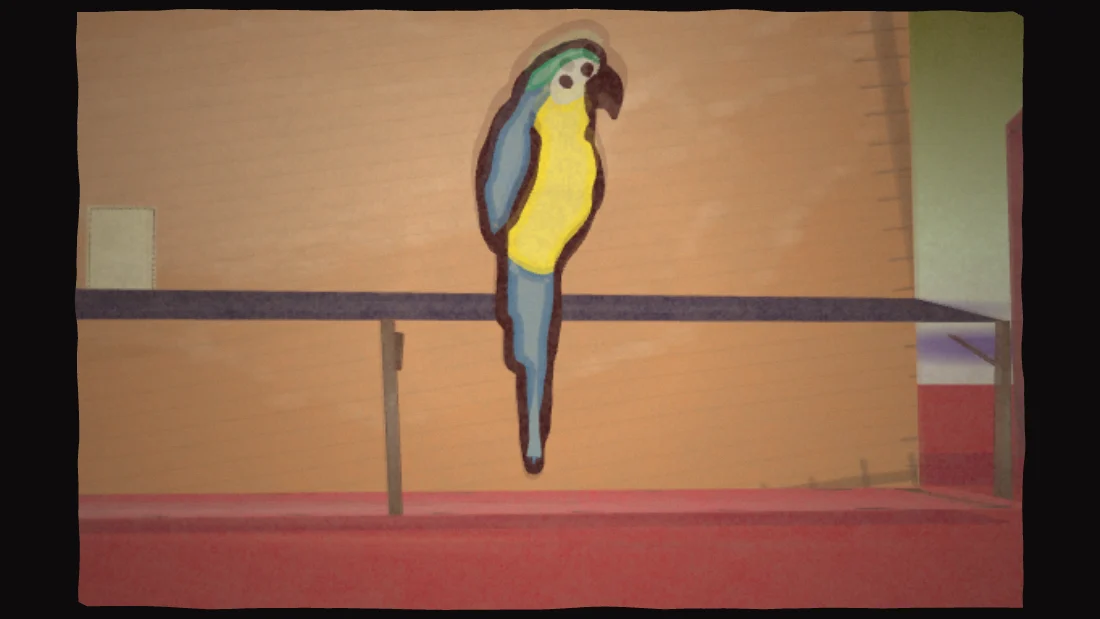
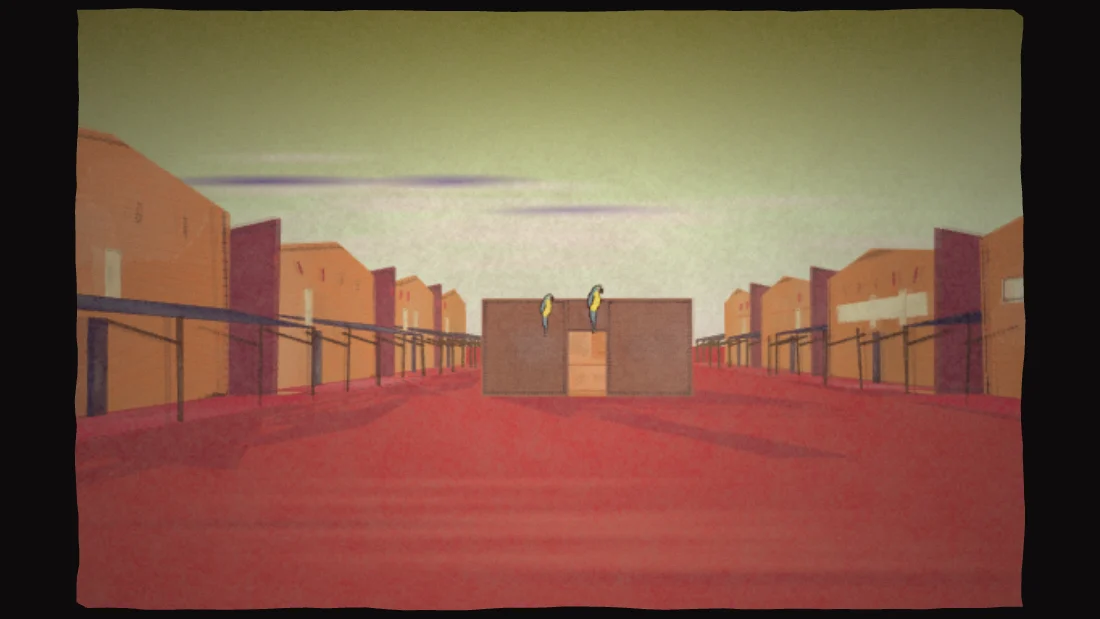
THE FIRST DRAWN OBJECT. A blue-and-gold macaw, supplied as a face-forward vector drawing, becomes a thing standing in the town — not a sprite pasted on the screen but a slab at a position in feet, EXTRUDED back along its own normal so walking round it shows the side wall. It sorts among the buildings and a wall in front of it hides it. Ten angles, because an object that only reads from one is a sprite.
Series 100
The Macaw
THE FIRST DRAWN OBJECT. A blue-and-gold macaw, supplied as a face-forward vector drawing, becomes a thing standing in the town — not a sprite pasted on the screen but a slab at a position in feet, EXTRUDED back along its own normal so walking round it shows the side wall. It sorts among the buildings and a wall in front of it hides it. Ten angles, because an object that only reads from one is a sprite.
 Series 101
The Corner Holds
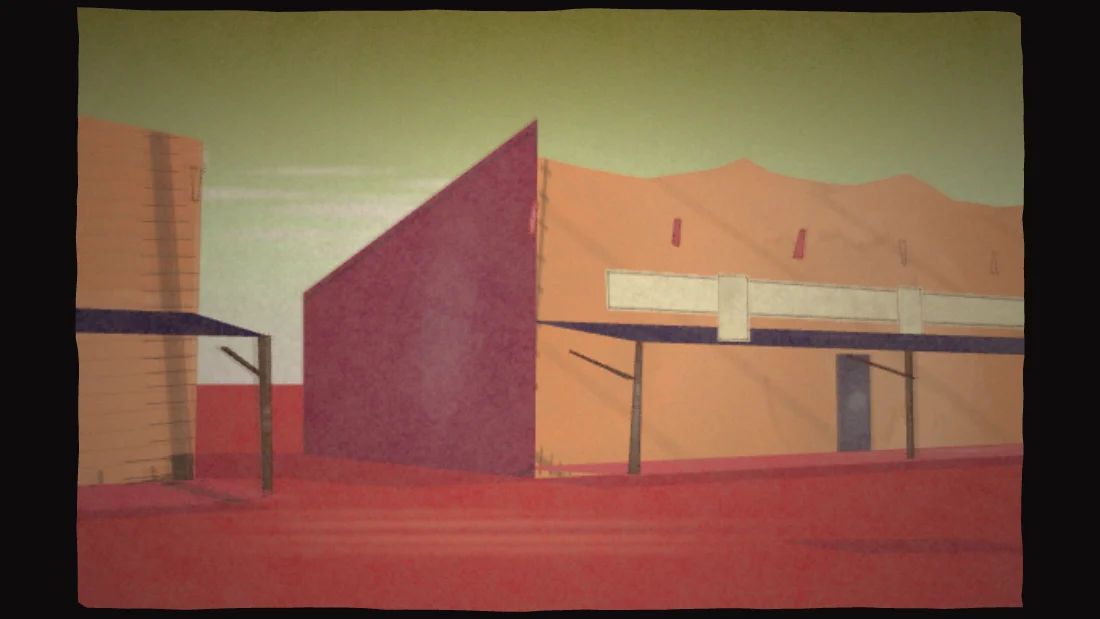
A DRAWN LINE ON A BUILDING IS NOT A DRAWN LINE ON A SCREEN. Running the contour over every face in the frame loop measured 1.6 frames a second. So the edge is drawn once into the wall’s own texture, in the wall’s own coordinates — free to walk past, already foreshortened when it is projected, and it stays where it was drawn. It boils, because the cel is in the texture key. And the seams are closed: two faces meeting along an edge left half a pixel of background between them, which is what made a building read as cards laid side by side.
Series 101
The Corner Holds
A DRAWN LINE ON A BUILDING IS NOT A DRAWN LINE ON A SCREEN. Running the contour over every face in the frame loop measured 1.6 frames a second. So the edge is drawn once into the wall’s own texture, in the wall’s own coordinates — free to walk past, already foreshortened when it is projected, and it stays where it was drawn. It boils, because the cel is in the texture key. And the seams are closed: two faces meeting along an edge left half a pixel of background between them, which is what made a building read as cards laid side by side.
 Series 102
Blown Up, Not Cut Out
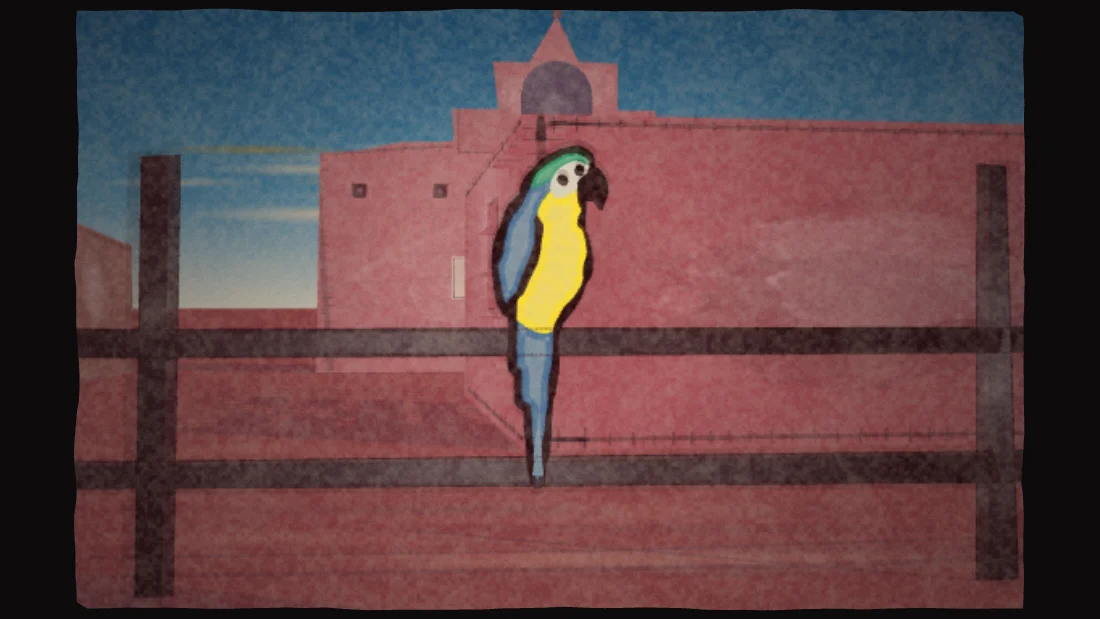
AN EXTRUSION OF A DRAWN THING LOOKS LIKE A DRAWN THING ON A PLINTH. These are blown up instead — a stack of shells, each inset a little and lifted a little, the rim at zero lift so the seam touches and there is no wall. And the cross-section is a fact about the object: a haft is a stick and is round, an axe head is a wedge and stays near nothing across the bit. A knife is sharp; so is this, for the same reason.
Series 102
Blown Up, Not Cut Out
AN EXTRUSION OF A DRAWN THING LOOKS LIKE A DRAWN THING ON A PLINTH. These are blown up instead — a stack of shells, each inset a little and lifted a little, the rim at zero lift so the seam touches and there is no wall. And the cross-section is a fact about the object: a haft is a stick and is round, an axe head is a wedge and stays near nothing across the bit. A knife is sharp; so is this, for the same reason.
 Series 103
Everything Throws Something
Series 52 settled it for the pictures — every plate makes one decision, where the sun is — and the walkable world never did it. Buildings, rails and birds sat on the ground with nothing underneath, which is most of why they read as standing ON a surface rather than IN a place. Every caster goes into one path and is filled once, so two shadows crossing merge instead of stacking. And the sun is a per-scene decision now.
Series 103
Everything Throws Something
Series 52 settled it for the pictures — every plate makes one decision, where the sun is — and the walkable world never did it. Buildings, rails and birds sat on the ground with nothing underneath, which is most of why they read as standing ON a surface rather than IN a place. Every caster goes into one path and is filled once, so two shadows crossing merge instead of stacking. And the sun is a per-scene decision now.
 Series 104
Through The Door
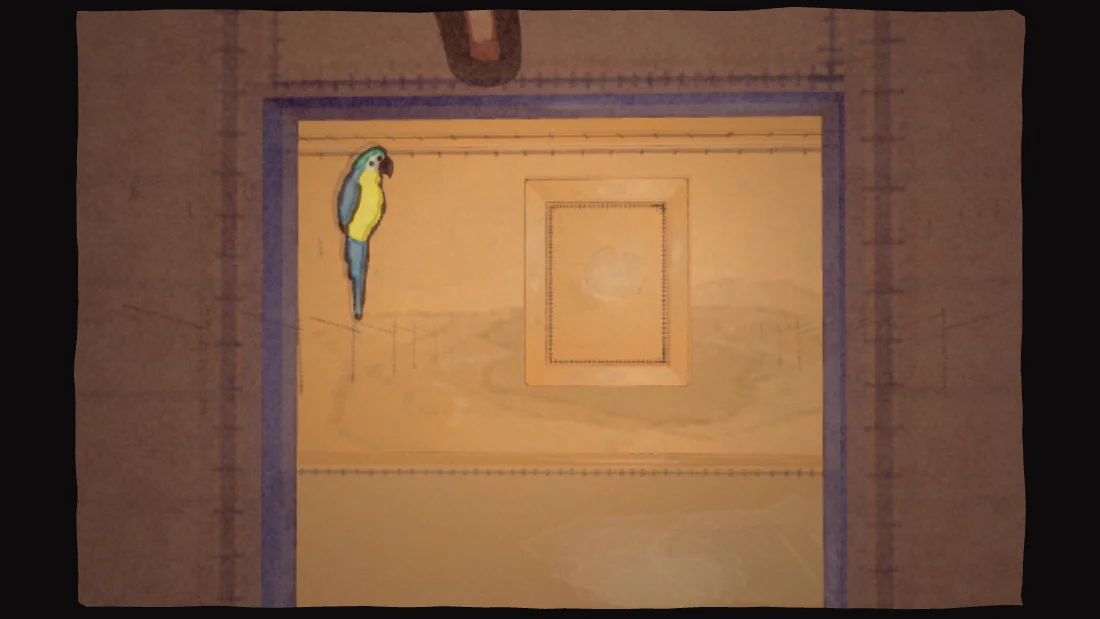
The interiors and the exteriors have been in the same feet and the same camera since Series 69 and never once in the same LIST, so a doorway was a dark rectangle painted on a wall. shell70 builds no front wall — a room is open toward you — so there was nothing to cut through, only a facade to put in front of it with a real hole. Ten stations along one line that goes indoors, and two that turn and look back out.
Series 104
Through The Door
The interiors and the exteriors have been in the same feet and the same camera since Series 69 and never once in the same LIST, so a doorway was a dark rectangle painted on a wall. shell70 builds no front wall — a room is open toward you — so there was nothing to cut through, only a facade to put in front of it with a real hole. Ten stations along one line that goes indoors, and two that turn and look back out.
 Series 105
Open Country
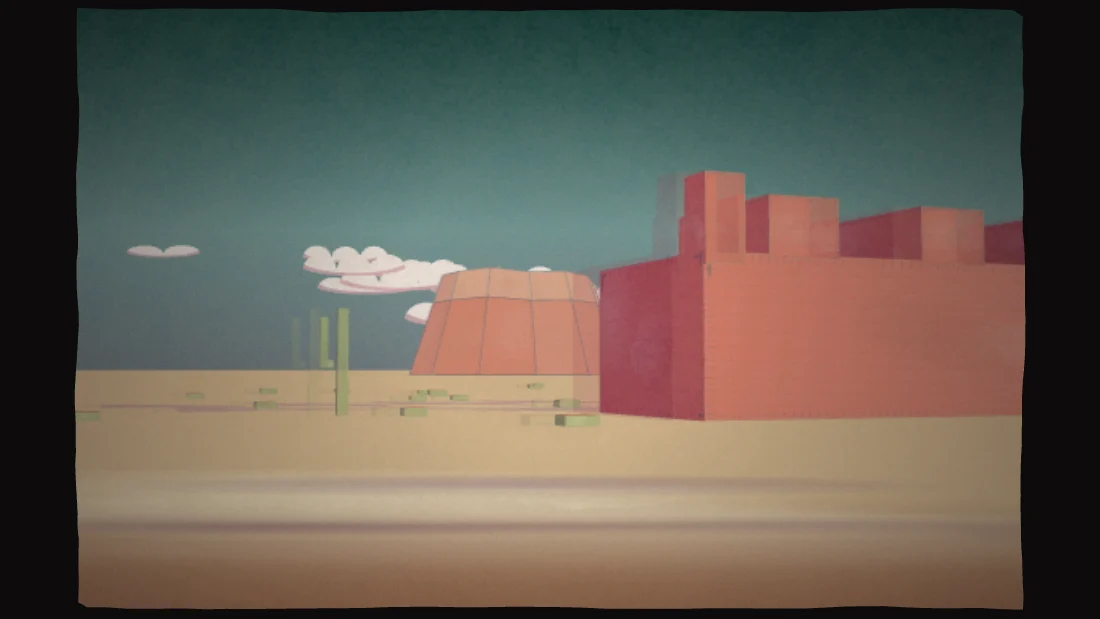
I WROTE THIS LOOK OFF A MISREAD AND THEN MEASURED THE FRAMES. Eight series running were the same nine town places from another camera, so this is a different country: one built thing or none, a few saguaro, and a band of buttes half a mile out. Then I built a look for it from memory — flat colour, a drawn line — and it looked nothing like the references. Sampled properly, they are airbrushed, and THE SUNLIT FLAT IS THE BRIGHTEST THING IN THE FRAME, above a sky that every plate of mine had brighter. Correcting that exposed two faults it had been hiding: the ground was one flat value where the films ramp, and distance faded toward a MASS colour over the scene’s own depth — so my own rule since Series 77, that distance fades toward the AIR, had been broken since the renderer was written. Start walks, turns, trucks, rises, cranes and pushes; every 3D series before this moved one way.
Series 105
Open Country
I WROTE THIS LOOK OFF A MISREAD AND THEN MEASURED THE FRAMES. Eight series running were the same nine town places from another camera, so this is a different country: one built thing or none, a few saguaro, and a band of buttes half a mile out. Then I built a look for it from memory — flat colour, a drawn line — and it looked nothing like the references. Sampled properly, they are airbrushed, and THE SUNLIT FLAT IS THE BRIGHTEST THING IN THE FRAME, above a sky that every plate of mine had brighter. Correcting that exposed two faults it had been hiding: the ground was one flat value where the films ramp, and distance faded toward a MASS colour over the scene’s own depth — so my own rule since Series 77, that distance fades toward the AIR, had been broken since the renderer was written. Start walks, turns, trucks, rises, cranes and pushes; every 3D series before this moved one way.
 Series 106
Fifty Stations
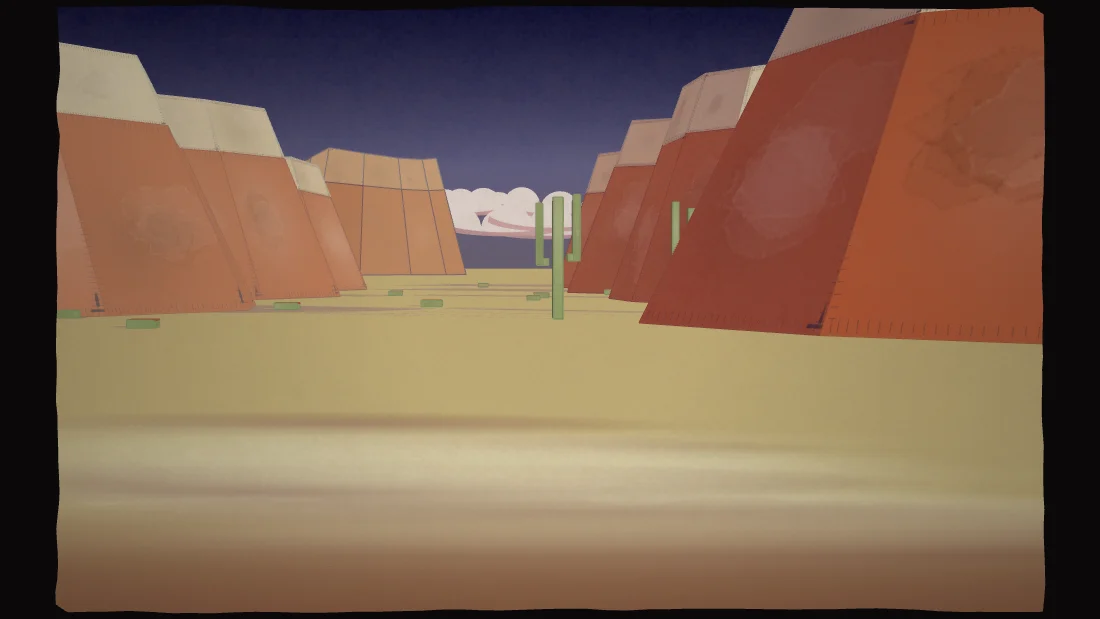
BACK TO FIFTY, AND THE GHOST IS GONE. Ten open-country places — five new: a canyon, a pueblo, a fence line off the reference frames, dunes, a bleached ribcage — under five hours, each hour transcribed from one measured reference frame, with a station rolled per plate so no place is seen from the same spot twice. Since Series 97 the moving camera was drawn by cross-fading the two nearest of twenty-eight cached steps — a DOUBLE EXPOSURE, which is why the world broke apart in motion. Measured, the render was never the cost: 2.4ms at the exact camera, because the paint caches against the faces, not the camera. One render, one film pass, every frame — and the register runs all the time: the line boils, the colour fringes, moving or still.
Series 106
Fifty Stations
BACK TO FIFTY, AND THE GHOST IS GONE. Ten open-country places — five new: a canyon, a pueblo, a fence line off the reference frames, dunes, a bleached ribcage — under five hours, each hour transcribed from one measured reference frame, with a station rolled per plate so no place is seen from the same spot twice. Since Series 97 the moving camera was drawn by cross-fading the two nearest of twenty-eight cached steps — a DOUBLE EXPOSURE, which is why the world broke apart in motion. Measured, the render was never the cost: 2.4ms at the exact camera, because the paint caches against the faces, not the camera. One render, one film pass, every frame — and the register runs all the time: the line boils, the colour fringes, moving or still.
 Series 107
The Grain
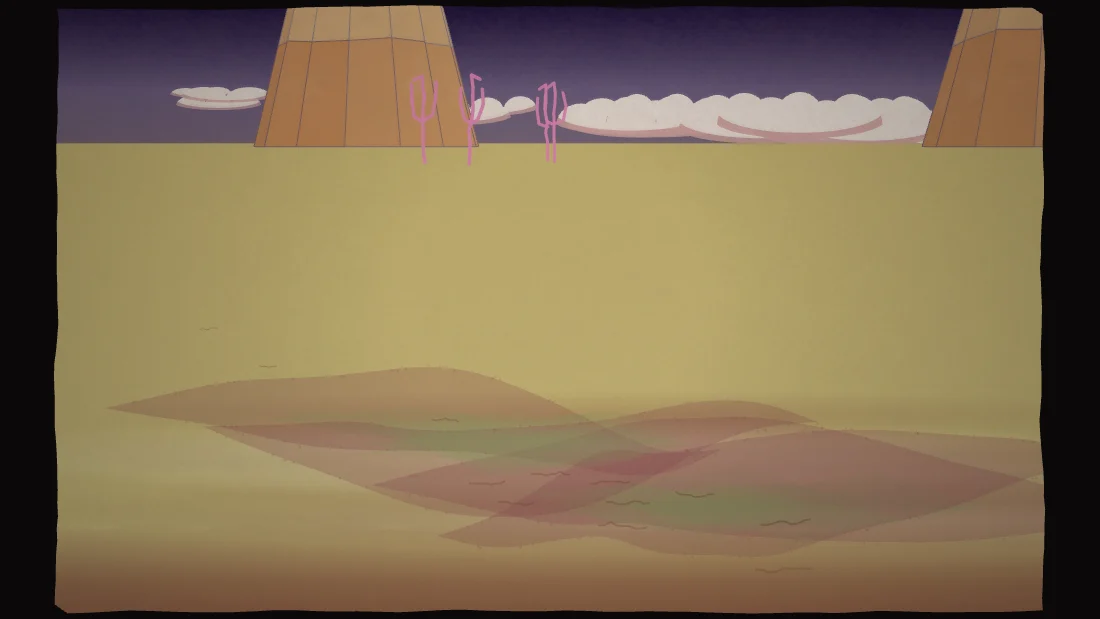
THE GROUND IS LAYERS AND A CACTUS IS THREE STROKES. From the sprayed reference frame: big lakes of a darker contrasting colour curling across the flat like wood grain, their edges grainy the way an airbrush edge is grainy — a probability, not a line — with green-gold mottling inside and scratchy scribbles between; and a cactus that is a PINK OUTLINE, no fill, in a colour the ground does not contain. A blotch is a wandering path given a swelling half-width, filled flat and rimmed with sprayed dots; a cactus is a SPINE, polylines in world feet stroked with the boiling hand line, casting no shadow and taking no air fade, because a line on a cel has no volume and does not haze. Five sprayed hours derived from Series 106’s five, so 106 renders on untouched.
Series 107
The Grain
THE GROUND IS LAYERS AND A CACTUS IS THREE STROKES. From the sprayed reference frame: big lakes of a darker contrasting colour curling across the flat like wood grain, their edges grainy the way an airbrush edge is grainy — a probability, not a line — with green-gold mottling inside and scratchy scribbles between; and a cactus that is a PINK OUTLINE, no fill, in a colour the ground does not contain. A blotch is a wandering path given a swelling half-width, filled flat and rimmed with sprayed dots; a cactus is a SPINE, polylines in world feet stroked with the boiling hand line, casting no shadow and taking no air fade, because a line on a cel has no volume and does not haze. Five sprayed hours derived from Series 106’s five, so 106 renders on untouched.
 Series 108
The Overland
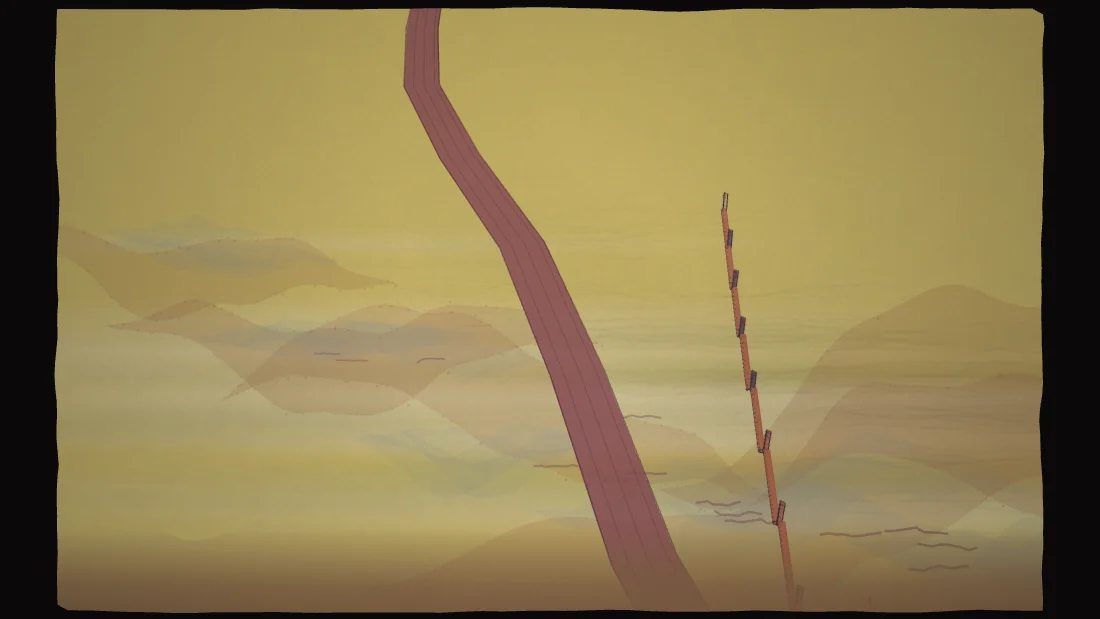
THE VIEW ANGLE WAS WRONG. Every plate since Series 1 stood ON the ground with a horizon across the middle; the overhead reference frames look DOWN, and from up there the ground is the whole picture. Five ALTITUDES instead of five hours — plumb, high, far off, adrift, low — and the country finally has ROADS: world-space strips on z = 0 filled in the ground pass with a wobbling ink line down each side, a railroad drawn as a LADDER tie by tie, and a round WALLED TOWN the roads radiate from. And a new architecture, from the artist: THE SEGMENT IS THE MASK. Texture is not painted into each piece — one full-frame grain sheet is painted for the whole plate and every piece reveals its slice of it through its silhouette, so the grain flows continuously across the picture the way a cel production’s does.
Series 108
The Overland
THE VIEW ANGLE WAS WRONG. Every plate since Series 1 stood ON the ground with a horizon across the middle; the overhead reference frames look DOWN, and from up there the ground is the whole picture. Five ALTITUDES instead of five hours — plumb, high, far off, adrift, low — and the country finally has ROADS: world-space strips on z = 0 filled in the ground pass with a wobbling ink line down each side, a railroad drawn as a LADDER tie by tie, and a round WALLED TOWN the roads radiate from. And a new architecture, from the artist: THE SEGMENT IS THE MASK. Texture is not painted into each piece — one full-frame grain sheet is painted for the whole plate and every piece reveals its slice of it through its silhouette, so the grain flows continuously across the picture the way a cel production’s does.
 Series 109
On Cels
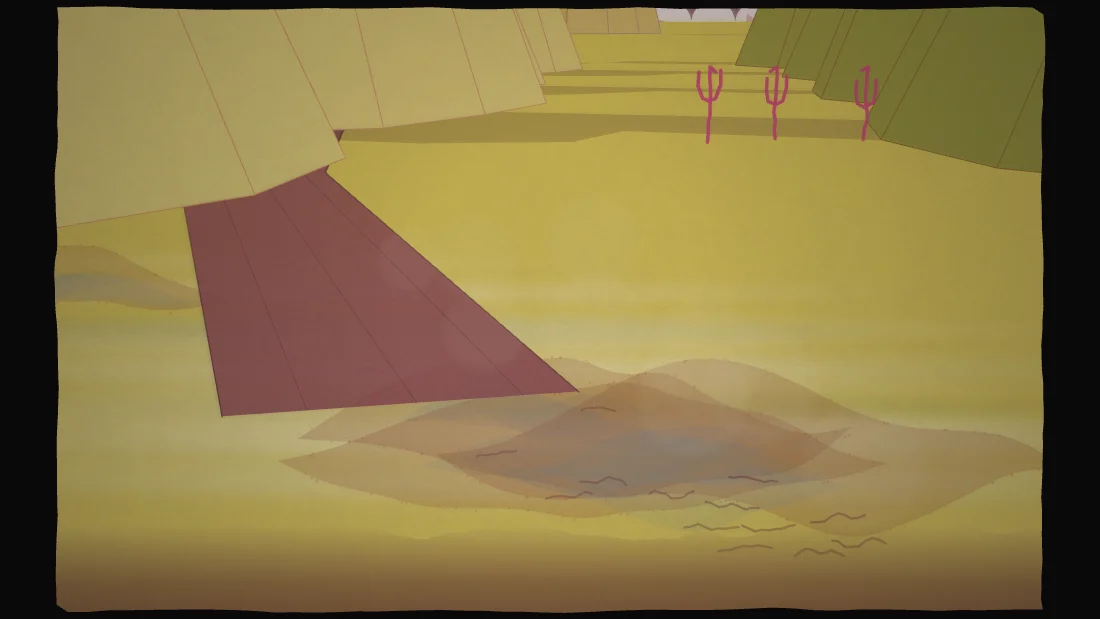
THE INSTRUCTION HAD TO BE SAID TWICE: "individual pieces from clouds to mountains get INDIVIDUAL texture." Series 108 pushed one neutral grain sheet through every silhouette, giving every piece the same skin. The production model is a STACK — a texture plane PER CLASS, each with its own mark vocabulary at its own scale, revealed through its class’s masks. Rock: coarse wood-grain strands with KNOTS, through the masses. The finest stipple through the clouds, because vapour has no grain. Spray strands through the sky; the blotch lakes on the ground. The clouds compose on their own cel, the plane laid through them with source-atop. And above everything, the layers that belong to the LENS and no piece: the register slip, the grain, and a BOKEH of soft discs, held per cel like every other mark in this project.
Series 109
On Cels
THE INSTRUCTION HAD TO BE SAID TWICE: "individual pieces from clouds to mountains get INDIVIDUAL texture." Series 108 pushed one neutral grain sheet through every silhouette, giving every piece the same skin. The production model is a STACK — a texture plane PER CLASS, each with its own mark vocabulary at its own scale, revealed through its class’s masks. Rock: coarse wood-grain strands with KNOTS, through the masses. The finest stipple through the clouds, because vapour has no grain. Spray strands through the sky; the blotch lakes on the ground. The clouds compose on their own cel, the plane laid through them with source-atop. And above everything, the layers that belong to the LENS and no piece: the register slip, the grain, and a BOKEH of soft discs, held per cel like every other mark in this project.
 Series 110
Slinger Gold
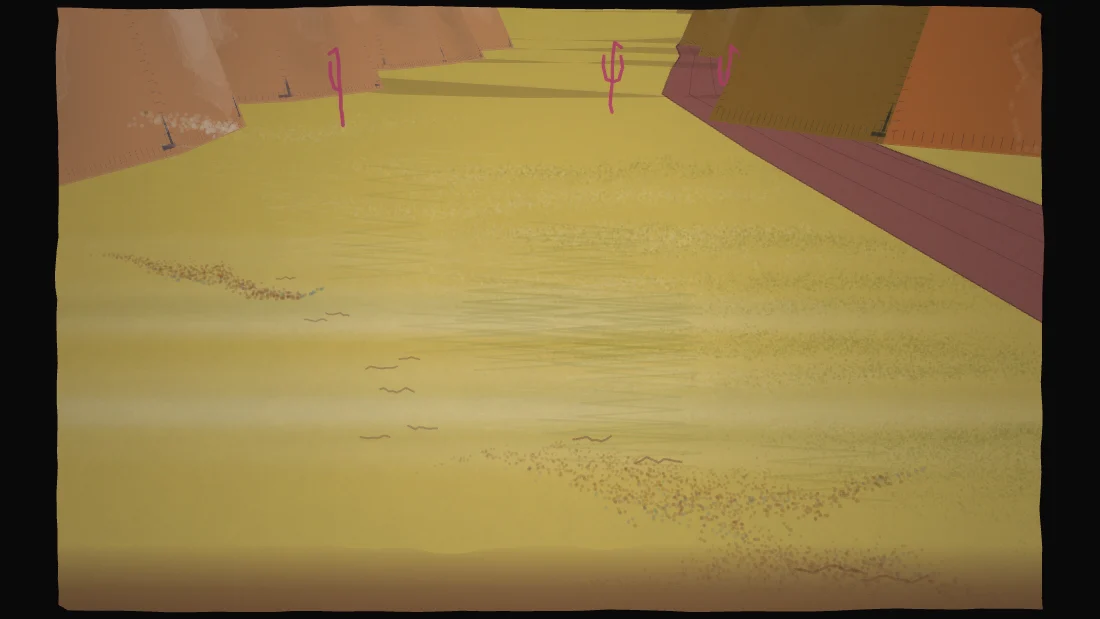
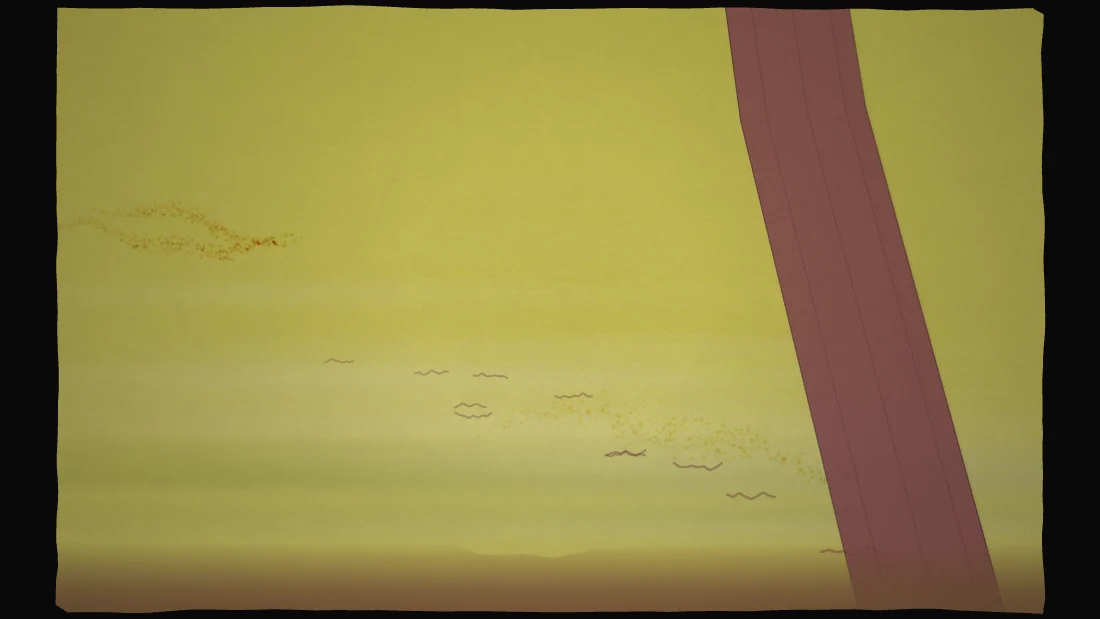
THE ARTIST DREW ON MY PLATE: squiggles across every wall and stretch of ground — the marks a surface is supposed to carry — circles around the translucent blob stains, and a note: properly paint surfaces, not blob shapes; vector spray paint at different resolution for screen on each object; not floating discs that sit sad in a corner. So a surface is PAINTED: dense sprayed stipple laid in DRIFTS, dots clustering along invisible wandering lanes the way spray from a can actually lands, plus the scribbled zigzag strands the markup drew. The resolution follows the SCREEN: coarse, mid, fine planes, each face picking by its own footprint. A patch is a CLOUD OF PARTICLES about a wandering spine — no polygon, the shape IS its spray. The spray goes down LAST, after the light washes — the first wiring buried the paint under three fills of sun and air. And the bokeh is deleted.
Series 110
Slinger Gold
THE ARTIST DREW ON MY PLATE: squiggles across every wall and stretch of ground — the marks a surface is supposed to carry — circles around the translucent blob stains, and a note: properly paint surfaces, not blob shapes; vector spray paint at different resolution for screen on each object; not floating discs that sit sad in a corner. So a surface is PAINTED: dense sprayed stipple laid in DRIFTS, dots clustering along invisible wandering lanes the way spray from a can actually lands, plus the scribbled zigzag strands the markup drew. The resolution follows the SCREEN: coarse, mid, fine planes, each face picking by its own footprint. A patch is a CLOUD OF PARTICLES about a wandering spine — no polygon, the shape IS its spray. The spray goes down LAST, after the light washes — the first wiring buried the paint under three fills of sun and air. And the bokeh is deleted.
 Series 111
Burnish
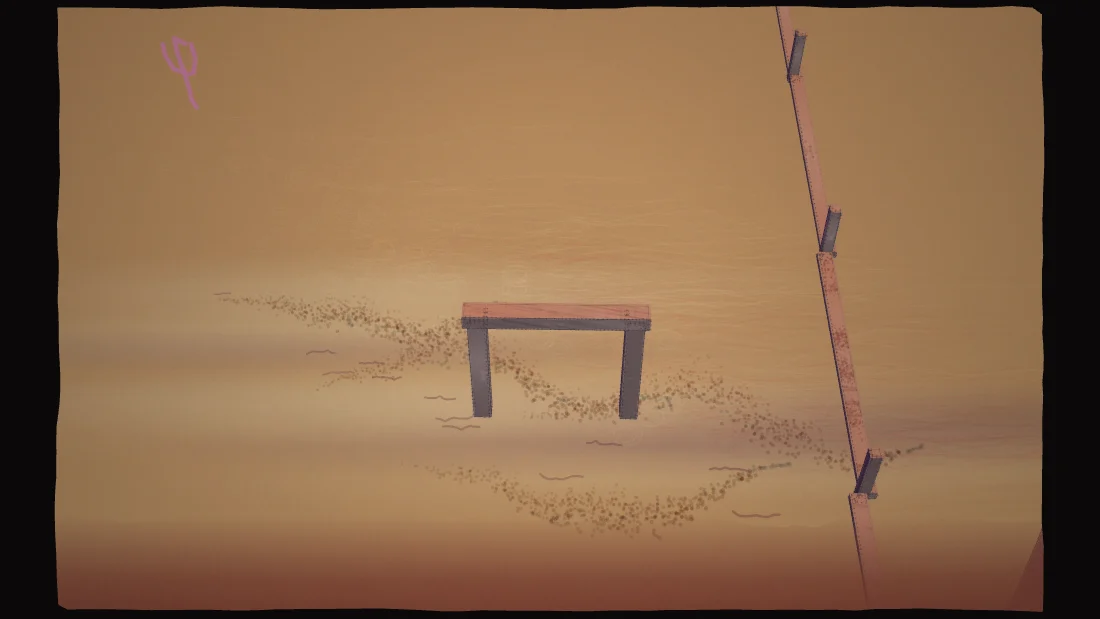
THE LAYERS GOT THEIR EFFECTS. From the artist: have the different layers carry different layer effects — overlay, color burn, exclusion — and let different sections and sizes go for different brushes and scribbles. A texture layer is stamped with a COMPOSITING MODE now, not just an alpha: overlay pushes contrast where the paint lands, color-burn eats into the fill like pigment into wet ground, exclusion turns a mark into a cold ghost of its own colour. And a section does not take the same brush as its neighbour: each face draws a KIND from its class’s kit — spray, hatch, grain, curl, scribble — by its own centroid seed and screen size, so one wall is sprayed while the next is hatched, the way a hand actually varies across a painting.
Series 111
Burnish
THE LAYERS GOT THEIR EFFECTS. From the artist: have the different layers carry different layer effects — overlay, color burn, exclusion — and let different sections and sizes go for different brushes and scribbles. A texture layer is stamped with a COMPOSITING MODE now, not just an alpha: overlay pushes contrast where the paint lands, color-burn eats into the fill like pigment into wet ground, exclusion turns a mark into a cold ghost of its own colour. And a section does not take the same brush as its neighbour: each face draws a KIND from its class’s kit — spray, hatch, grain, curl, scribble — by its own centroid seed and screen size, so one wall is sprayed while the next is hatched, the way a hand actually varies across a painting.
 Series 112
The Burned Hours
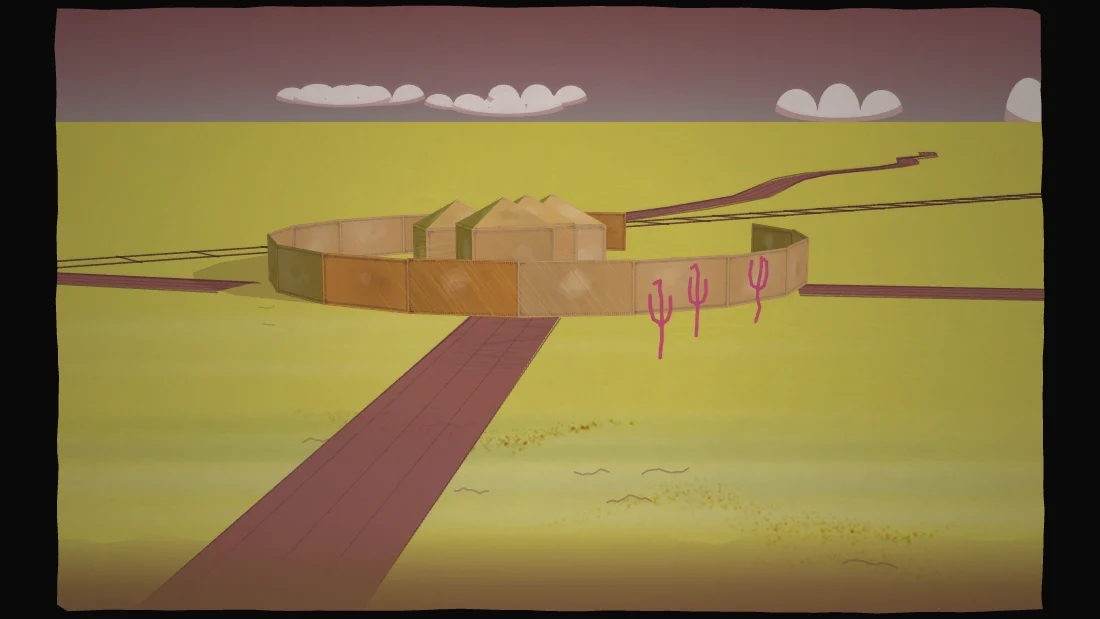
THE ENGINE ACROSS THE WHOLE DAY. Series 111 proved the layer effects on one gold hour; this one runs them through all five, and each hour gets its own chord of modes, because a mode is a physical medium and the media change with the light. The day overlays. Ember BURNS. The bleach hour multiplies, a wash sinking into pale ground. The weather overlays hatch into the teal. And the night takes EXCLUSION: on a dark ground an excluded mark comes back as COLD LIGHT, which is what a mark made at night should do. Ten plates per hour, one altitude band each, so the day runs top to bottom of the series.
Series 112
The Burned Hours
THE ENGINE ACROSS THE WHOLE DAY. Series 111 proved the layer effects on one gold hour; this one runs them through all five, and each hour gets its own chord of modes, because a mode is a physical medium and the media change with the light. The day overlays. Ember BURNS. The bleach hour multiplies, a wash sinking into pale ground. The weather overlays hatch into the teal. And the night takes EXCLUSION: on a dark ground an excluded mark comes back as COLD LIGHT, which is what a mark made at night should do. Ten plates per hour, one altitude band each, so the day runs top to bottom of the series.
 Series 113
Guilded
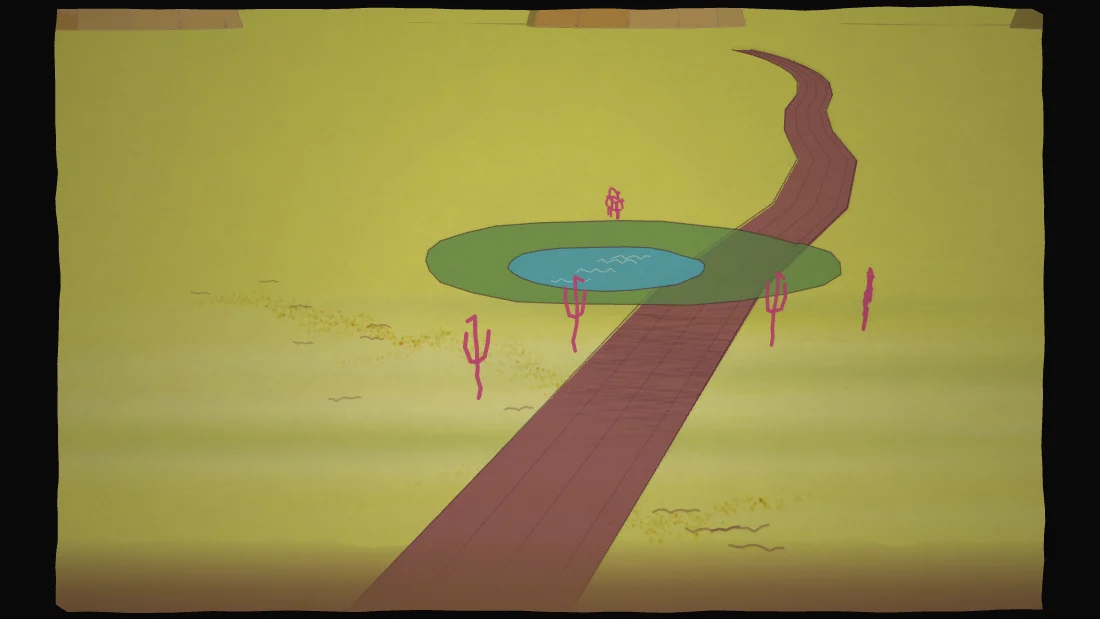
NO SURFACE WITHOUT A BRUSH. Series 111 left two things bare: the ROAD — the one painted thing in the frame with no paint ON it — and the WALLED TOWN, whose houses wore the same skin as the buttes and whose red roofs, being triangles, fell through the four-point gate unpainted. All closed: the road band clips its own grain-and-scribble plane under MULTIPLY, because a road is worn INTO and its marks darken; anything built takes a hatch-led BUILDING kit; the roofs carry their own curl kit. And the town plates AIM AT THE TOWN — a plumb station stands straight over the ring, an oblique one takes the pitch that actually looks at it — after two renders in a row framed golden nothing with the town a sliver at the top edge. The walled town takes a double share of the fifty, because it is the one place where every kit meets: rock behind, road through, wall around, house within, roof on top.
Series 113
Guilded
NO SURFACE WITHOUT A BRUSH. Series 111 left two things bare: the ROAD — the one painted thing in the frame with no paint ON it — and the WALLED TOWN, whose houses wore the same skin as the buttes and whose red roofs, being triangles, fell through the four-point gate unpainted. All closed: the road band clips its own grain-and-scribble plane under MULTIPLY, because a road is worn INTO and its marks darken; anything built takes a hatch-led BUILDING kit; the roofs carry their own curl kit. And the town plates AIM AT THE TOWN — a plumb station stands straight over the ring, an oblique one takes the pitch that actually looks at it — after two renders in a row framed golden nothing with the town a sliver at the top edge. The walled town takes a double share of the fifty, because it is the one place where every kit meets: rock behind, road through, wall around, house within, roof on top.
 Series 114
Stock and Water
STOCK AND WATER, AND THE TWO MODES NOBODY HAD PLAYED. A SPRING — standing water at last, a pool with ripple squiggles and a drawn edge on its green apron — and a HERD, a loose string of drawn steers along the trail. A steer follows the rule the pink cactus proved: a living thing in this style is a DRAWING — six strokes, back, belly, four legs, a horn flick and a tail, casting nothing, hazing never. The walled town finally gets the green circle inside its ring; grass and water are ground DISCS drawn in the ground pass, and they go down AFTER the roads, because a trail leads TO the water and the grass grows over the wheel ruts. And the WASH: soft blobs of two foreign colours over the whole picture under the COLOR and HUE modes. Three new colourways carry it — OASIS, RED EARTH, MONSOON — with guilded and burned night, new colour top to bottom of the fifty.
Series 114
Stock and Water
STOCK AND WATER, AND THE TWO MODES NOBODY HAD PLAYED. A SPRING — standing water at last, a pool with ripple squiggles and a drawn edge on its green apron — and a HERD, a loose string of drawn steers along the trail. A steer follows the rule the pink cactus proved: a living thing in this style is a DRAWING — six strokes, back, belly, four legs, a horn flick and a tail, casting nothing, hazing never. The walled town finally gets the green circle inside its ring; grass and water are ground DISCS drawn in the ground pass, and they go down AFTER the roads, because a trail leads TO the water and the grass grows over the wheel ruts. And the WASH: soft blobs of two foreign colours over the whole picture under the COLOR and HUE modes. Three new colourways carry it — OASIS, RED EARTH, MONSOON — with guilded and burned night, new colour top to bottom of the fifty.
 Series 115
The Flipped Country
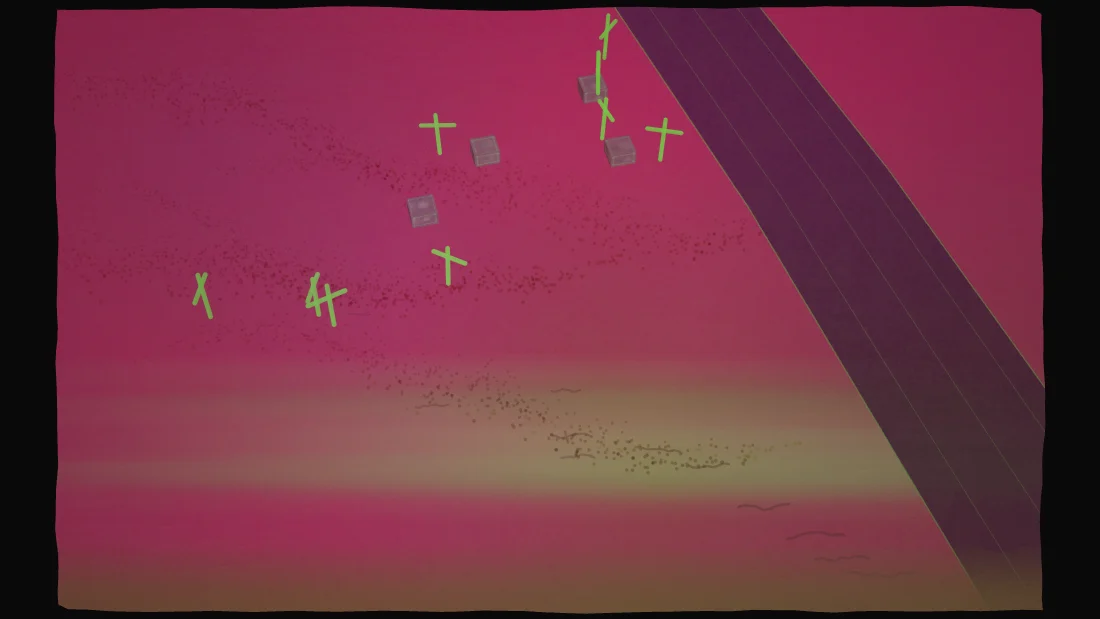
THE PAINT IS PINNED TO THE WORLD NOW. The texture planes were stamped at screen zero-zero every frame, so the geometry slid underneath a stationary sheet of paint — two planes, one that moved and one that never did, and the world did not look connected. Under the ANCHORED engine a face’s plane rides its own centroid, the ground plane rides a tracked ground point, the sky rides the yaw, all drawn tiled so the slice under the mask is covered wherever the pin has dragged it; and the patch field spreads over the whole ground instead of packing into one screen band. Five places this project has never drawn — the ARROYO, the PLAYA, the CAMP, the BURYING GROUND, one colossal BUTTE — under five flipped colourways: WHITE LINE, BLACKLIGHT, BRUISE, MINT ROSE, VERDANT.
Series 115
The Flipped Country
THE PAINT IS PINNED TO THE WORLD NOW. The texture planes were stamped at screen zero-zero every frame, so the geometry slid underneath a stationary sheet of paint — two planes, one that moved and one that never did, and the world did not look connected. Under the ANCHORED engine a face’s plane rides its own centroid, the ground plane rides a tracked ground point, the sky rides the yaw, all drawn tiled so the slice under the mask is covered wherever the pin has dragged it; and the patch field spreads over the whole ground instead of packing into one screen band. Five places this project has never drawn — the ARROYO, the PLAYA, the CAMP, the BURYING GROUND, one colossal BUTTE — under five flipped colourways: WHITE LINE, BLACKLIGHT, BRUISE, MINT ROSE, VERDANT.
 Series 116
The Flipped Country II
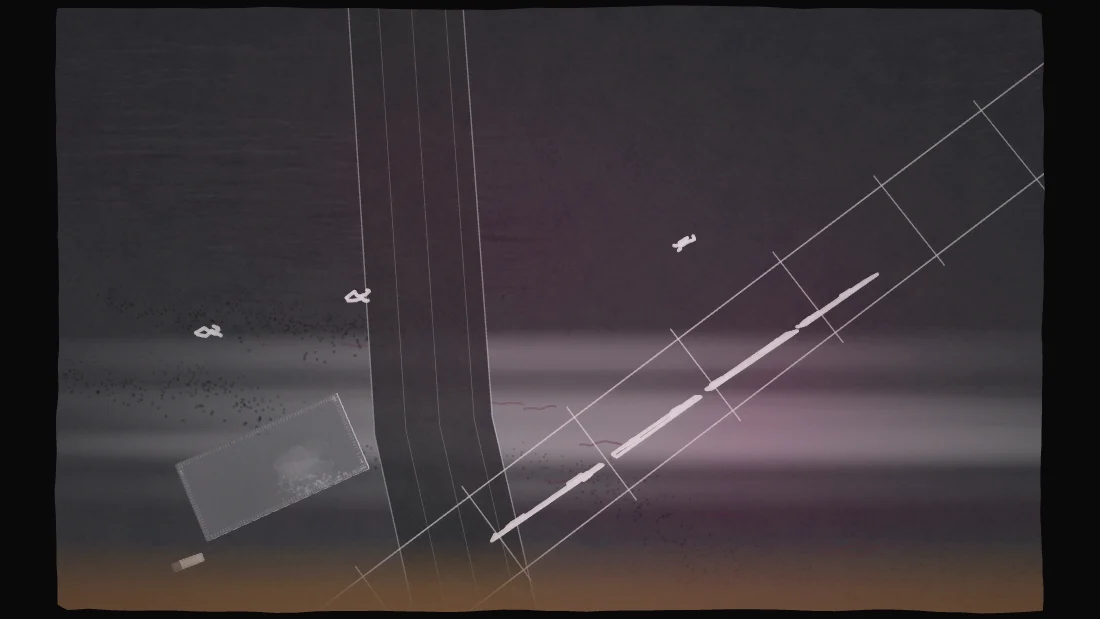
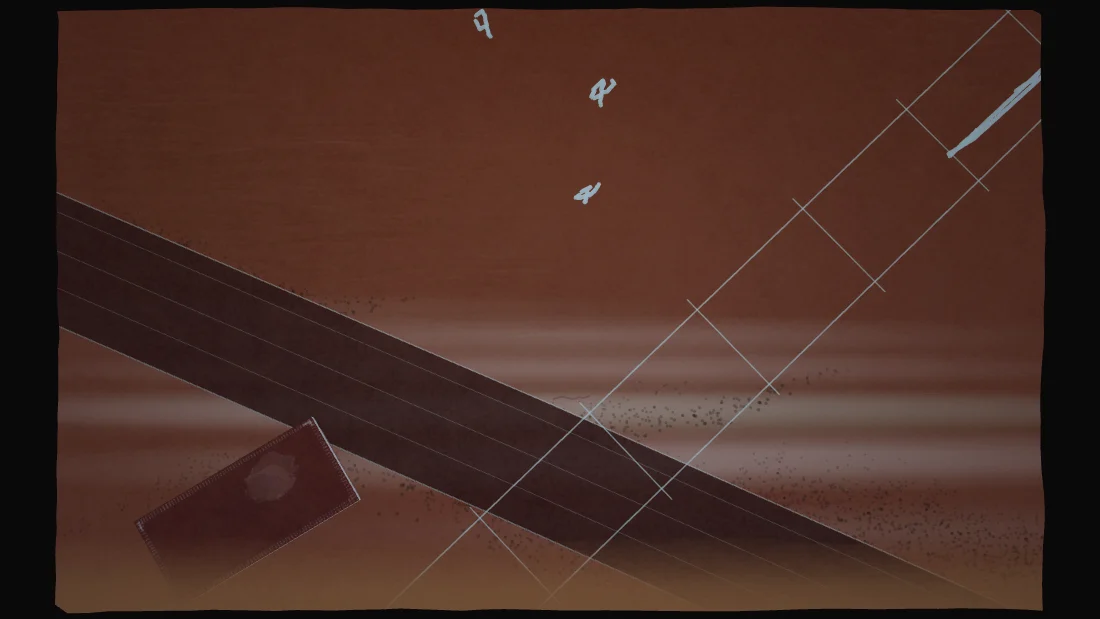
PART TWO, AND THE TRAIN. The MINEWORKS’ leaning headframe; the DEPOT, where the rail finally carries something — a locomotive and three cars as LINE DRAWINGS, chimney, wheels and all; the PLANTED FIELD’s agave rows; the GHOST TOWN’s broken walls; the OXBOW, where the river — a road that happens to be water — loops back on itself. Five more flips: X-RAY, POPSICLE, LILAC LEMON, BLOOD MOON, CHARTREUSE under cobalt.
Series 116
The Flipped Country II
PART TWO, AND THE TRAIN. The MINEWORKS’ leaning headframe; the DEPOT, where the rail finally carries something — a locomotive and three cars as LINE DRAWINGS, chimney, wheels and all; the PLANTED FIELD’s agave rows; the GHOST TOWN’s broken walls; the OXBOW, where the river — a road that happens to be water — loops back on itself. Five more flips: X-RAY, POPSICLE, LILAC LEMON, BLOOD MOON, CHARTREUSE under cobalt.
 Series 117
In Motion
THE TRAIN ROLLS, AND THE LOOKS ARE A PLACE YOU WALK. The locomotive got a heading baked into its entity, and the draw offsets every stroke along it by the film’s own clock — the world list never rebuilds, the drawing just goes somewhere. It is moving whether you are or not, at rest exactly at t=0 so every still reproduces. And the walkable world became the LOOKS BASKET: all twelve new places joined the walk cycle with the flipped colourways as their hours, and the L key cycles EVERY look in the book on the spot you are standing — the place stays, the camera stays, the whole treatment changes. A catalogue of looks you stand inside, at westernart96. The depot takes a triple share of the fifty, because the train is the news.
Series 117
In Motion
THE TRAIN ROLLS, AND THE LOOKS ARE A PLACE YOU WALK. The locomotive got a heading baked into its entity, and the draw offsets every stroke along it by the film’s own clock — the world list never rebuilds, the drawing just goes somewhere. It is moving whether you are or not, at rest exactly at t=0 so every still reproduces. And the walkable world became the LOOKS BASKET: all twelve new places joined the walk cycle with the flipped colourways as their hours, and the L key cycles EVERY look in the book on the spot you are standing — the place stays, the camera stays, the whole treatment changes. A catalogue of looks you stand inside, at westernart96. The depot takes a triple share of the fifty, because the train is the news.
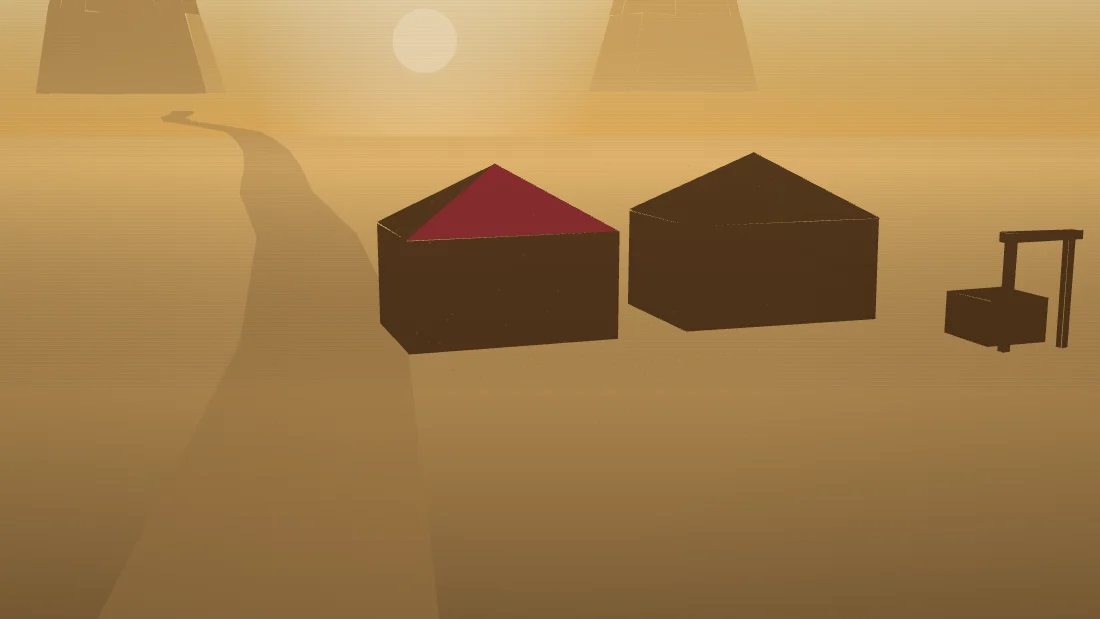 Series 118
The Gold Fog
A foggy dawn over a ghost town, in gold — painted in VALUE ALONE. Every thing a flat silhouette on a six-step gold ramp, the fog laid between the depth bands like sheets of leaf, and Start burns it off. One thing in every plate is not gold: the door that kept its paint.
Series 118
The Gold Fog
A foggy dawn over a ghost town, in gold — painted in VALUE ALONE. Every thing a flat silhouette on a six-step gold ramp, the fog laid between the depth bands like sheets of leaf, and Start burns it off. One thing in every plate is not gold: the door that kept its paint.